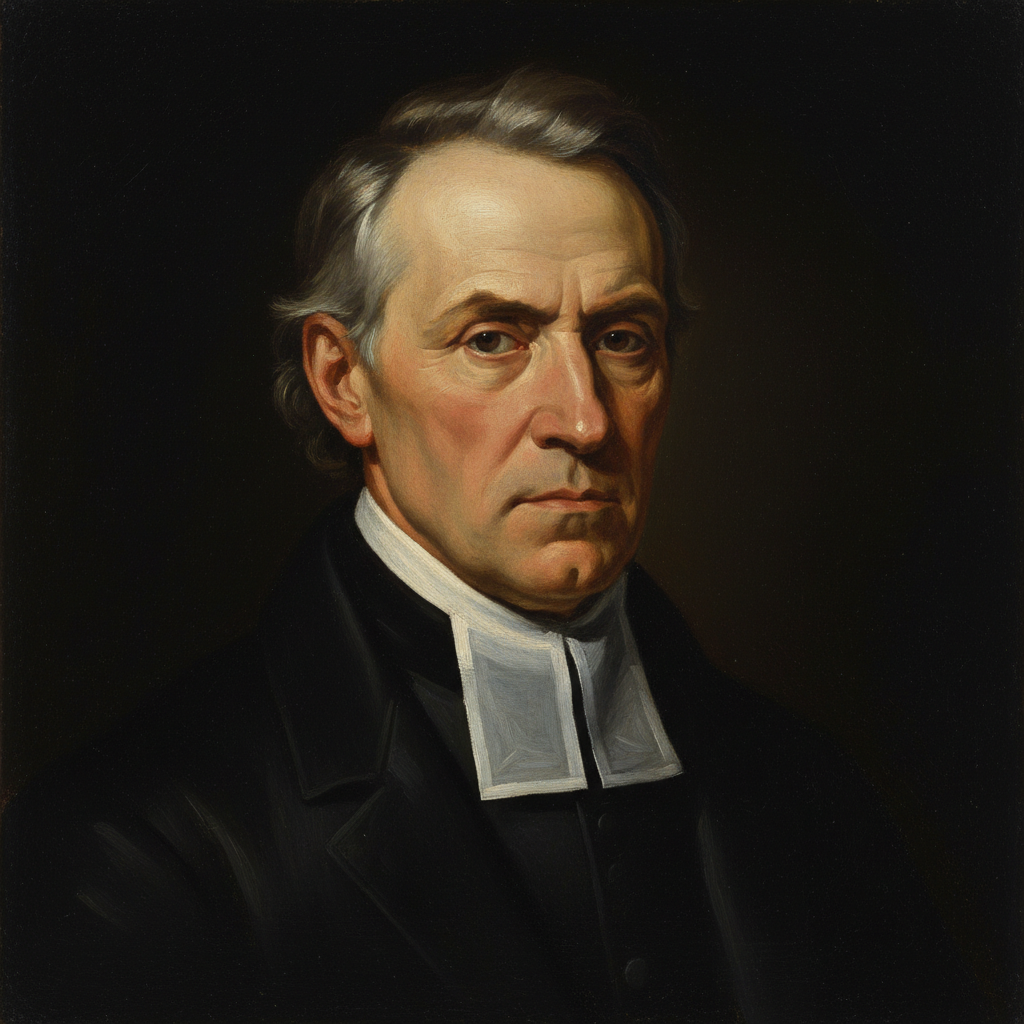
John Wesley — "I have no time to be in a hurry."
I have no time to be in a hurry.
I have no time to be in a hurry.
Click any product to generate a realistic preview. Up to 3 at a time.
* Initial load can take up to 90 seconds — revising the preview in another color is nearly instant.
"I have been in this city for over a year, yet I have not seen one instance of a truly awakened soul."
"I am a debtor to all the world, to do all the good I can, in every place, to every soul."
"My hair is much whiter than it was a year ago; but my eyes are not much dimmer, nor my natural strength much abated."
"We have nothing to do but to save souls."
"I am a debtor both to the wise and to the unwise."
English Anglican cleric and founder of Methodism, whose open-air preaching and class-meeting structure created the largest 18th-century evangelical revival. Closely associated with Charles Wesley (his hymn-writing brother) and George Whitefield (early co-revivalist, later doctrinal opponent). For an intellectual contrast, see George Whitefield, Calvinist evangelical revivalist — Whitefield's predestinarian Calvinism vs Wesley's free-grace Arminian theology split the early Methodist movement permanently in the 1739-41 break. The founding evangelical Calvinist-Arminian schism — the two parallel evangelical traditions American Christianity descends from.
Found in 1 providers: grok
1 source checked
Despite constant demands on our attention, rushing through life causes us to miss what matters most. True productivity comes from deliberate, focused action rather than frantic busyness. Slowing down paradoxically allows one to accomplish more with greater quality and intention. The quote challenges the assumption that speed equals effectiveness, arguing instead that calm purposefulness is the foundation of meaningful work and a well-lived life.
Wesley rode over 250,000 miles on horseback and preached 40,000+ sermons across Britain and America. His daily schedule began at 4am and included preaching, writing, organizing Methodist societies, and correspondence. Yet he maintained this philosophy of unhurried deliberateness, believing spiritual transformation required patience. His methodical approach to Christianity itself—hence 'Methodism'—reflected his conviction that disciplined, unhurried practice produced lasting change.
The 18th century Industrial Revolution was accelerating British society, displacing rural workers into chaotic urban factories and creating frantic economic pressure. Wesley ministered primarily to these dispossessed laborers facing brutal working conditions and existential uncertainty. Against this backdrop of industrialized urgency and social upheaval, his counsel to resist hurry was countercultural—an assertion that spiritual and human dignity transcended the relentless pace capitalism was imposing on ordinary people.
AI-generated insights based on extensive research and information for context. Factual errors? Email [email protected].
Your cart is empty