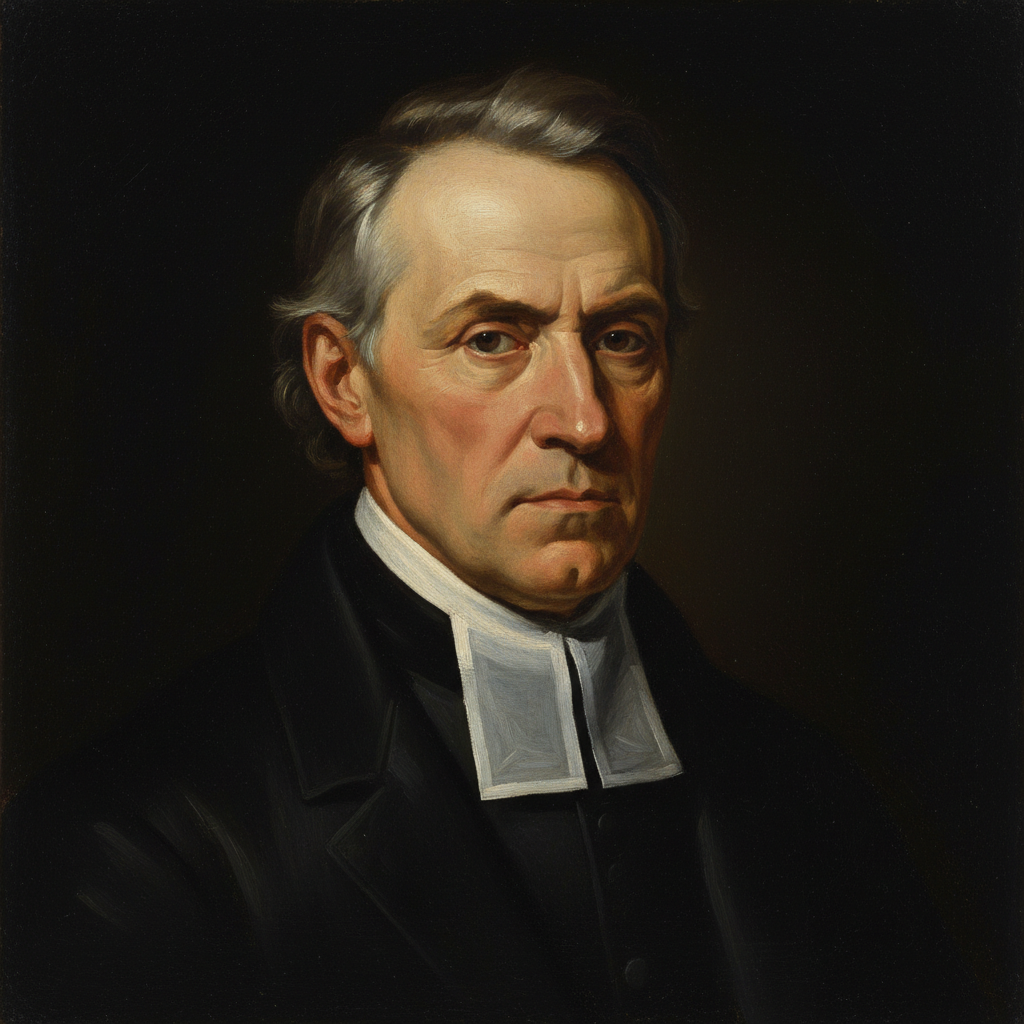
John Wesley — "I do not think that I have ever spent an hour in my life, from the age of twenty…"
I do not think that I have ever spent an hour in my life, from the age of twenty-one to this day, without employing it in some useful way.
I do not think that I have ever spent an hour in my life, from the age of twenty-one to this day, without employing it in some useful way.
Click any product to generate a realistic preview. Up to 3 at a time.
* Initial load can take up to 90 seconds — revising the preview in another color is nearly instant.
"I am a man of one book."
"I have often thought that the greatest comfort in life, is to have a friend."
"I will not speak to you as a Methodist, but as a man of common sense."
"Holy tempers are the very essence of religion."
"The more I see of the working of the present government, the more I am convinced that they are ripe for destruction."
English Anglican cleric and founder of Methodism, whose open-air preaching and class-meeting structure created the largest 18th-century evangelical revival. Closely associated with Charles Wesley (his hymn-writing brother) and George Whitefield (early co-revivalist, later doctrinal opponent). For an intellectual contrast, see George Whitefield, Calvinist evangelical revivalist — Whitefield's predestinarian Calvinism vs Wesley's free-grace Arminian theology split the early Methodist movement permanently in the 1739-41 break. The founding evangelical Calvinist-Arminian schism — the two parallel evangelical traditions American Christianity descends from.
Found in 1 providers: grok
1 source checked
Every hour of adult life was deliberately spent on something productive or meaningful—never wasted on idle distraction. This is a declaration of radical intentionality: time is a moral resource, and squandering it is a form of failure. It challenges the reader to audit their own hours and consider whether busyness and purposefulness are the same thing.
Wesley famously rose at 4am daily, preached 40,000-plus sermons, rode 250,000 miles on horseback across Britain, and wrote prolifically into his eighties. Methodism itself was named for the methodical, disciplined approach Wesley and his Oxford peers applied to spiritual and practical life. This quote is biographical fact as much as aspiration.
The 18th-century Evangelical Revival in Britain emerged partly as a reaction against perceived moral laxity in the established Church of England. Industrial-era England was redefining labor and productivity as virtues. Wesley's emphasis on disciplined time use resonated with emerging working-class audiences and helped shape Protestant work-ethic culture that influenced both religious practice and capitalist labor norms.
AI-generated insights based on extensive research and information for context. Factual errors? Email [email protected].
Your cart is empty