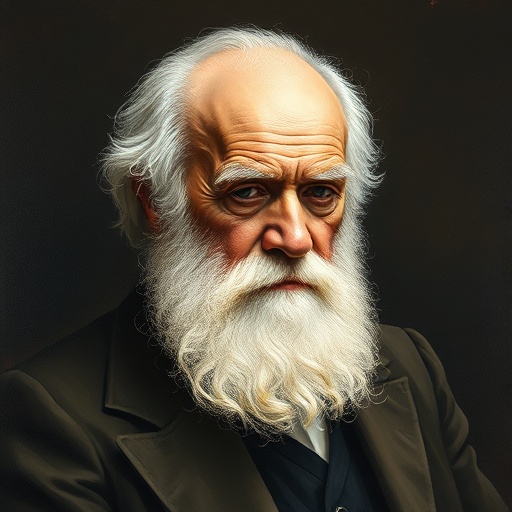
Charles Darwin — "I have felt a considerable reluctance to express myself in this chapter on the s…"
I have felt a considerable reluctance to express myself in this chapter on the subject of religion.
I have felt a considerable reluctance to express myself in this chapter on the subject of religion.
Click any product to generate a realistic preview. Up to 3 at a time.
* Initial load can take up to 90 seconds — revising the preview in another color is nearly instant.
"Man is descended from a hairy, tailed quadruped, probably arboreal in its habits, and an inhabitant of the Old World."
"I have no great quickness of apprehension or wit which is so remarkable in some clever men, but I have a fair share of invention and of common sense."
"Blushing is the most peculiar and most human of all expressions."
"Man has risen to the very summit of the organic scale; and the fact of his having thus risen, instead of having been aboriginally placed there, is the best proof of his power of development."
"I hate a Barnacle as no man ever did before, not even a Sailor in a slow-sailing ship."
British naturalist whose On the Origin of Species (1859) established evolution by natural selection — the unifying theory of modern biology. Closely associated with Thomas Henry Huxley (his 'bulldog' public defender) and Alfred Russel Wallace (independent co-discoverer of natural selection). For an intellectual contrast, see William Paley, Anglican theologian and Natural Theology author (1743-1805) — Origin of Species is structurally a 400-page reply to Paley — Darwin admired Paley's watchmaker-argument as an undergraduate at Cambridge and then spent 20 years building the empirical machinery to displace him. The cleanest 'design argument vs natural selection' founding rebuttal in science.
The standard scholarly entry points to Charles Darwin's work: Janet Browne (Harvard, history of science) — Charles Darwin: Voyaging (1995) and The Power of Place (2002); Adrian Desmond (UCL, biographer) — Darwin: The Life of a Tormented Evolutionist (1991, with James Moore). These are the works graduate seminars cite when teaching Charles Darwin.
Found in 1 providers: grok
1 source checked
Darwin is openly admitting his discomfort with addressing religion — not hiding the awkwardness but naming it directly. In plain terms: he found it genuinely difficult to state his religious views, knowing the topic was explosive and personal. This is intellectual honesty about self-censorship. He's not dodging religion out of indifference, but out of awareness that whatever he says will be scrutinized, misused, and hurtful to people he loves.
Darwin trained briefly for the clergy at Cambridge before the Beagle voyage changed everything. His theory of evolution challenged biblical creation directly, making him religion's most famous scientific antagonist. His wife Emma was devoutly Christian and genuinely feared for his soul. He gradually lost his faith after his daughter Annie's death in 1851. He called himself agnostic, not atheist — carefully. His reluctance was biographical: speaking freely could wound Emma and inflame a culture war already raging around his name.
Victorian England treated religious skepticism as social and moral transgression. The Church of England permeated public life — universities, courts, Parliament. Darwin published Origin in 1859, triggering immediate theological shockwaves. The 1860 Oxford debate between Huxley and Bishop Wilberforce became legendary. Blasphemy prosecutions still occurred. Admitting religious doubt risked professional ruin and social exile. Darwin watched colleagues vilified for far milder positions. His reluctance reflects a culture where scientific truth and religious authority were locked in open, bitter conflict.
AI-generated insights based on extensive research and information for context. Factual errors? Email [email protected].
Your cart is empty