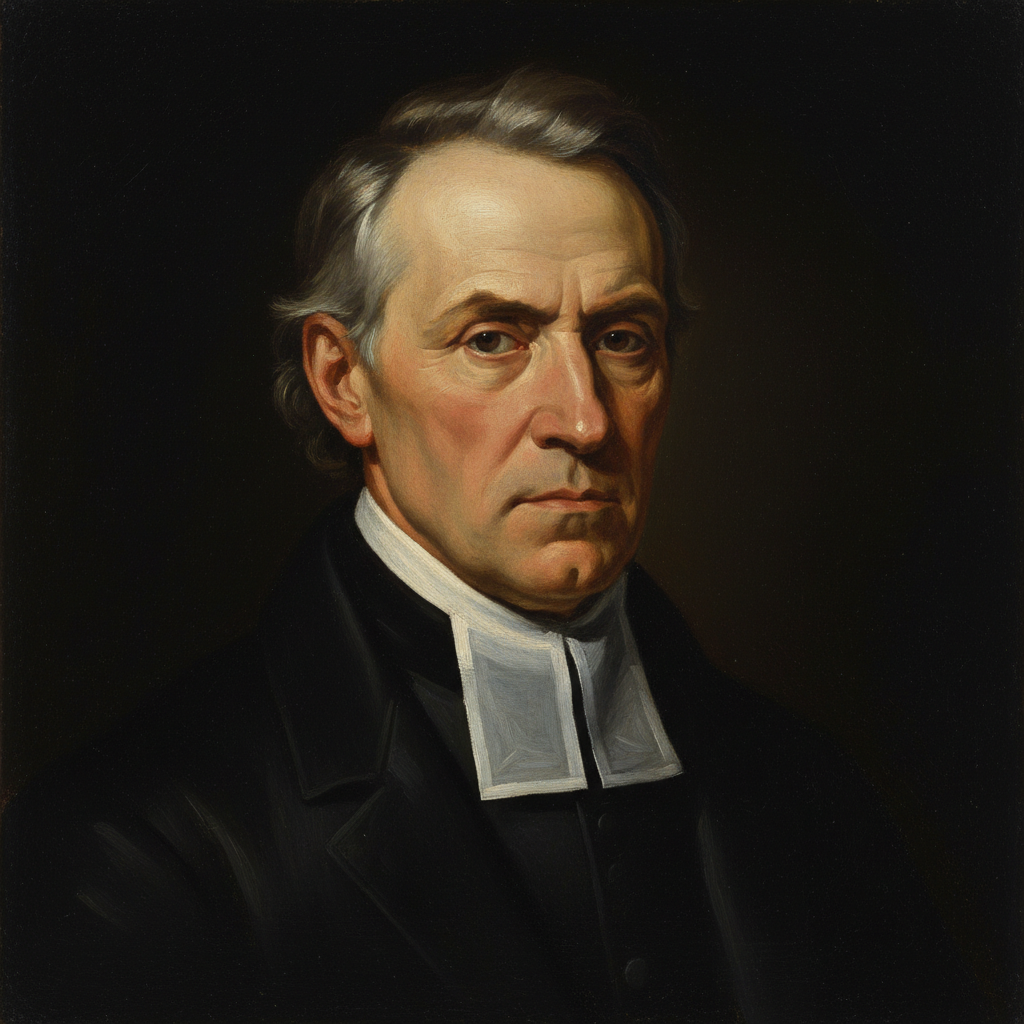
John Wesley — "I have found that the more I pray, the more I have to pray for."
I have found that the more I pray, the more I have to pray for.
I have found that the more I pray, the more I have to pray for.
Click any product to generate a realistic preview. Up to 3 at a time.
* Initial load can take up to 90 seconds — revising the preview in another color is nearly instant.
"I have often thought, that if I were to choose a time to live, it should be in the first ages of Christianity."
"I still find, and find it to my comfort, that I am not in the number of the rich. If I am not, I am not in the number of them that are in danger of falling into temptation and a snare, and into many f…"
"I have often wondered that any man, who has tasted of the pleasures of retirement, can ever be prevailed upon to quit them."
"The greatest enemy to human happiness is the love of money."
"I believe that all true Christians are brothers and sisters, whatever their denomination."
English Anglican cleric and founder of Methodism, whose open-air preaching and class-meeting structure created the largest 18th-century evangelical revival. Closely associated with Charles Wesley (his hymn-writing brother) and George Whitefield (early co-revivalist, later doctrinal opponent). For an intellectual contrast, see George Whitefield, Calvinist evangelical revivalist — Whitefield's predestinarian Calvinism vs Wesley's free-grace Arminian theology split the early Methodist movement permanently in the 1739-41 break. The founding evangelical Calvinist-Arminian schism — the two parallel evangelical traditions American Christianity descends from.
Found in 1 providers: grok
1 source checked
Prayer grows its own appetite — the more you pray, the more aware you become of what needs prayer. This describes a spiritual feedback loop: engaging with God expands your consciousness of need, gratitude, and intercession. Rather than resolving concerns and leaving silence, prayer multiplies awareness. It is a counter-intuitive truth about spiritual practice: it does not empty the prayer list but continuously fills it with deeper, wider, more urgent concerns.
Wesley rose at 4am daily to pray for two hours, logging over 250,000 miles on horseback across Britain and America. Each journey exposed him to new poverty, illness, and spiritual desolation — miners, prisoners, orphans, slaves. His founding of Methodist societies created thousands of members whose needs demanded intercession. His lifelong commitment to social reform meant prayer perpetually revealed more injustice, more suffering, and more souls requiring both his attention and God's direct intervention.
Wesley lived through Britain's early Industrial Revolution and the Enlightenment's rationalist challenge to faith. Mass rural-to-urban migration created unprecedented poverty — child labor, gin epidemics, debtors' prisons. The established Church of England largely ignored the working poor. Wesley's Methodist revival, spanning the 1730s through 1790s, emerged as a direct response emphasizing personal piety and social action. In an era of profound human suffering and institutional religious neglect, prayer that expanded rather than satisfied was both spiritually honest and practically necessary.
AI-generated insights based on extensive research and information for context. Factual errors? Email [email protected].
Your cart is empty