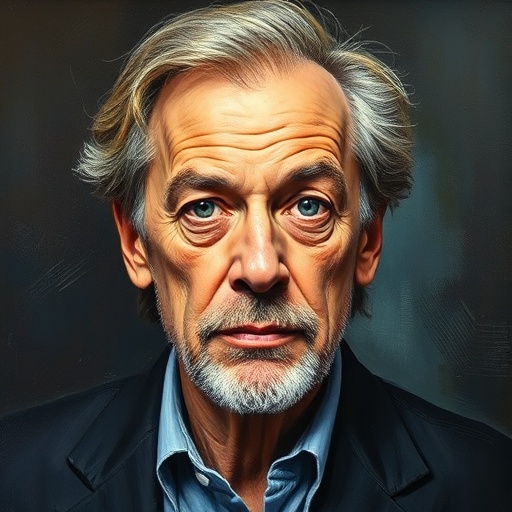
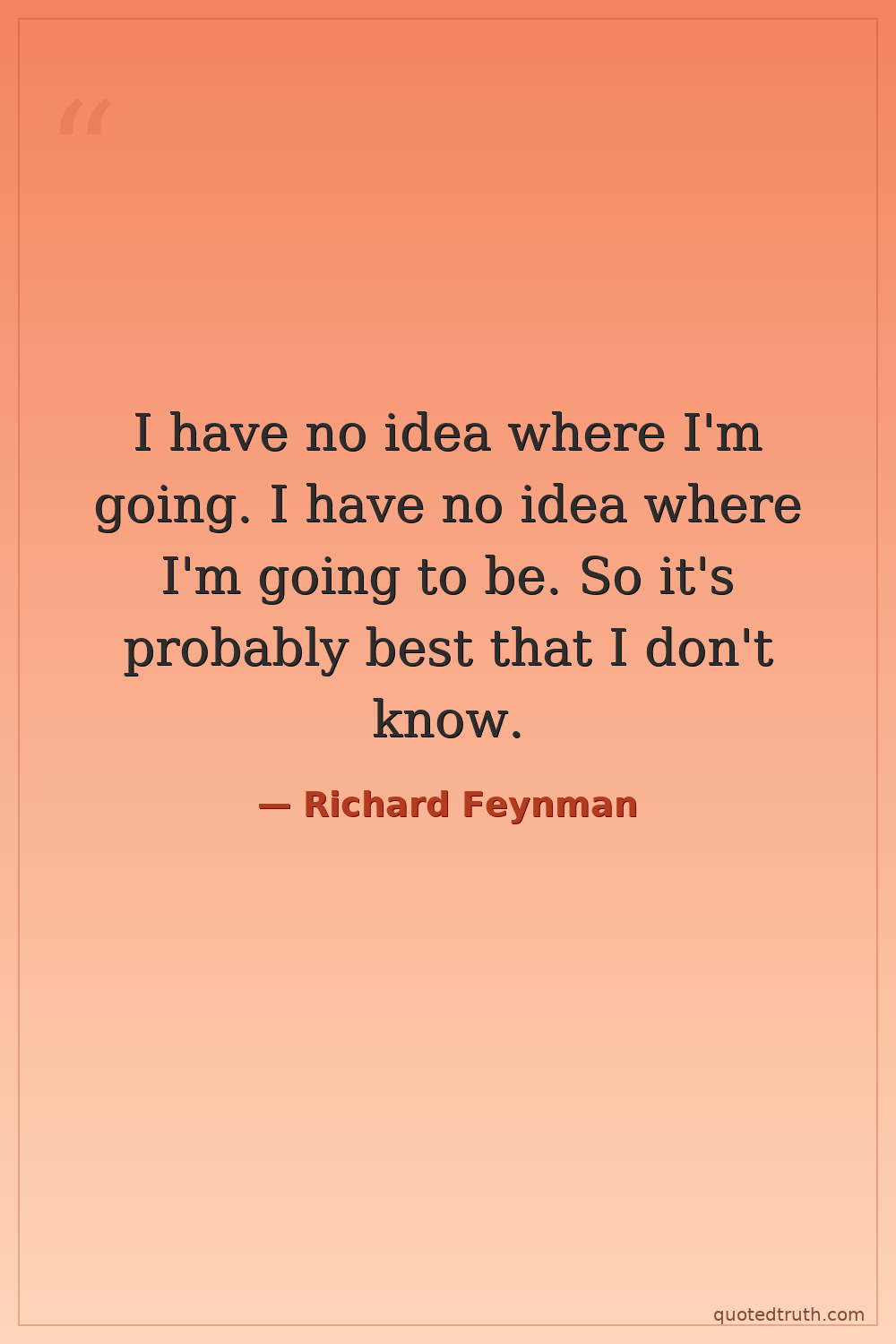
Richard Feynman — "I have no idea where I'm going. I have no idea where I'm going to be. So it's pr…"
I have no idea where I'm going. I have no idea where I'm going to be. So it's probably best that I don't know.
I have no idea where I'm going. I have no idea where I'm going to be. So it's probably best that I don't know.
Click any product to generate a realistic preview. Up to 3 at a time.
* Initial load can take up to 90 seconds — revising the preview in another color is nearly instant.
"You see my physics students don't understand it... That is because I don't understand it. Nobody does."
"The price of doing science is the necessity of not being a know-it-all."
"I learned very early the difference between knowing the name of something and knowing something."
"When you are a scientist, you are a child. You are always asking 'Why?'"
"I got a dollar for my patent! I give it to everybody. Result: everybody who has one of these patent because it was easy a lot of people had been sending things in lots of patents. Everybody come down …"
American theoretical physicist who shared the 1965 Nobel for QED, developed Feynman diagrams, and wrote the Feynman Lectures on Physics. Closely associated with Julian Schwinger (co-Nobelist for QED) and Murray Gell-Mann (Caltech rival and Eightfold-Way physicist). For an intellectual contrast, see Deepak Chopra, physician and quantum-mysticism author — Feynman's Caltech 'cargo cult science' commencement address is the precise template for what he saw as misuse of physics terminology — Chopra-style appropriation of quantum vocabulary for metaphysical claims is the canonical example of what Feynman called 'fooling yourself'.
Found in 1 providers: grok
1 source checked
Not knowing your future direction isn't a failure of planning—it's liberation. Locking onto a destination forces you to filter out everything that doesn't fit the route. Staying genuinely uncertain keeps every door open, letting life unfold without the distortion of a fixed goal. The final line carries the punch: ignorance here isn't a gap to fill but a condition to preserve. Knowing would constrain; not knowing protects the full range of possibility.
Feynman built quantum electrodynamics—a field whose foundation is irreducible uncertainty. He famously called 'I don't know' his most important phrase, treating ignorance as the honest starting point of science. He zigzagged from Los Alamos bomb work to bongo drums to safe-cracking to teaching freshman physics with equal intensity, never optimizing toward a single destination. His Nobel Prize came from following curiosity, not a career plan. The quote is essentially his biography compressed.
Feynman worked through Cold War science, when U.S. funding tied researchers to deliverables—missile defense, nuclear weapons, the space race. Government contracts demanded roadmaps and projected outcomes. Within this landscape, treating purposelessness as wisdom was genuinely subversive. His era also saw McCarthyism pressure intellectuals toward conformity. Feynman's deliberate refusal to know his destination—institutional or personal—was a quiet rebellion against a scientific culture that prized planned, fundable, politically aligned trajectories.
AI-generated insights based on extensive research and information for context. Factual errors? Email [email protected].
Your cart is empty