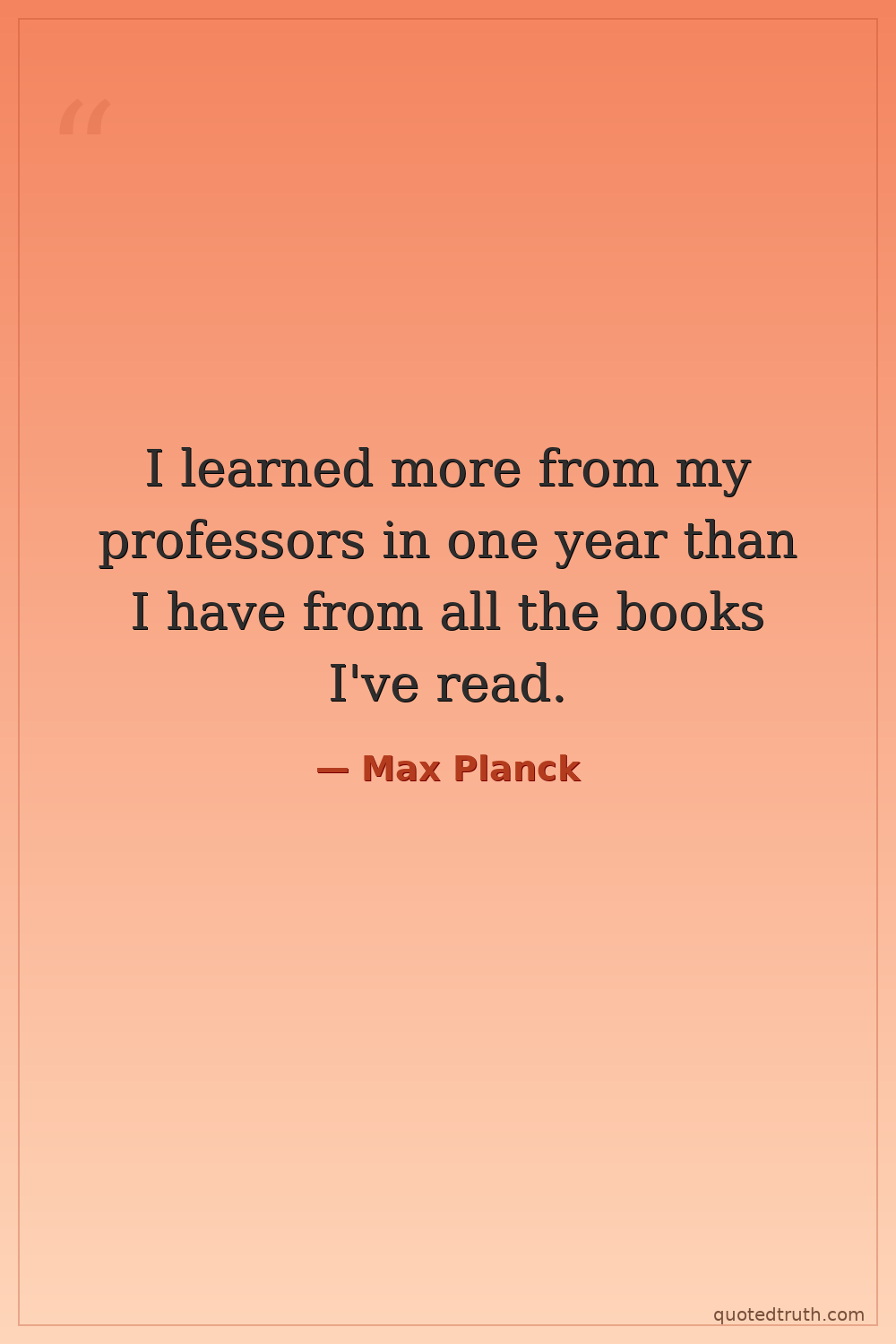
Max Planck — "I learned more from my professors in one year than I have from all the books I'v…"
I learned more from my professors in one year than I have from all the books I've read.
I learned more from my professors in one year than I have from all the books I've read.
Click any product to generate a realistic preview. Up to 3 at a time.
* Initial load can take up to 90 seconds — revising the preview in another color is nearly instant.
"There is no matter as such! All matter originates and exists only by virtue of a force which brings the particle of an atom to vibration and holds this most minute solar system of the atom together. W…"
"I consider the consciousness as fundamental. I consider matter as derivative from consciousness. We cannot get behind consciousness. Everything that we talk about, everything that we regard as existin…"
"Science cannot solve the ultimate mystery of nature. And that is because, in the last analysis, we ourselves are a part of nature and therefore a part of the mystery that we are trying to solve."
"The pioneer feels nature as an enemy, or as a force to be conquered."
"I started from the assumption that the energy of an oscillator is quantized. I did this in an act of desperation."
Found in 1 providers: grok
1 source checked
Planck is saying that direct mentorship from skilled teachers taught him more than years of independent reading. Face-to-face instruction, watching experts reason through problems, and receiving immediate feedback compressed learning in a way that solitary study could not match. Books deliver information, but professors transmit judgment, method, and the unwritten craft of thinking through hard problems with a living guide.
Planck studied under Hermann von Helmholtz and Gustav Kirchhoff in Berlin, two titans of 19th-century physics whose seminars shaped his rigorous approach to thermodynamics. Though he initially found their lectures dry, working closely with them taught him the discipline that later let him derive the quantum hypothesis in 1900. He became the same kind of mentor, famously supporting Einstein early and guiding students like Max von Laue through the University of Berlin.
Planck's era (late 1800s to mid-1900s) was the golden age of European university apprenticeship, when physics advanced through small seminar groups clustered around great professors in Berlin, Göttingen, and Munich. Textbooks lagged years behind research, so personal contact with working scientists was the only path to the frontier. This mentor-driven tradition produced quantum mechanics, relativity, and nearly every Nobel laureate of that generation before World War II scattered the German scientific community.
AI-generated insights based on extensive research and information for context. Factual errors? Email [email protected].
Your cart is empty