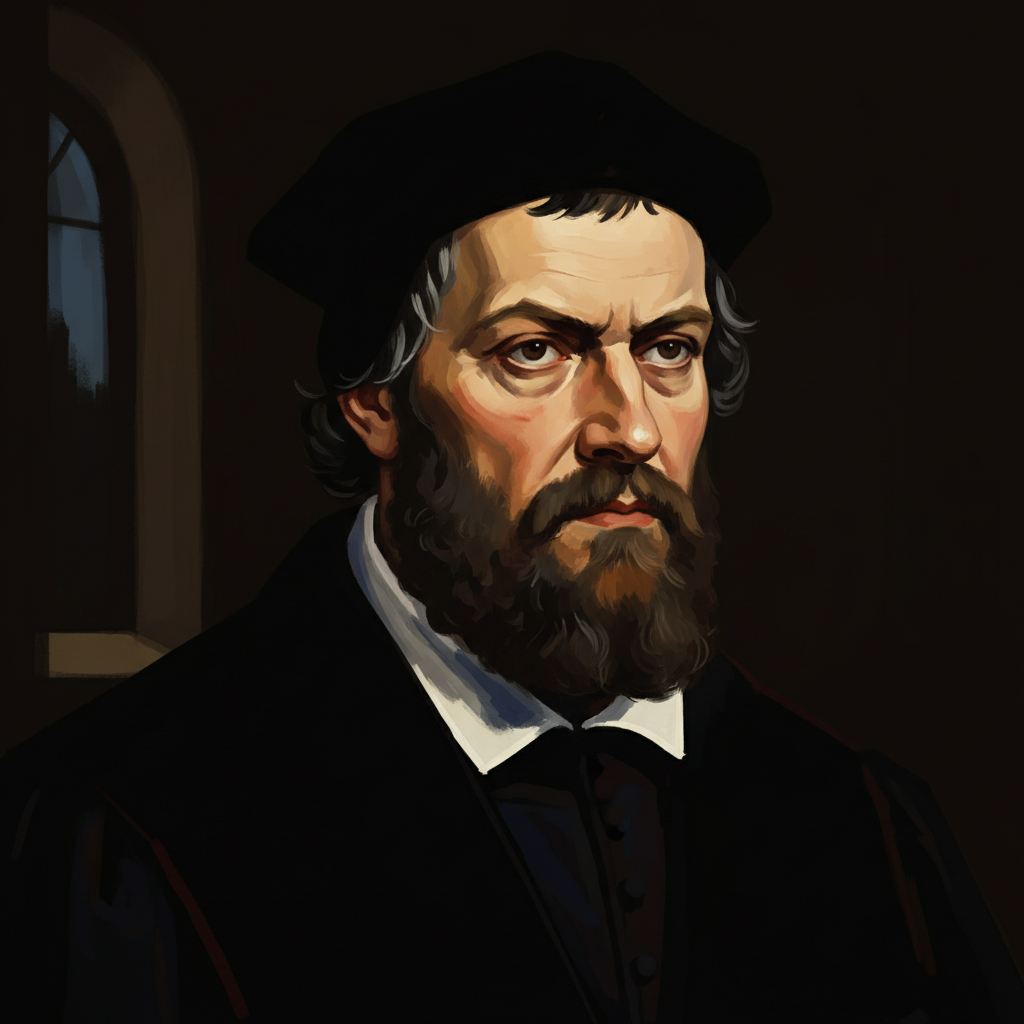
Martin Luther — "I would rather be a swineherd than a Pope."
I would rather be a swineherd than a Pope.
I would rather be a swineherd than a Pope.
Click any product to generate a realistic preview. Up to 3 at a time.
* Initial load can take up to 90 seconds — revising the preview in another color is nearly instant.
"There are three ways of growing: by study, by experience, and by prayer."
"If any man doth ascribe of salvation, even the very least, to the free will of man, he knoweth nothing of grace, and he hath not learnt Jesus Christ aright."
"He who does not love wine, women, and song remains a fool his whole life long."
"For I know One who suffered and made satisfaction on my behalf. His name is Jesus Christ, Son of God, and where He is there I shall be also!"
"I am not afraid of a pope or a cardinal, but of a little bird that sings in the tree."
German theologian whose 95 Theses (1517) launched the Protestant Reformation and broke the Catholic Church's monopoly on Western Christianity. Closely associated with Philipp Melanchthon (Lutheran systematizer) and John Calvin (later Reformer who built on Luther's break). For an intellectual contrast, see Pope Leo X, Renaissance pope (1513-1521) — Leo X's indulgence sales triggered Luther's break and Leo excommunicated him in 1521 — Luther's entire Reformation is structured as a direct answer to the indulgence-funded Vatican Leo represented.
Found in 1 providers: grok
1 source checked
Luther declares he would prefer the lowly, dirty job of tending pigs over holding the highest office in the Catholic Church. He is saying the papacy, for all its prestige and power, is so morally compromised and spiritually corrupt that an honest peasant job is more dignified. Status and authority mean nothing if the position itself demands participating in what he considers deception and abuse.
Luther spent his career attacking papal authority, from his 1517 Ninety-Five Theses against indulgences to his 1520 excommunication by Pope Leo X. He called the pope the Antichrist and rejected Rome's claim to interpret scripture. For a former Augustinian monk who once revered Rome, this insult captures his complete break: the papal office was not merely flawed but actively disgraceful compared to any honest labor.
In early-modern Europe, the Renaissance papacy was notorious for selling indulgences, nepotism, and funding lavish projects like St. Peter's Basilica through exploitation of peasants. The printing press spread Luther's insults across German-speaking lands rapidly, fueling peasant resentment against Rome. Saying this aloud risked execution for heresy, yet Luther's protection by Frederick the Wise of Saxony let such declarations ignite the Reformation and fracture Western Christendom permanently.
AI-generated insights based on extensive research and information for context. Factual errors? Email [email protected].
Your cart is empty