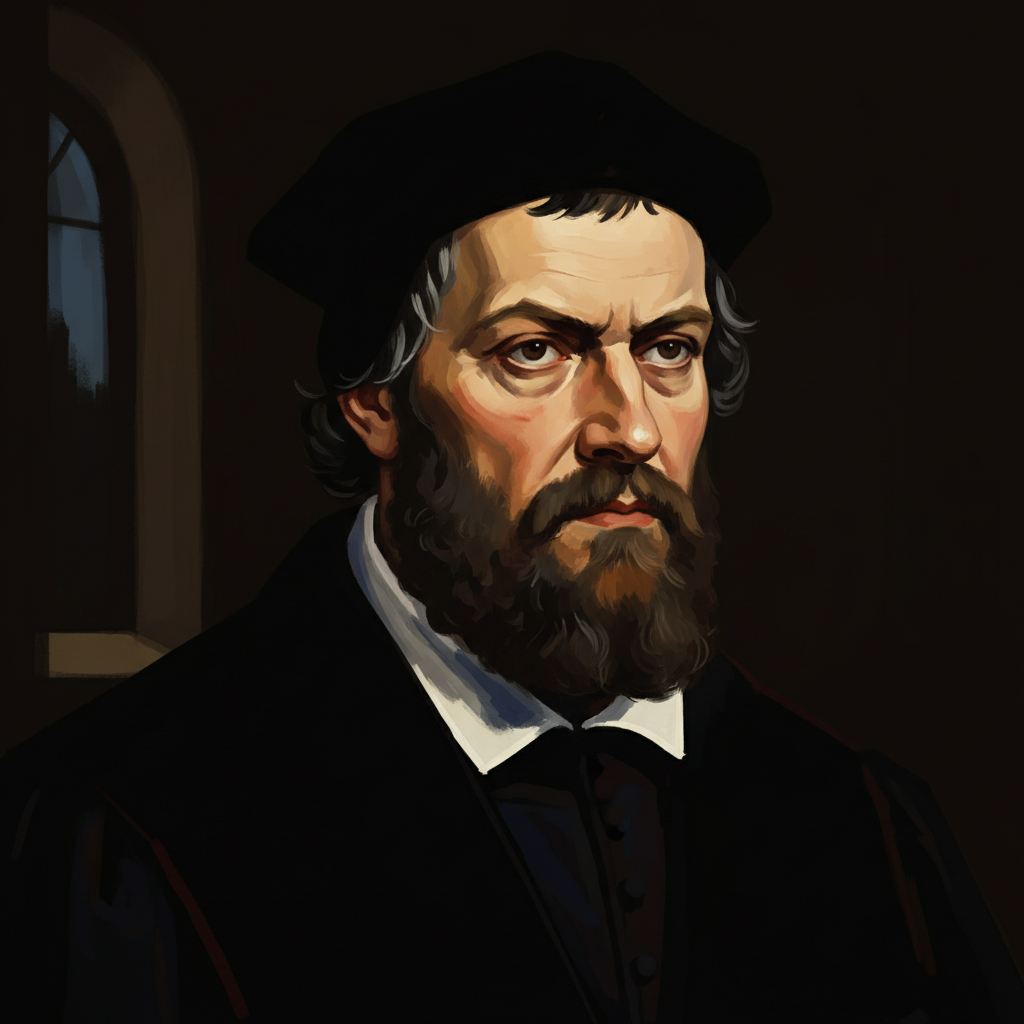
Martin Luther — "I am not afraid of a pope or a cardinal, but of a little bird that sings in the …"
I am not afraid of a pope or a cardinal, but of a little bird that sings in the tree.
I am not afraid of a pope or a cardinal, but of a little bird that sings in the tree.
Click any product to generate a realistic preview. Up to 3 at a time.
* Initial load can take up to 90 seconds — revising the preview in another color is nearly instant.
"Burn down their synagogues, forbid all that I enumerated earlier, force them to work, and deal with them with utmost severity, as Moses did in the wilderness, when he slew three thousand... for if we …"
"Therefore, dear Lords, help here, save here, release here, stab, smite, strangle here, whoever can. And if you die in it, blessed are you; for you die in obedience to God's Word and command (Rom. 13) …"
"Whatever your heart clings to and confides in, that is really your God."
"The world is like a drunken peasant. If you help him to mount on one side of his horse, he tumbles off on the other."
"Melanchthon is a miserable little worm of a man."
German theologian whose 95 Theses (1517) launched the Protestant Reformation and broke the Catholic Church's monopoly on Western Christianity. Closely associated with Philipp Melanchthon (Lutheran systematizer) and John Calvin (later Reformer who built on Luther's break). For an intellectual contrast, see Pope Leo X, Renaissance pope (1513-1521) — Leo X's indulgence sales triggered Luther's break and Leo excommunicated him in 1521 — Luther's entire Reformation is structured as a direct answer to the indulgence-funded Vatican Leo represented.
Found in 1 providers: grok
1 source checked
Luther admits that powerful authorities do not terrify him, but the small voice of conscience does. External threats from rulers or institutions matter less than the quiet inner whisper reminding him of truth, guilt, or duty. The 'little bird' represents that persistent moral voice you cannot silence. Worldly power can be faced down; your own conscience cannot be argued with or escaped.
Luther famously defied the pope and emperor at the Diet of Worms in 1521, declaring his conscience captive to the Word of God. He was excommunicated, declared an outlaw, yet refused to recant. This quote captures his core conviction that conscience, shaped by scripture, outranks any church hierarchy. The paradox fits a man who challenged the most powerful institutions in Europe while wrestling privately with deep spiritual anxiety and self-scrutiny.
In early sixteenth-century Europe, the Catholic Church wielded immense political and spiritual authority, selling indulgences and enforcing doctrine through tribunals. Luther's 1517 Ninety-Five Theses ignited the Protestant Reformation, fracturing Christendom and triggering decades of religious wars. Printing presses spread ideas faster than Rome could suppress them. Ordinary believers began reading scripture in their own languages, and the notion that personal conscience could override papal authority was genuinely revolutionary, dangerous, and punishable by death.
AI-generated insights based on extensive research and information for context. Factual errors? Email [email protected].
Your cart is empty