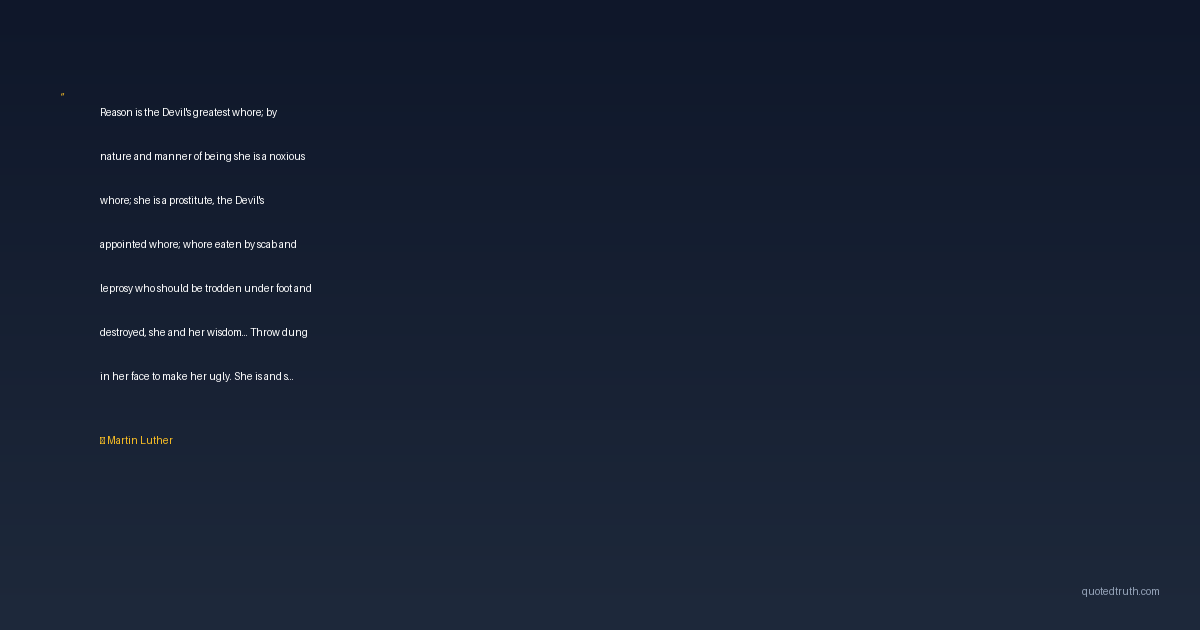
Martin Luther — "Reason is the Devil's greatest whore; by nature and manner of being she is a nox…"

Reason is the Devil's greatest whore; by nature and manner of being she is a noxious whore; she is a prostitute, the Devil's appointed whore; whore eaten by scab and leprosy who should be trodden under foot and destroyed, she and her wisdom... Throw dung in her face to make her ugly. She is and should be drowned in baptism... She would deserve, the wretch, to be banished from the sight of God.
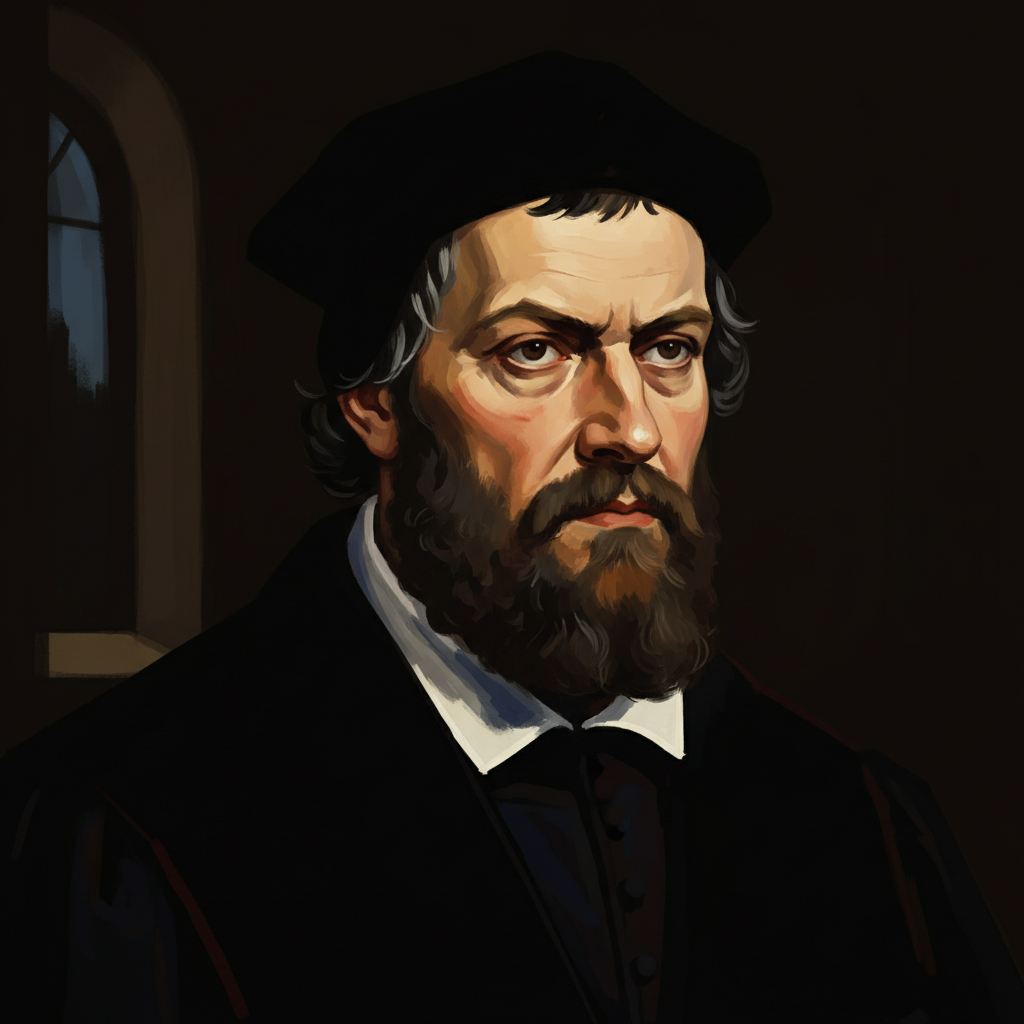
Martin Luther — Martin Luther Early Modern · Leader of the Protestant Reformation

Get This Quote & Author's Image Illustrated On:

Click any product to generate a realistic preview. Up to 3 at a time.
* Initial load can take up to 90 seconds — revising the preview in another color is nearly instant.

Kitchen

Apparel

Other

About Martin Luther (1483-1546)

German theologian whose 95 Theses (1517) launched the Protestant Reformation and broke the Catholic Church's monopoly on Western Christianity. Closely associated with Philipp Melanchthon (Lutheran systematizer) and John Calvin (later Reformer who built on Luther's break). For an intellectual contrast, see Pope Leo X, Renaissance pope (1513-1521) — Leo X's indulgence sales triggered Luther's break and Leo excommunicated him in 1521 — Luther's entire Reformation is structured as a direct answer to the indulgence-funded Vatican Leo represented.

Details

Against the Heavenly Prophets in the Matter of Images and Sacrament, 1525

Date: 1525

Biblical

Verification

Unverifiable

Found in 1 providers: gemini

1 source checked

Understanding this quote

What it means

Luther is violently attacking human reason when it operates independently of faith. He calls unaided intellect a destructive force that seduces people away from God, comparing it to a diseased prostitute who must be utterly degraded and destroyed. The point is not that thinking is bad, but that reason divorced from scripture leads souls astray and must be subordinated, even humiliated, beneath revealed religious truth.

Relevance to Martin Luther

Luther built his entire Reformation on sola scriptura, the principle that scripture alone, not philosophical argument or papal logic, reveals truth. As a former Augustinian monk who broke with Rome in 1517, he despised the Scholastic tradition that married Aristotle to Christianity. His fierce, scatological rhetoric here is vintage Luther, who routinely used coarse language against opponents and believed justification comes through faith, never through rational merit or works.

The era

The early sixteenth century was the height of Scholastic theology, where universities taught faith through Aristotelian logic and Thomas Aquinas's syntheses. Humanist scholars like Erasmus championed reason and classical learning. Luther's 1517 Ninety-Five Theses ignited the Reformation precisely by rejecting this rationalist framework, arguing that the Catholic Church's elaborate logical justifications for indulgences, purgatory, and papal authority had buried the gospel beneath human cleverness rather than divine revelation.

AI-generated insights based on extensive research and information for context. Factual errors? Email [email protected].
Your Cart

Your cart is empty