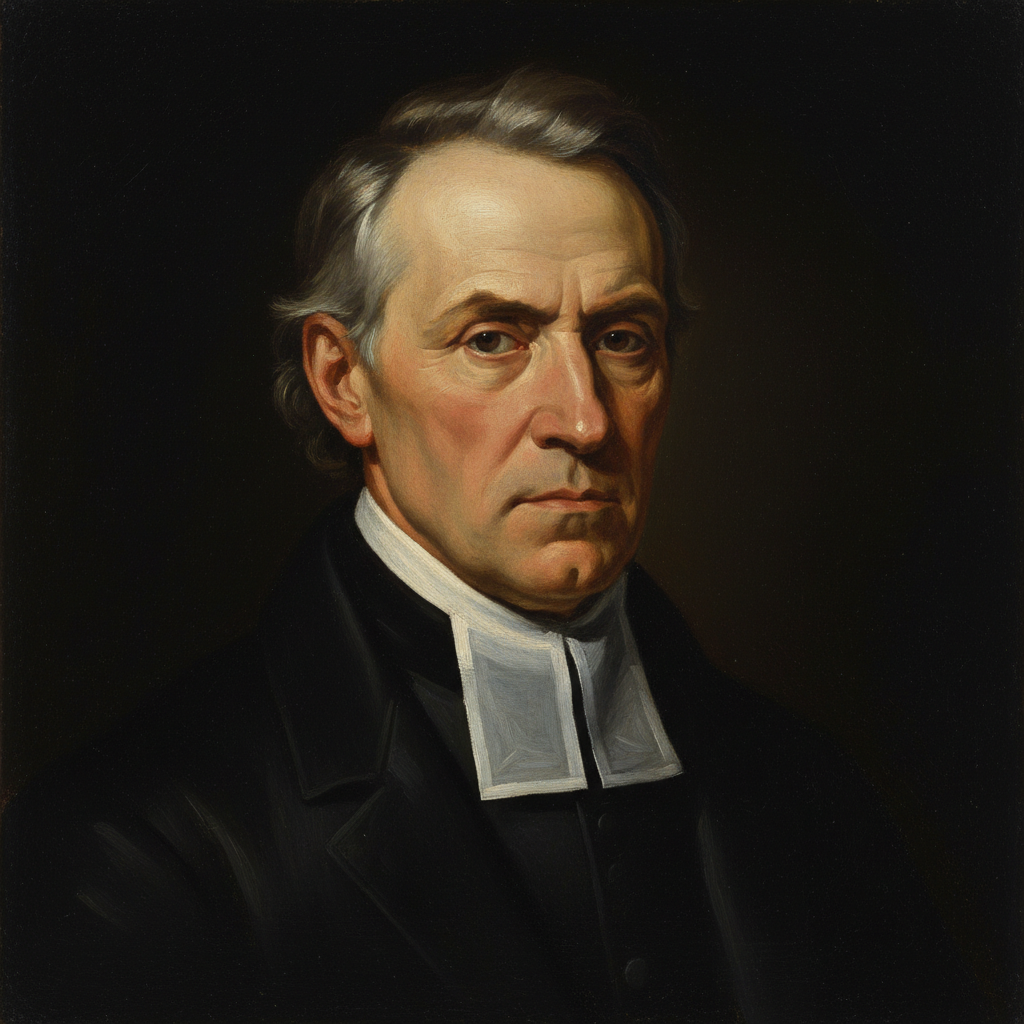
John Wesley — "It is not enough to be zealous; we must be zealous for God."
It is not enough to be zealous; we must be zealous for God.
It is not enough to be zealous; we must be zealous for God.
Click any product to generate a realistic preview. Up to 3 at a time.
* Initial load can take up to 90 seconds — revising the preview in another color is nearly instant.
"I set myself on fire, and people come to watch me burn."
"I would as soon believe that the sun would stand still, as that a Christian could fall from grace and be lost."
"The Lord is at hand; therefore fear not."
"I am not afraid of giving too much trouble to God. He is able to bear it."
"It is not the being in a place, but the being in a state, that makes us happy."
English Anglican cleric and founder of Methodism, whose open-air preaching and class-meeting structure created the largest 18th-century evangelical revival. Closely associated with Charles Wesley (his hymn-writing brother) and George Whitefield (early co-revivalist, later doctrinal opponent). For an intellectual contrast, see George Whitefield, Calvinist evangelical revivalist — Whitefield's predestinarian Calvinism vs Wesley's free-grace Arminian theology split the early Methodist movement permanently in the 1739-41 break. The founding evangelical Calvinist-Arminian schism — the two parallel evangelical traditions American Christianity descends from.
Found in 1 providers: grok
1 source checked
Passion alone is not enough — what matters is where that passion is aimed. Wesley warns that someone can be intensely devoted to a cause, a church institution, or even religious rules without genuinely centering God. True zeal must be God-directed: motivated by love for God, aligned with God's purposes, not merely human enthusiasm wearing a religious label. Misdirected fervor, however intense, misses the point entirely.
Wesley himself embodied ferocious energy: he preached over 40,000 sermons and rode 250,000 miles on horseback. But his 1738 Aldersgate conversion — where he felt his heart 'strangely warmed' — convinced him that effort without genuine God-centeredness was empty religion. His Oxford Holy Club had been mocked as overly rigorous; he understood firsthand how zeal could become mere performance. Methodist theology centered on inward transformation, not outward religious activity alone.
Eighteenth-century Britain saw the Enlightenment eroding traditional faith while the Church of England had grown institutionally comfortable, often serving the wealthy and ignoring the poor. Religious 'enthusiasm' was a term of mockery. Meanwhile, political factions routinely invoked religion to justify wars and persecution. Wesley's revival movement arose precisely because zeal had become either suppressed or weaponized — he insisted authentic Christian fervor must answer to God's purposes, not cultural fashion or political agenda.
AI-generated insights based on extensive research and information for context. Factual errors? Email [email protected].
Your cart is empty