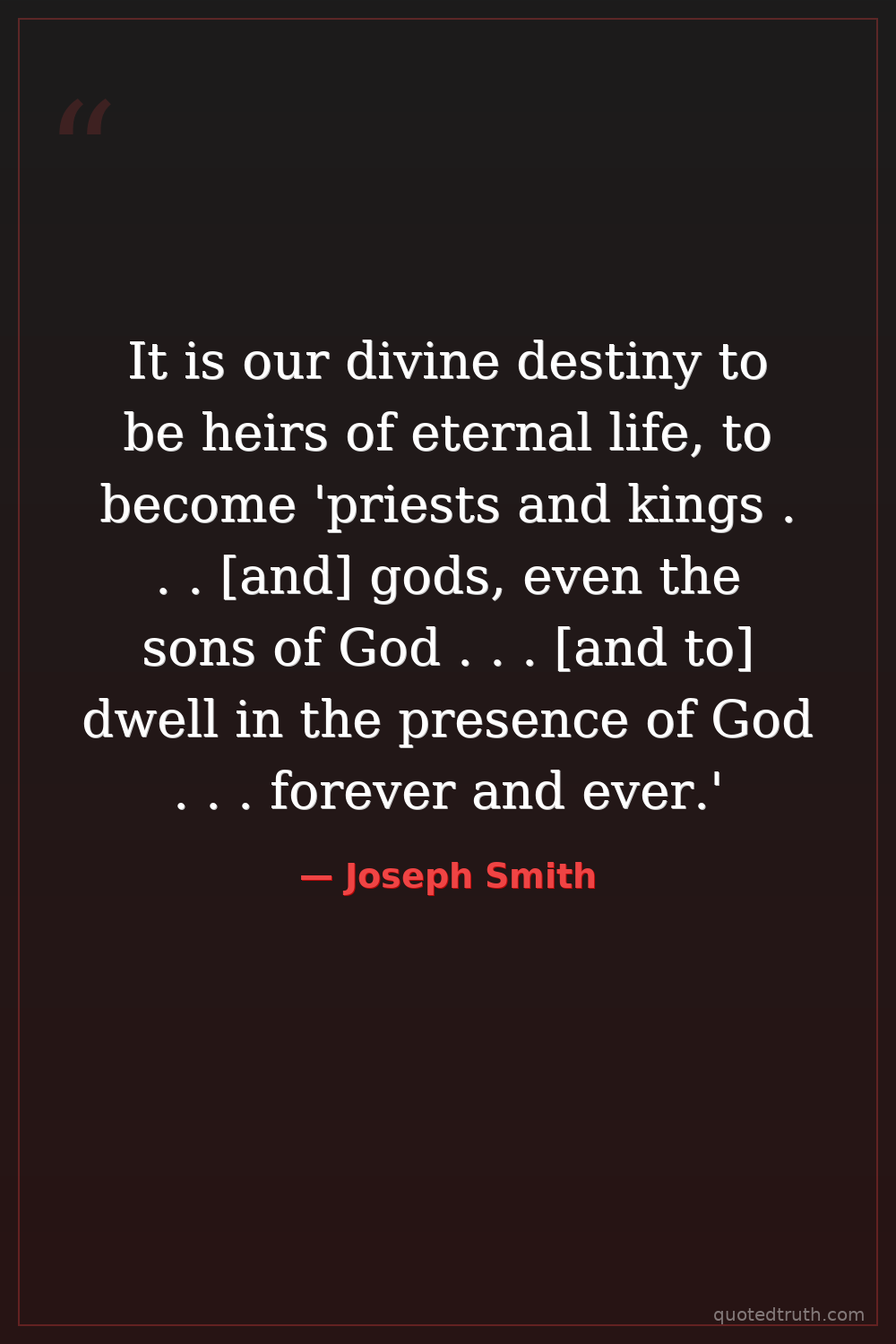
What it means
Humans are not simply mortal beings awaiting judgment but are destined for divine transformation — literally becoming god-like heirs who dwell eternally with God. This envisions existence as a trajectory toward exaltation, not mere salvation from sin. The destination is co-heirship with Christ: ruling, reigning, and dwelling in God's presence forever. It frames human life as a divine apprenticeship culminating in eternal, glorified existence.
Relevance to Joseph Smith
Smith's theology placed human deification — called eternal progression — at its core. His 1844 King Follett Discourse declared God himself was once mortal, making human ascent to godhood doctrine, not metaphor. He constructed an entire sacramental architecture — temple endowments, celestial marriage, priesthood ordinances — to enable this exaltation. This vision of radical human potential was the capstone of his revelations and set Mormonism apart from every other Christian tradition.
The era
Smith preached this during the Second Great Awakening (1790s–1840s), an era of intense American religious ferment, frontier optimism, and widespread rejection of Old World church authority. New denominations multiplied; ordinary people claimed direct access to God. This culture prized unlimited self-improvement and destiny. Smith's claim that humans could become divine aligned perfectly with emerging American exceptionalism — a nation that felt its own destiny was cosmic, unlimited, and divinely ordained.
AI-generated insights based on extensive research and information for context. Factual errors? Email [email protected].