Isaac Newton — "I keep the subject constantly before me and wait till the first dawnings open sl…"
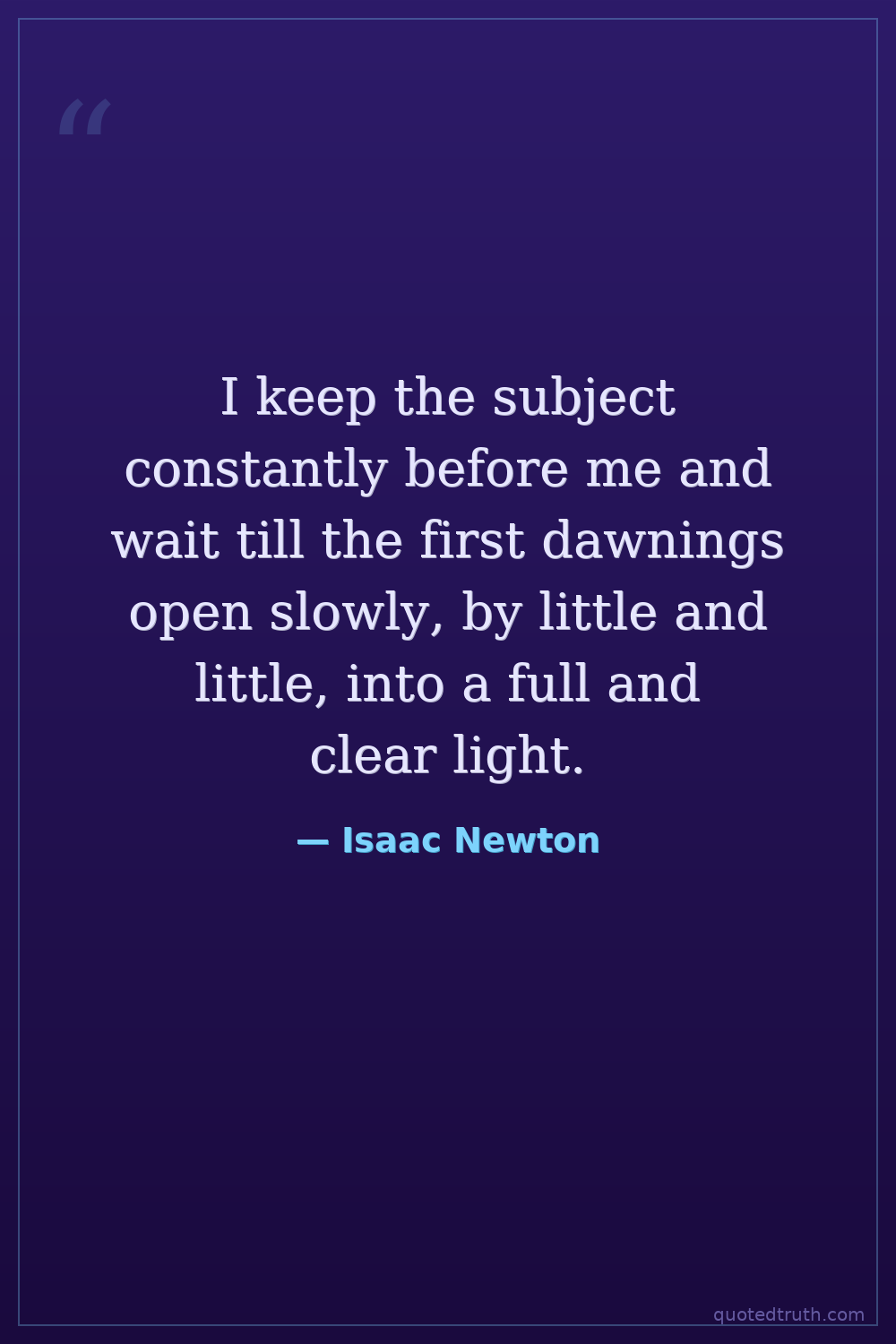
I keep the subject constantly before me and wait till the first dawnings open slowly, by little and little, into a full and clear light.
I keep the subject constantly before me and wait till the first dawnings open slowly, by little and little, into a full and clear light.
Click any product to generate a realistic preview. Up to 3 at a time.
* Initial load can take up to 90 seconds — revising the preview in another color is nearly instant.
"Atheism is so senseless and odious to mankind that it never had many professors."
"Hypotheses non fingo. (I frame no hypotheses.)"
"Opposition to godliness is atheism in profession and idolatry in practice. Atheism is so senseless."
"Atheism is so senseless. When I look at the solar system, I see the earth at the right distance from the sun to receive the proper amounts of heat and light. This did not happen by chance."
"To explain all nature is too difficult a task for any one man or even for any one age. 'Tis much better to do a little with certainty, & leave the rest for others that come after you, than to explain …"
Found in 2 providers: grok,deepseek
2 sources checked
True understanding doesn't arrive all at once — it builds gradually through sustained attention. Newton describes holding a problem in mind continuously and trusting that clarity will emerge incrementally, not in a sudden flash. It's deep, patient intellectual focus: living with a question until it resolves from vague intuition into sharp comprehension. Patience and persistence, not sudden genius, drive discovery. The light doesn't switch on; it slowly dawns.
Newton was legendary for his powers of concentration — colleagues reported he forgot to eat, standing transfixed mid-thought for hours. He spent 18 months writing Principia Mathematica and sat on his gravity theory for over two decades before publishing. His breakthroughs in calculus, optics, and celestial mechanics all emerged from years of obsessive, continuous mental immersion — not sudden inspiration. This quote is less philosophy than personal confession of his actual working method.
The early modern period saw natural philosophy competing against scholastic tradition and mystical revelation for legitimacy. The Royal Society, founded 1660, championed patient empirical inquiry over inherited authority. Descartes had proposed reason alone could unlock nature's laws, while alchemy still promised instant illumination. Newton's slow, methodical approach — holding a problem for years — embodied the new scientific ethos: disciplined rational persistence rather than theological revelation or ancient texts as the path to truth.
AI-generated insights based on extensive research and information for context. Factual errors? Email [email protected].
Your cart is empty