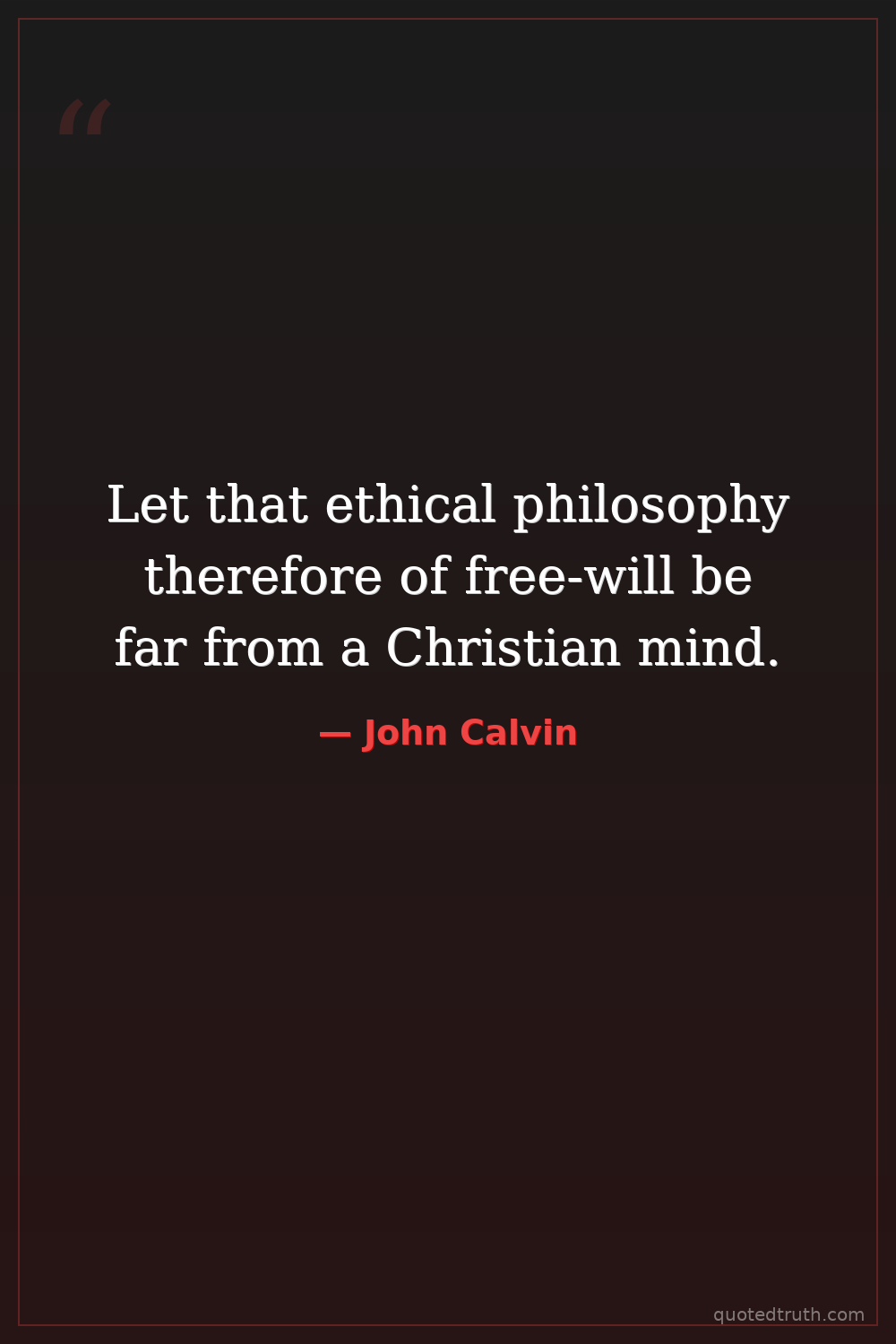
John Calvin — "Let that ethical philosophy therefore of free-will be far from a Christian mind."
Let that ethical philosophy therefore of free-will be far from a Christian mind.
Let that ethical philosophy therefore of free-will be far from a Christian mind.
Click any product to generate a realistic preview. Up to 3 at a time.
* Initial load can take up to 90 seconds — revising the preview in another color is nearly instant.
"It is not in vain that he banishes all those human affections which soften our hearts; that he commands paternal love and all the benevolent feelings between brothers, relations, and friends to cease;…"
"The reprobate are not bound to believe, because God does not give them the grace to believe."
"Servetus suffered the penalty due his heresies, but was it by my will. Certainly his arrogance destroyed him not less than his impiety."
"Ignorance of predestination is a great evil, because it deprives us of the knowledge of God's glory."
"God's election is not of him that willeth, nor of him that runneth, but of God that sheweth mercy."
French theologian whose Institutes of the Christian Religion (1536) systematized Protestant Reformed doctrine, including predestination. Closely associated with Martin Luther (Reformation founder, Calvin's predecessor). For an intellectual contrast, see Jacobus Arminius, Dutch Reformed theologian (1560-1609) — Arminius's rejection of strict double-predestination founded Arminianism — the theological tradition modern Methodism, most evangelicalism, and Pentecostalism descend from. The Calvinist-Arminian debate has divided Protestantism for 400 years.
Found in 1 providers: gemini
1 source checked
Calvin is urging Christians to reject the philosophical notion that humans possess genuine free will over moral choices. He argues that believing humans can independently choose righteousness corrupts Christian thinking. True faith requires acknowledging that human will is enslaved to sin after the Fall, and that salvation belongs entirely to God's sovereign grace—not human decision, effort, or moral striving.
Calvin's theology centered on predestination and total depravity—doctrines requiring that human will is bound, not free. His Institutes of the Christian Religion exhaustively argued this against humanist opponents like Erasmus. As Geneva's dominant reformer, he codified Protestant rejection of free will into church doctrine and governance. This quote distills his core conviction: Christianity and confidence in human moral autonomy are fundamentally incompatible.
The 16th-century Reformation made free will a defining theological battleground. Erasmus defended human moral agency against Luther's 1525 treatise On the Bondage of the Will, which Calvin extended. Medieval Scholasticism had debated the question for centuries, but the printing press now spread it to mass audiences. The Council of Trent later formally affirmed Catholic free-will doctrine, cementing Calvin's rejection as a permanent fault line between Protestant and Catholic Christianity.
AI-generated insights based on extensive research and information for context. Factual errors? Email [email protected].
Your cart is empty