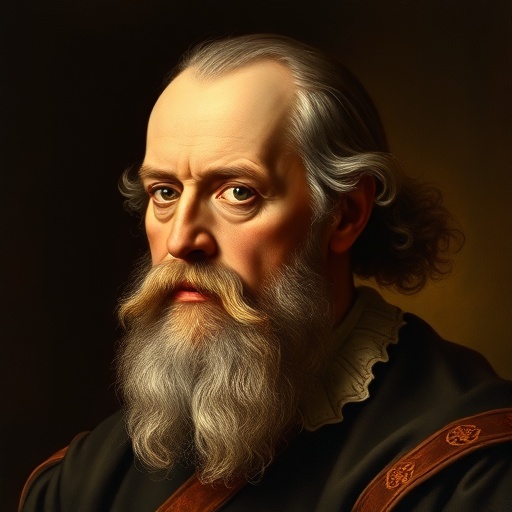
Galileo Galilei — "Mathematics is the language in which God has written the universe."
Mathematics is the language in which God has written the universe.
Mathematics is the language in which God has written the universe.
Click any product to generate a realistic preview. Up to 3 at a time.
* Initial load can take up to 90 seconds — revising the preview in another color is nearly instant.
"I know that I am mortal, and that my life will pass away like a shadow; but I hope that my discoveries will live on."
"The sun, with all those planets revolving around it and dependent on it, can still ripen a bunch of grapes as if it had nothing else in the universe to do."
"I cannot without great astonishment — I might say without great insult to my intelligence — hear it attributed as a prime perfection and nobility of the natural and integral bodies of the universe tha…"
"The universe is a grand book which cannot be understood unless one first learns to comprehend the language and interpret the characters in which it is written."
"To deny the evidence of one's own eyes, and to prefer to believe a doctrine which is contrary to all experience, shows a mind that is either very dull or very prejudiced."
Found in 2 providers: grok,deepseek
2 sources checked
The universe operates according to precise mathematical principles that can be discovered and understood by human reason. Numbers, geometry, and equations aren't human inventions imposed on nature—they're the actual structure of reality. To understand the cosmos, you must speak math. Observation without mathematical description produces incomplete knowledge; together they reveal the deep order underlying everything from planetary motion to falling objects.
Galileo abandoned Aristotelian qualitative physics in favor of quantitative measurement, expressing motion, acceleration, and projectile trajectories as mathematical equations. His telescopic discoveries—Jupiter's moons, Venus's phases, sunspots—were validated through geometry and calculation. Facing Inquisition pressure, his conviction that mathematical truth transcended Church authority reflected this belief: God's creation was written in equations, not scripture, and empirical mathematics was the only honest way to read it.
The early modern period was witnessing the Scientific Revolution's break from medieval scholasticism, which relied on Aristotle's qualitative descriptions and theological authority. Europe was caught between Ptolemaic geocentrism endorsed by the Catholic Church and the emerging Copernican heliocentric model. Mathematical astronomy—Kepler's laws, Galileo's mechanics—was demonstrating that precise calculation outperformed ancient philosophy. Asserting mathematics as God's language was quietly radical, implying human reason could access divine truth independent of Church interpretation.
AI-generated insights based on extensive research and information for context. Factual errors? Email [email protected].
Your cart is empty