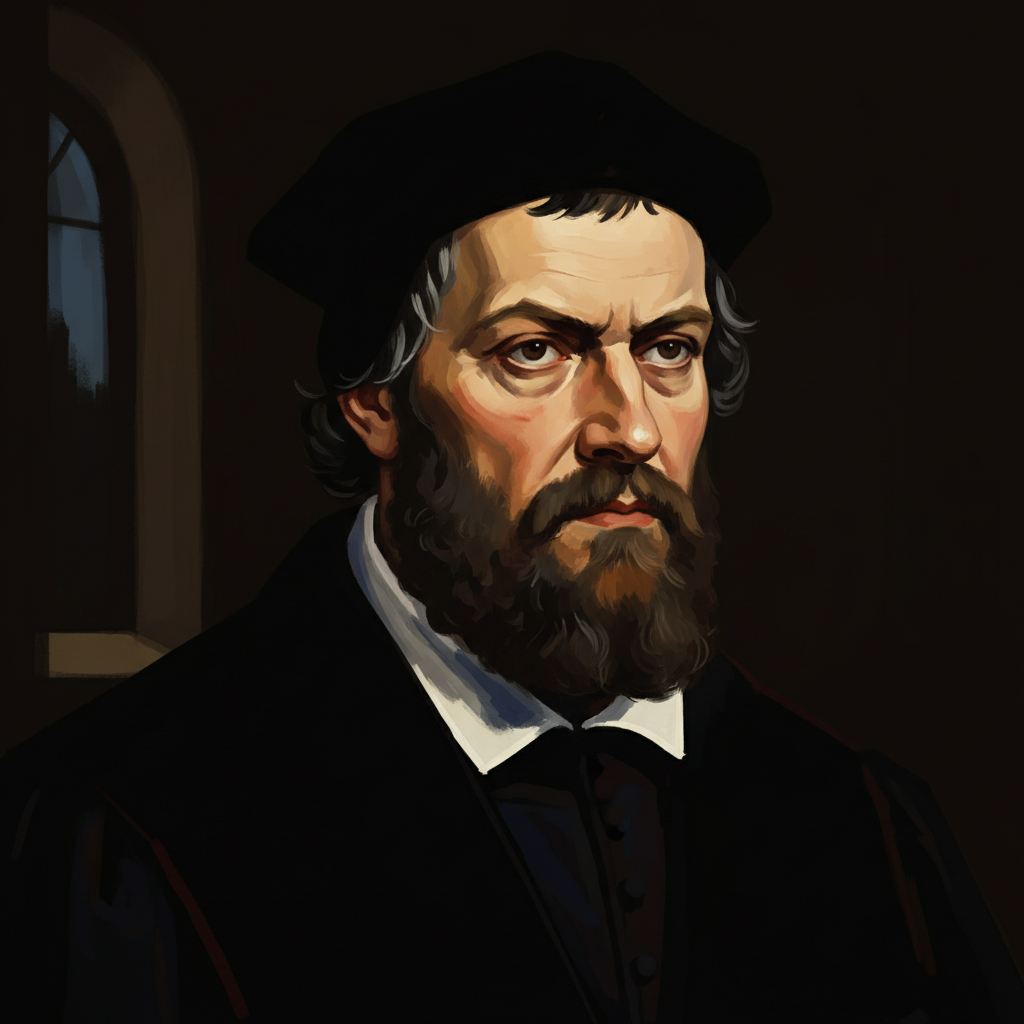
Martin Luther — "One should praise women, whether it be true or false."
One should praise women, whether it be true or false.
One should praise women, whether it be true or false.
Click any product to generate a realistic preview. Up to 3 at a time.
* Initial load can take up to 90 seconds — revising the preview in another color is nearly instant.
"Whenever the devil harasses you, seek the company of men or drink more, or joke and talk nonsense, or do some other merry thing. Sometimes we must drink more, sport, recreate ourselves, and even sin a…"
"God created the world, and he gave it to man, and he said, 'Be fruitful and multiply, and fill the earth and subdue it.'"
"What then shall we Christians do with this damned, rejected race of Jews? First, their synagogues or churches should be set on fire, and whatever does not burn up should be covered with earth and crus…"
"I am nothing but a poor, stinking bag of worms."
"Heretics are not to be disputed with, but to be condemned unheard, and whilst they perish by fire, the faithful ought to pursue the evil to its source, and bathe their heads in the blood of the Cathol…"
German theologian whose 95 Theses (1517) launched the Protestant Reformation and broke the Catholic Church's monopoly on Western Christianity. Closely associated with Philipp Melanchthon (Lutheran systematizer) and John Calvin (later Reformer who built on Luther's break). For an intellectual contrast, see Pope Leo X, Renaissance pope (1513-1521) — Leo X's indulgence sales triggered Luther's break and Leo excommunicated him in 1521 — Luther's entire Reformation is structured as a direct answer to the indulgence-funded Vatican Leo represented.
Found in 1 providers: gemini
1 source checked
Luther is giving practical advice about social grace with women: offer compliments freely, regardless of whether the praise is strictly accurate. The point is that affirmation builds goodwill and harmony, while withheld or blunt honesty creates friction. He treats flattery here less as deception and more as a kindness that smooths relationships, suggesting that generous words cost little but gain much in domestic and social peace.
Luther famously married the former nun Katharina von Bora in 1525, and his Table Talk collected blunt, often earthy remarks on marriage, women, and household life. Though a fierce theologian who challenged the Pope, he was also a pragmatic husband who valued domestic harmony. This quip reflects his conversational side: not doctrinal writing, but folk wisdom from a reformer who lived publicly as husband and father.
In early modern Europe, women's roles were tightly bound to household, marriage, and male authority, and courtly manners emphasized elaborate verbal deference. The Reformation Luther led was itself reshaping marriage, ending mandatory clerical celibacy and elevating companionate Protestant households. His recorded sayings circulated as Tischreden among students and guests, capturing the blend of theological seriousness and homey advice typical of sixteenth-century Wittenberg domestic culture.
AI-generated insights based on extensive research and information for context. Factual errors? Email [email protected].
Your cart is empty