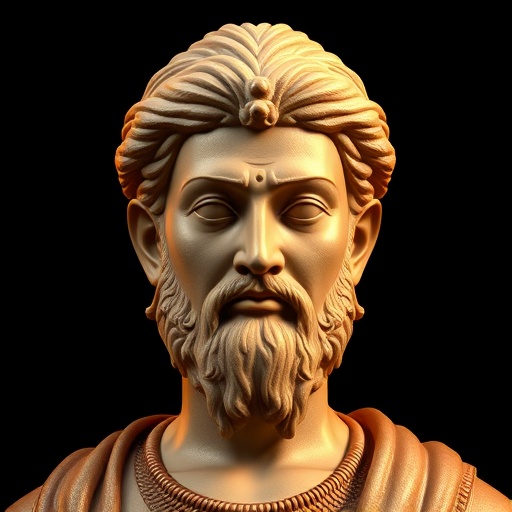
Mahavira — "One who is pure in thought, word, and deed is truly happy."
One who is pure in thought, word, and deed is truly happy.
One who is pure in thought, word, and deed is truly happy.
Click any product to generate a realistic preview. Up to 3 at a time.
* Initial load can take up to 90 seconds — revising the preview in another color is nearly instant.
"All men who are ignorant are miserable; all who are wise are happy."
"The ignorant, who are attached to the world, suffer from misery and pain."
"Do not be proud of wealth, people, relations, or youth; time takes all away in a moment."
"Do not be led by the senses, but lead the senses."
"Attachment is the root of all suffering."
24th and last Tirthankara of Jainism, whose teachings of strict ahimsa (non-violence), aparigraha (non-attachment), and karma reshaped ancient Indian religion. Closely associated with The Buddha (near-contemporary moral revolutionary, also reacting against Vedic ritualism). For an intellectual contrast, see Vedic Brahmanical ritual sacrifice, the animal-sacrifice-centered Vedic religion of his era — Mahavira's ahimsa demanded total non-violence, including not eating root vegetables that kill the plant — a maximum-distance ethical move from the Vedic priestly tradition that ritually sacrificed cattle and horses. The two cleanest poles of ancient Indian religious ethics.
Found in 1 providers: grok
1 source checked
True happiness comes from complete integrity across all three dimensions of human expression: your inner thoughts, the words you speak, and the actions you take. When these align — when you think honestly, speak truthfully, and act ethically — you experience genuine, lasting contentment. This isn't about wealth or pleasure; it's about the peace that comes from living without internal contradiction, where your private mind and public behavior are one.
Mahavira's entire ascetic life embodied this tri-fold purity. At 30, he renounced his noble title, gave up possessions and clothing, and observed strict silence for years — practicing purity in deed. His five core vows included satya (truthfulness) for word, and ahimsa (non-violence) extending to thought. Jainism's Three Jewels — right faith, right knowledge, right conduct — map directly onto this principle, making it the structural spine of everything he taught.
Mahavira lived around 599–527 BCE in the Gangetic plains during India's Axial Age — the same era as the Buddha. Vedic Brahmanism dominated, demanding animal sacrifice, rigid caste hierarchy, and priestly rituals for spiritual merit. Mahavira's insistence that purity comes from personal conduct — not birth caste or ritual — was radical and socially disruptive. His message appealed to the rising merchant class, who could achieve spiritual standing through ethical living rather than Brahmin-mediated sacrifice.
AI-generated insights based on extensive research and information for context. Factual errors? Email [email protected].
Your cart is empty