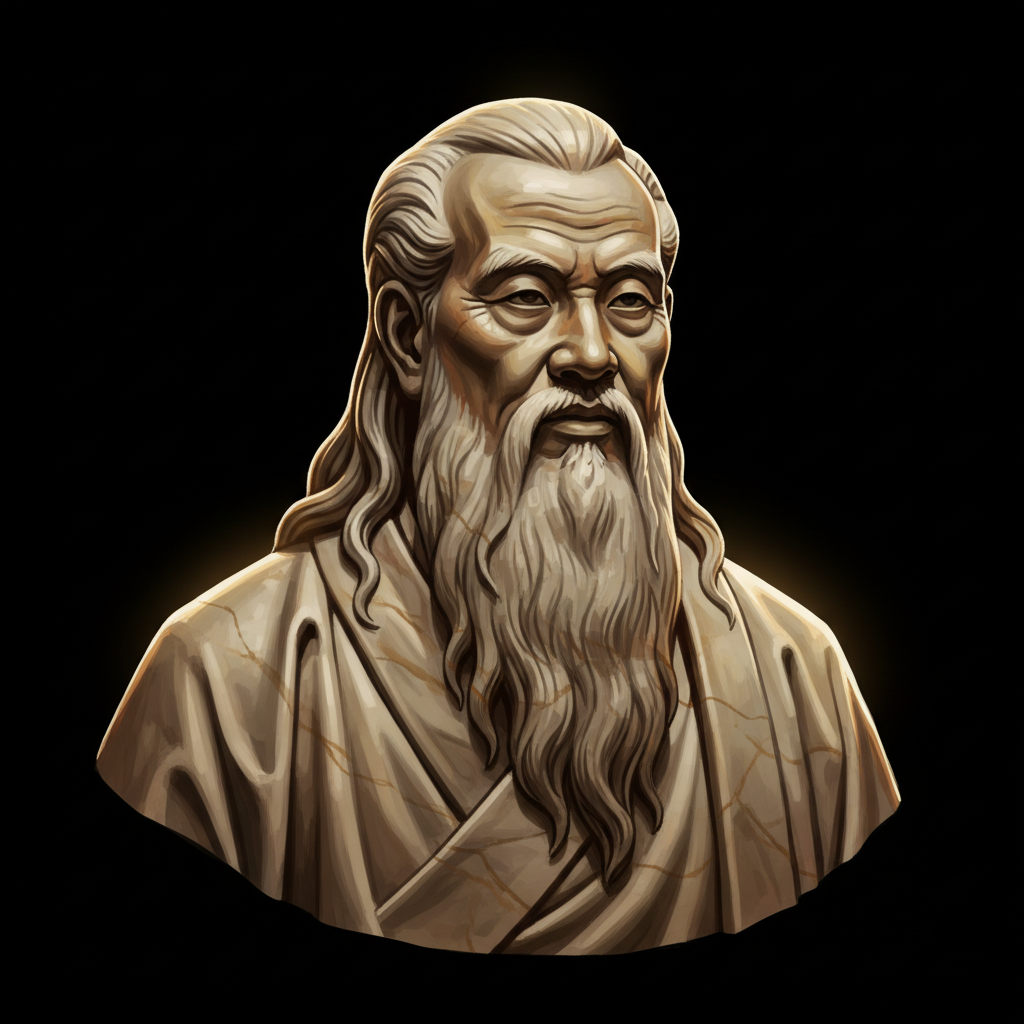
Laozi — "Simplicity, patience, compassion. These three are your greatest treasures."
Simplicity, patience, compassion. These three are your greatest treasures.
Simplicity, patience, compassion. These three are your greatest treasures.
Click any product to generate a realistic preview. Up to 3 at a time.
* Initial load can take up to 90 seconds — revising the preview in another color is nearly instant.
"The greatest villain is the one who tries to do good."
"When the world has the Tao, the swift horses are used for hauling manure. When the world is without the Tao, war horses are bred in the suburbs."
"The sage puts his person last, and it comes first. He treats his person as an outsider, and it is preserved."
"Simplicity has no name is free of desires. Being free of desires it is tranquil. And the world will be at peace of it's own accord."
"To yield is to be preserved whole. To be bent is to be straightened. To be empty is to be filled. To be worn out is to be renewed. To have little is to gain. To have plenty is to be perplexed."
Reputed founder of Taoism and author of the Tao Te Ching, whose wu wei (effortless action) shaped East Asian philosophy. Closely associated with Zhuangzi (later Taoist who extended Laozi's framework). For an intellectual contrast, see Confucius, near-contemporary Chinese sage of social ritual and duty — Confucius systematized social order through ritual and hierarchy; Laozi argued that all such systems were the disease, not the cure — the two founding poles of Chinese moral philosophy.
Found in 1 providers: grok
1 source checked
Three qualities matter most for living well. Simplicity means cutting away unnecessary wants, distractions, and complications so you can focus on what actually matters. Patience means accepting that things unfold in their own time rather than forcing outcomes. Compassion means treating others, and yourself, with genuine kindness. Together they form a practical foundation for a steady, contented life and shield you from the restlessness, frustration, and cruelty that complicate human existence.
Laozi reportedly served as a keeper of royal archives in the Zhou court, a quiet scholarly post that suited his temperament. Tradition says he grew weary of court corruption and rode west, leaving behind the Tao Te Ching at a border guard's request. The values listed here mirror his teachings throughout that text: wu wei (effortless action), returning to the uncarved block of natural simplicity, and ci, the maternal compassion he names as one of his own three treasures.
Laozi lived during the late Zhou dynasty, roughly the 6th century BCE, as central authority crumbled and rival states drifted toward the Warring States period. Philosophers competed to advise rulers on restoring order, with Confucians prescribing ritual and hierarchy and Legalists prescribing harsh law. Laozi's counter-message of simplicity, restraint, and compassion offered a quieter alternative aimed at individuals and rulers exhausted by ambition, war, and elaborate court machinery in a violent, fragmenting age.
AI-generated insights based on extensive research and information for context. Factual errors? Email [email protected].
Your cart is empty