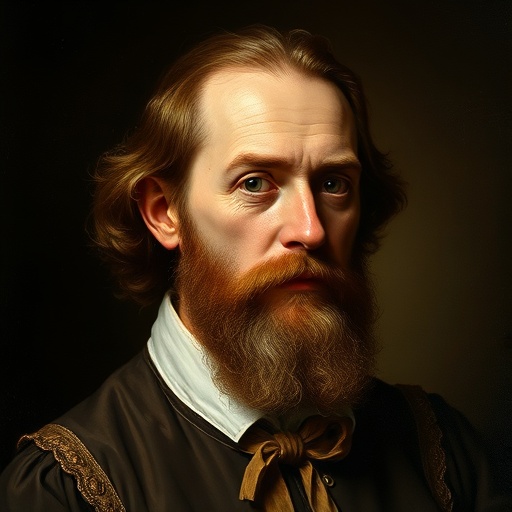
William Harvey — "The blood is the life."
The blood is the life.
The blood is the life.
Click any product to generate a realistic preview. Up to 3 at a time.
* Initial load can take up to 90 seconds — revising the preview in another color is nearly instant.
"The physician must be a philosopher, for there is not so great a difference between them."
"All we know is that the blood is in motion, but what sets it in motion is God’s secret."
"I hold that the motion of the blood is in a circle, and is constantly impelled and distributed by the pulsific action of the heart."
"The greatest happiness is to be able to understand the works of God."
"Nature is nowhere accustomed to exhibit herself more openly than in her failures."
English physician whose On the Motion of the Heart and Blood in Animals (1628) demonstrated blood circulation, overturning 1,400 years of Galenic medicine. Closely associated with Francis Bacon (his contemporary in the new English empiricism). For an intellectual contrast, see Galenic medicine, the 2nd-century Greek medical tradition (humors, blood-as-consumed-fuel) — Harvey calculated that the heart pumps more blood per hour than the body could possibly produce as fuel — a single quantitative observation that demolished the entire Galenic-Aristotelian medical worldview. The cleanest example in medical history of arithmetic disproving 14 centuries of authority.
A concise and powerful statement reflecting his central discovery.
Date: 1628 (implied by his work)
Life & DeathFound in 1 providers: gemini
1 source checked
Blood is not merely a bodily fluid but the essential substance that sustains life itself. Without it flowing, life ceases. The statement reduces biology to its most elemental truth: circulation is not incidental to life but constitutes it. It sounds simple but carries radical weight—claiming that a physical, measurable substance, not a spiritual force or humoral balance, is what keeps a living body alive.
Harvey's 1628 publication proved blood circulates continuously, pumped by the heart, overturning 1,400 years of Galenic medicine that held blood was produced in the liver and consumed by tissues. His meticulous dissections and quantitative measurements led him to see blood not symbolically but as life's literal mechanical engine. This quote is the thesis his entire career demonstrated through careful empirical experiment.
In Harvey's early modern Europe, Galen's ancient framework still dominated medicine: blood was made in the liver, consumed by organs, never recirculating. The Scientific Revolution was dismantling ancient authority through observation. Blood also carried enormous religious significance—Christ's sacrifice, transubstantiation, noble bloodlines. Harvey's era stood precisely at the crossroads where empirical science began replacing metaphysical explanations of life with measurable, physical mechanisms.
AI-generated insights based on extensive research and information for context. Factual errors? Email [email protected].
Your cart is empty