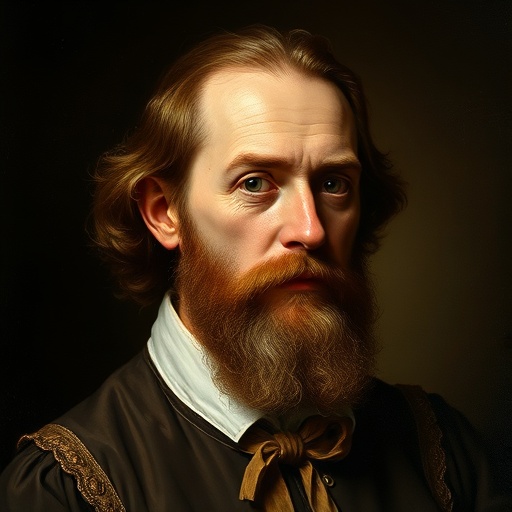
William Harvey — "The greatest happiness is to be able to understand the works of God."
The greatest happiness is to be able to understand the works of God.
The greatest happiness is to be able to understand the works of God.
Click any product to generate a realistic preview. Up to 3 at a time.
* Initial load can take up to 90 seconds — revising the preview in another color is nearly instant.
"The more accurately and industriously I have examined the matter, the more clearly have I perceived the truth."
"Only by understanding the wisdom of natural foods and their effects on the body, shall we attain mastery of disease and pain, which shall enable us to relieve the burden of mankind."
"To search for truth is to search for God."
"The body is the instrument of the soul."
"The motion of the blood is constant and circular."
English physician whose On the Motion of the Heart and Blood in Animals (1628) demonstrated blood circulation, overturning 1,400 years of Galenic medicine. Closely associated with Francis Bacon (his contemporary in the new English empiricism). For an intellectual contrast, see Galenic medicine, the 2nd-century Greek medical tradition (humors, blood-as-consumed-fuel) — Harvey calculated that the heart pumps more blood per hour than the body could possibly produce as fuel — a single quantitative observation that demolished the entire Galenic-Aristotelian medical worldview. The cleanest example in medical history of arithmetic disproving 14 centuries of authority.
An expression of joy derived from scientific and theological understanding.
Date: Uncertain (attributed)
BiblicalFound in 1 providers: gemini
1 source checked
True fulfillment comes from comprehending how the natural world operates — its mechanisms, patterns, and underlying order. Understanding creation at a deep level, rather than wealth or power, is the highest form of human satisfaction. This frames intellectual discovery as a sacred act, placing curiosity and knowledge above material pursuits or social status as the ultimate source of meaning and joy.
Harvey spent decades meticulously dissecting animals and humans to uncover how blood actually circulates — contradicting Galen's 1,400-year-old dogma. His 1628 De Motu Cordis was built purely on observation and experiment. This quote perfectly mirrors his life's driving force: understanding God's creation through rigorous empirical investigation rather than accepting inherited authority or scripture alone.
The early modern period was a battleground between religious tradition and emerging empirical science. Harvey worked during the Scientific Revolution, when Vesalius, Galileo, and Kepler were overturning ancient authorities. Framing scientific inquiry as understanding 'God's works' was both sincere and politically strategic — it made dangerous anatomical investigation acceptable to the Church by casting observation as devotion rather than heresy.
AI-generated insights based on extensive research and information for context. Factual errors? Email [email protected].
Your cart is empty