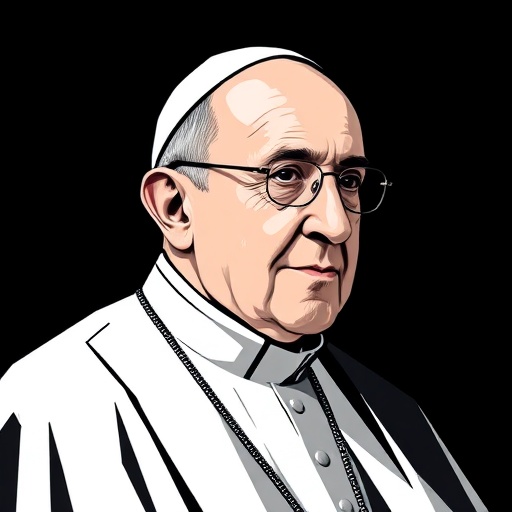
Pope Francis — "The devil exists, and he is a real person, not a myth."
The devil exists, and he is a real person, not a myth.
The devil exists, and he is a real person, not a myth.
Click any product to generate a realistic preview. Up to 3 at a time.
* Initial load can take up to 90 seconds — revising the preview in another color is nearly instant.
"A pastor who does not pray is a pastor who is in danger."
"The true power is service. The Pope must be a servant of servants."
"We must not be afraid of dialogue."
"The Church is not a supermarket. The Church is a Mother."
"I have not lost my peace. I would not know how to live without peace."
First Latin American and Jesuit pope (2013-), who has steered the Catholic Church toward pastoral inclusion on LGBTQ pastoral care, divorced Catholics, and climate. Closely associated with Pope John XXIII (the Vatican II reformer pope) and Cardinal Walter Kasper (his theological ally on pastoral reform). For an intellectual contrast, see Cardinal Raymond Burke, American traditionalist cardinal, former head of the Vatican Apostolic Signatura — Burke is the public face of Catholic traditionalism that views Francis's pastoral approach as doctrinally dangerous — he has formally challenged Amoris Laetitia and other Francis reforms.
Found in 1 providers: grok
1 source checked
The quote asserts that evil is not merely a metaphor, psychological construct, or symbol of human weakness, but an actual personal being with agency and intent. It pushes back against secular and progressive theological tendencies to reduce Satan to allegory. Francis insists evil has a source, an intelligence, a will—and treating it as myth leaves people spiritually unguarded, unable to recognize or resist genuine moral and spiritual danger in their lives.
Formed by Ignatian spirituality as a Jesuit, Francis was trained to discern spirits—including what Ignatius called the 'enemy of human nature.' He has referenced the devil throughout his papacy in homilies, interviews, and exhortations. As a reformist confronting clerical corruption, abuse scandals, and institutional inertia, Francis frames spiritual combat as inseparable from pastoral renewal. For him, naming the devil concretely isn't medieval superstition—it's the theological foundation for understanding how institutions and individuals become corrupted.
In the 21st century, secularization eroded belief in a personal devil even among practicing Catholics. Francis became pope in 2013 amid clerical abuse crises, global polarization, and declining Western religiosity. A culture that psychologizes evil and dismisses supernatural categories made his literal affirmation of Satan's existence deliberately countercultural. His statement reclaimed traditional Catholic cosmology at a moment when progressive theology often spiritualized or demythologized Scripture's adversarial figures into mere symbols of systemic injustice.
AI-generated insights based on extensive research and information for context. Factual errors? Email [email protected].
Your cart is empty