Wright Brothers (Orville & Wilbur) — "The fact that the machine has not failed in any material part is a source of gre…"
The fact that the machine has not failed in any material part is a source of great satisfaction.
The fact that the machine has not failed in any material part is a source of great satisfaction.
Click any product to generate a realistic preview. Up to 3 at a time.
* Initial load can take up to 90 seconds — revising the preview in another color is nearly instant.
"The machine has been working very nicely and we have been making several flights each day."
"The problem of flight is a problem of equilibrium."
"The machine is now a commercial success."
"I never had any particular love for the airplane. What I love is to fly."
"We were not looking for a fortune, but we were looking for a solution."
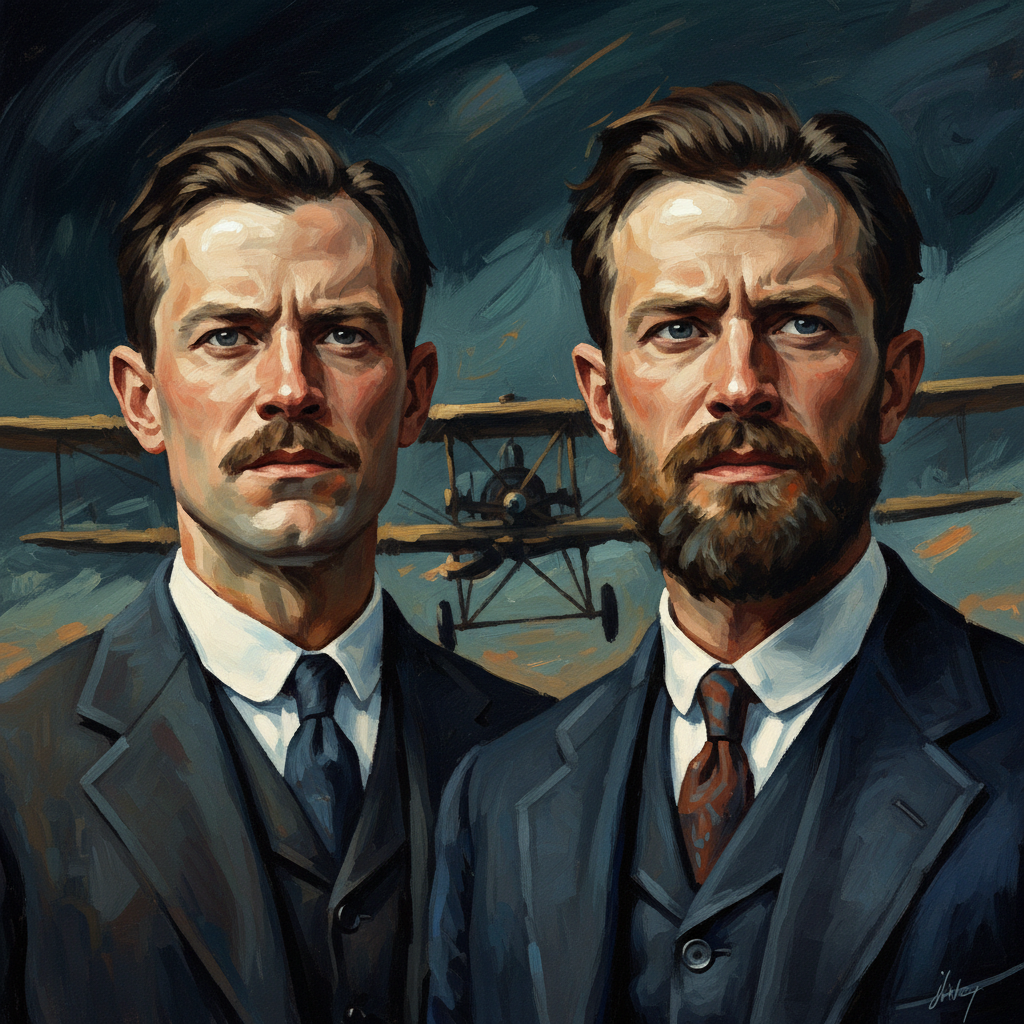
American aviation pioneers who achieved the first sustained powered controlled airplane flight at Kitty Hawk, NC, on December 17, 1903. Closely associated with Octave Chanute (their gliding mentor and aeronautical correspondent). For an intellectual contrast, see Samuel Pierpont Langley, Smithsonian Institution Secretary and government-funded aviation researcher — Langley's Aerodrome crashed twice into the Potomac in October-December 1903 with $50,000 of War Department funding; the Wright Brothers' bicycle-shop empiricism beat Langley's institutional Big Science by 9 days. The most-cited example in engineering history of empirical-tinkerer beating institution-funded credentialism.
Found in 1 providers: grok
1 source checked
When you pour everything into building something complex, the ultimate proof isn't theory—it's performance without breakdown. This captures the quiet, profound relief an engineer feels when every component holds under real conditions. It's not boasting about success; it's acknowledging that the machine itself validated the work. No part gave way. That silence—the absence of failure—is its own form of triumph, more meaningful than applause.
The Wright Brothers were bicycle mechanics turned aeronautical engineers who obsessively tested every component of their Flyer before attempting powered flight. They kept meticulous notebooks, conducted wind tunnel tests, and refined their wing-warping control system through dozens of glider trials. Reliability wasn't academic to them—a mid-air failure meant death. When the Flyer completed four flights at Kitty Hawk on December 17, 1903, holding together proved their systematic, disciplined engineering approach was sound.
In the early 1900s, mechanical failure was routine—engines seized, structures collapsed, and early aviation experiments routinely ended in disaster. Samuel Langley's government-funded Aerodrome crashed spectacularly just weeks before Kitty Hawk. Industrialization had brought complex machinery but not yet reliable engineering standards. The Wright Brothers worked without institutional backing or formal degrees, in an era when most experts declared heavier-than-air flight physically impossible. A machine that didn't fail was genuinely extraordinary.
AI-generated insights based on extensive research and information for context. Factual errors? Email [email protected].
Your cart is empty