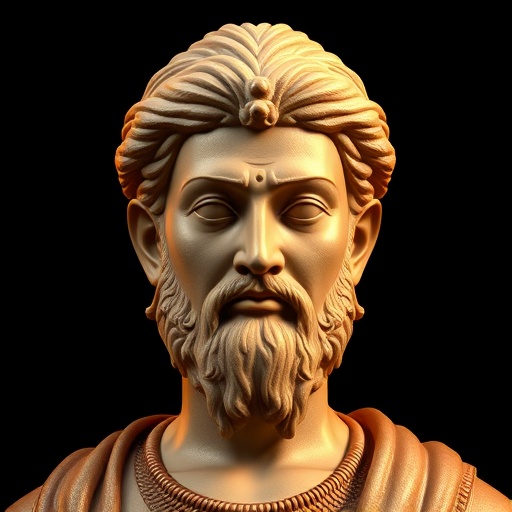
Mahavira — "The first step towards liberation is non-violence."
The first step towards liberation is non-violence.
The first step towards liberation is non-violence.
Click any product to generate a realistic preview. Up to 3 at a time.
* Initial load can take up to 90 seconds — revising the preview in another color is nearly instant.
"A man is born alone and dies alone; and he experiences the good and bad consequences of his karma alone; and he goes alone to hell or the supreme abode."
"The real spiritual path is not in rituals, but in inner purity."
"Happiness resides in perfect self-control."
"The ignorant, who are attached to the world, suffer from misery and pain."
"Control of the senses is the highest form of self-control."
24th and last Tirthankara of Jainism, whose teachings of strict ahimsa (non-violence), aparigraha (non-attachment), and karma reshaped ancient Indian religion. Closely associated with The Buddha (near-contemporary moral revolutionary, also reacting against Vedic ritualism). For an intellectual contrast, see Vedic Brahmanical ritual sacrifice, the animal-sacrifice-centered Vedic religion of his era — Mahavira's ahimsa demanded total non-violence, including not eating root vegetables that kill the plant — a maximum-distance ethical move from the Vedic priestly tradition that ritually sacrificed cattle and horses. The two cleanest poles of ancient Indian religious ethics.
Found in 1 providers: deepseek
1 source checked
True freedom—spiritual liberation from the endless cycle of rebirth—begins not with ritual or meditation but with an absolute commitment to harming no living being. Non-violence isn't passive; it demands active restraint in thought, speech, and action toward every creature. Without this foundation, all other spiritual effort is compromised. Liberation requires karmic purity, and ahimsa is the most direct way to stop accumulating the harmful karmic weight that keeps souls perpetually bound.
Mahavira abandoned royal wealth at 30 and spent 12 years as a naked wandering ascetic practicing radical ahimsa—filtering water to protect microorganisms, sweeping paths to avoid crushing insects, enduring attacks without retaliation. The Five Vows he prescribed to monks placed ahimsa first and absolute. His own liberation at 72, after decades of this discipline, made him living proof that non-violence was not merely philosophical but the actual operational mechanism of achieving moksha.
Sixth-century BCE India was dominated by Vedic Brahmanism, where priests conducted elaborate animal sacrifices as the prescribed path to divine favor and cosmic order. Mahavira's insistence that harming any creature—sacrificed ox or trampled ant—generated binding karma directly challenged this establishment. Buddhism was rising simultaneously, confirming the era's hunger for non-sacrificial spirituality, but Mahavira pushed ahimsa further than anyone: even unintentional harm carried karmic weight, making non-violence a total, uncompromising existential discipline.
AI-generated insights based on extensive research and information for context. Factual errors? Email [email protected].
Your cart is empty