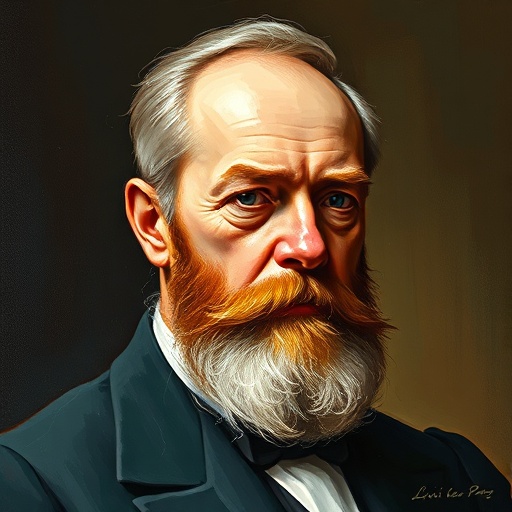
Louis Pasteur — "The future belongs to those who believe in the beauty of their dreams."
The future belongs to those who believe in the beauty of their dreams.
The future belongs to those who believe in the beauty of their dreams.
Click any product to generate a realistic preview. Up to 3 at a time.
* Initial load can take up to 90 seconds — revising the preview in another color is nearly instant.
"A bottle of wine contains more philosophy than all the books in the world."
"I owe everything to my wife, who has always encouraged me and shared my enthusiasm."
"The more I learn, the more I realize how much I don't know."
"I am utterly convinced that there is a germ for every disease."
"Science knows no country, because knowledge belongs to humanity, and is the torch which illuminates the world."
Often attributed to Eleanor Roosevelt, but occasionally to Pasteur, likely misattribution.
Date: Late 19th Century (approx.)
InspirationalFound in 1 providers: grok
1 source checked
Tomorrow rewards people who genuinely trust their own visions and aspirations. Holding firm conviction in what you imagine for yourself isn't naive optimism—it's the engine that drives real achievement. Those who dismiss their dreams as foolish surrender the future to others. Faith in possibility, paired with the willingness to act on it, determines who shapes what comes next and who simply watches it unfold.
Pasteur built his career chasing ideas mainstream science mocked—invisible microbes causing disease, heat-treating wine to prevent spoilage, injecting weakened pathogens to confer immunity. He faced fierce opposition from established physicians who rejected germ theory. His successful 1885 rabies vaccine on young Joseph Meister required believing in a treatment never tried on humans. His career proves dreams pursued with rigor reshape reality.
Pasteur worked during the 19th century scientific revolution, when miasma theory still dominated medicine and surgeons operated with unwashed hands. France was recovering from the Franco-Prussian War, industrializing rapidly, and wrestling between religious tradition and emerging science. Disease killed children routinely; childbed fever decimated maternity wards. Visionary thinking was transforming chemistry, biology, and public health, but entrenched institutions resisted every breakthrough that contradicted centuries of accepted wisdom.
AI-generated insights based on extensive research and information for context. Factual errors? Email [email protected].
Your cart is empty