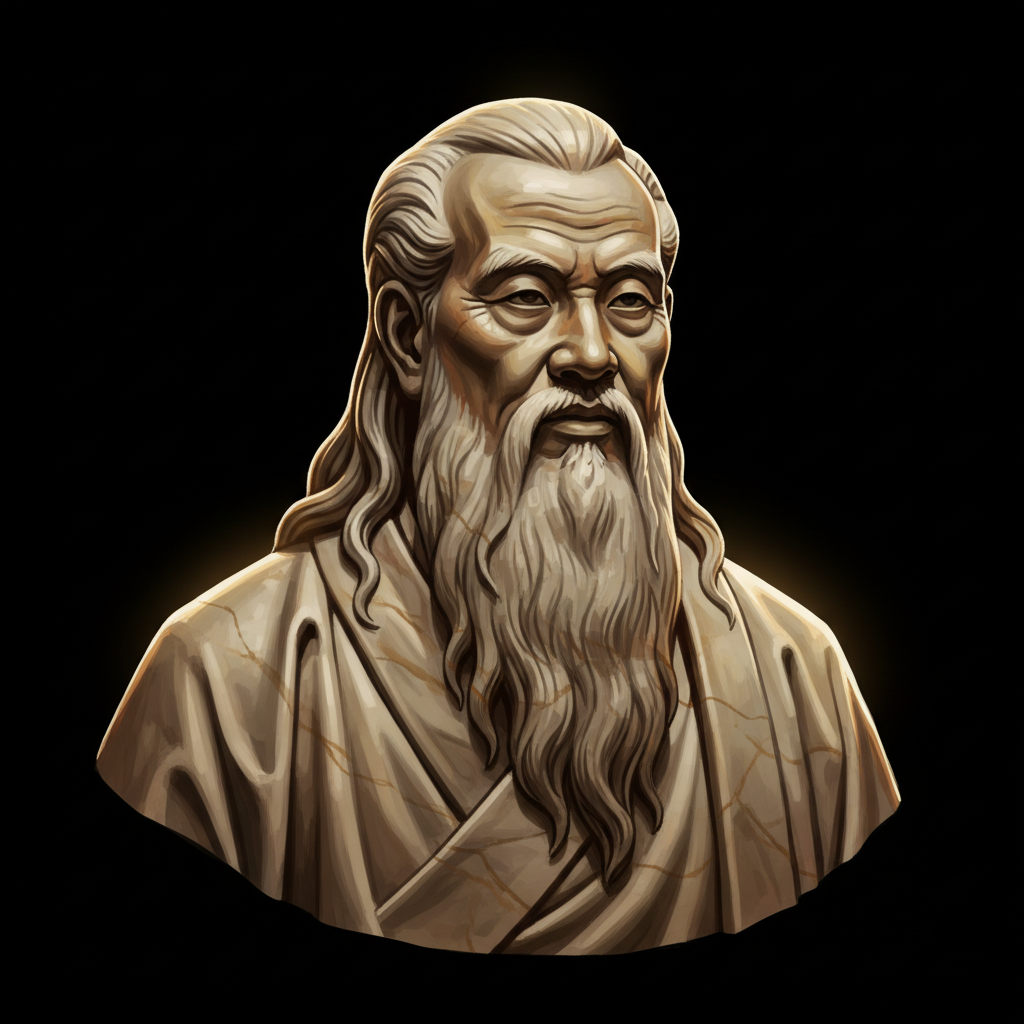
Laozi — "The greatest good is like water. Water benefits all things and does not contend."
The greatest good is like water. Water benefits all things and does not contend.
The greatest good is like water. Water benefits all things and does not contend.
Click any product to generate a realistic preview. Up to 3 at a time.
* Initial load can take up to 90 seconds — revising the preview in another color is nearly instant.
"The greatest victory is that which requires no battle."
"The sage is always without ambition."
"All things in the world come from being. And being comes from non-being."
"Governing a large country is like cooking a small fish. Too much handling will spoil it."
"When you are content to be simply yourself and don't compare or compete, everyone will respect you."
Reputed founder of Taoism and author of the Tao Te Ching, whose wu wei (effortless action) shaped East Asian philosophy. Closely associated with Zhuangzi (later Taoist who extended Laozi's framework). For an intellectual contrast, see Confucius, near-contemporary Chinese sage of social ritual and duty — Confucius systematized social order through ritual and hierarchy; Laozi argued that all such systems were the disease, not the cure — the two founding poles of Chinese moral philosophy.
Found in 1 providers: grok
1 source checked
True virtue works like water: it nourishes everything it touches, flows to the lowest places others avoid, and never fights for recognition or position. The highest form of goodness is quiet, humble service that benefits all without seeking credit, reward, or dominance. Rather than competing or asserting itself, it achieves its purpose through yielding, adaptability, and presence. Real greatness is measured by what you give freely, not by what you win.
Laozi preached wu wei, effortless action that accomplishes through non-striving, and this water metaphor is its clearest expression. As a reclusive archivist who reportedly withdrew from court life to avoid political contention, he embodied the yielding, low-seeking quality he praises here. His Tao Te Ching repeatedly returns to water, valleys, and emptiness as images of the Tao, rejecting the Confucian emphasis on hierarchy, striving, and public achievement in favor of quiet, receptive power.
Laozi lived during the turbulent late Zhou period, when rival states fought constantly and philosophers competed to advise ambitious rulers on conquest, ritual, and power. Confucians pushed active moral engagement and strict social roles; Legalists pushed harsh law and force. Against this backdrop of striving and contention, Laozi's praise of water, humility, and non-contention was a radical counter-vision, offering exhausted officials and commoners a path of retreat, simplicity, and harmony with nature rather than ceaseless political struggle.
AI-generated insights based on extensive research and information for context. Factual errors? Email [email protected].
Your cart is empty