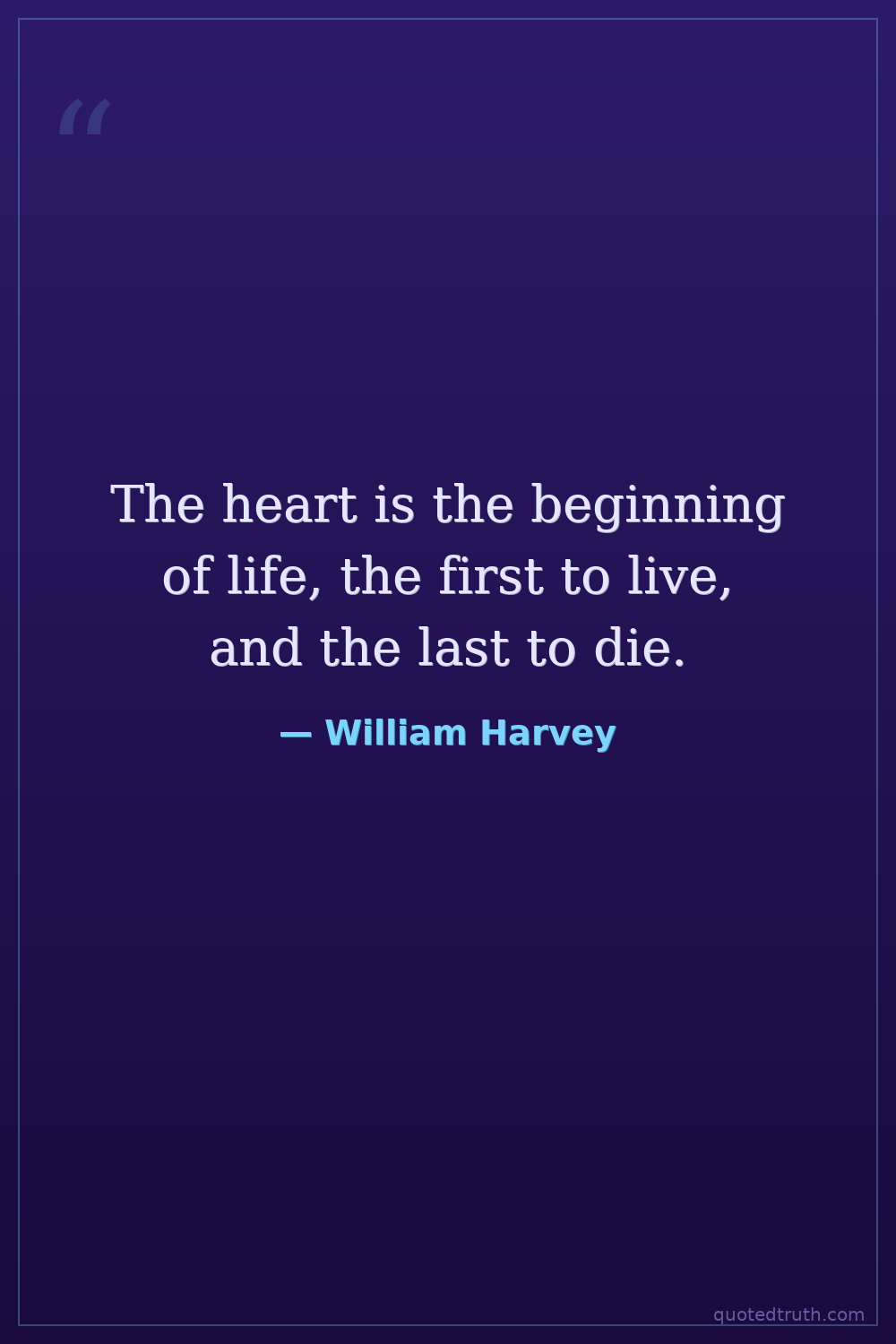
William Harvey — "The heart is the beginning of life, the first to live, and the last to die."
The heart is the beginning of life, the first to live, and the last to die.
The heart is the beginning of life, the first to live, and the last to die.
Click any product to generate a realistic preview. Up to 3 at a time.
* Initial load can take up to 90 seconds — revising the preview in another color is nearly instant.
"The motion of the blood is constant and circular."
"The greatest pleasure is to be found in the contemplation of truth."
"The body is a microcosm of the universe."
"Man comes into the world naked and unarmed, as if nature had destined him for a social creature, and ordained him to live under equitable laws and in peace..."
"The body is a machine, but it is a divine machine."
English physician whose On the Motion of the Heart and Blood in Animals (1628) demonstrated blood circulation, overturning 1,400 years of Galenic medicine. Closely associated with Francis Bacon (his contemporary in the new English empiricism). For an intellectual contrast, see Galenic medicine, the 2nd-century Greek medical tradition (humors, blood-as-consumed-fuel) — Harvey calculated that the heart pumps more blood per hour than the body could possibly produce as fuel — a single quantitative observation that demolished the entire Galenic-Aristotelian medical worldview. The cleanest example in medical history of arithmetic disproving 14 centuries of authority.
Found in 1 providers: grok
1 source checked
The heart is the most fundamental organ of life — it starts beating before most other organs develop and continues until the very moment of death. Everything else depends on it. This isn't metaphorical; it's anatomical. The heart drives blood through the body, delivering oxygen and nutrients, and when it stops, life ends. It's the engine of biological existence, both temporally first and last in the sequence of living.
Harvey proved in 1628 — publishing De Motu Cordis — that blood circulates continuously, powered by the heart as a mechanical pump, overturning Galen's fourteen-hundred-year-old model. He spent years dissecting animals and observing beating hearts in living creatures and embryos. This quote reflects his empirical conviction: the heart wasn't symbolic but a literal biological engine. His own observations of hearts stopping at death and starting earliest in developing embryos directly shaped this statement.
Harvey worked in early seventeenth-century Europe during the Scientific Revolution, when Galenic medicine — holding that blood was consumed rather than circulated — had dominated for over a millennium. The Church linked the heart to the soul, not mechanics. Harvey's empirical, observation-based methods challenged both ancient authority and religious tradition. His era saw Galileo face persecution for overturning dogma. Asserting the heart as a purely biological, mechanical first principle was scientifically and philosophically radical.
AI-generated insights based on extensive research and information for context. Factual errors? Email [email protected].
Your cart is empty