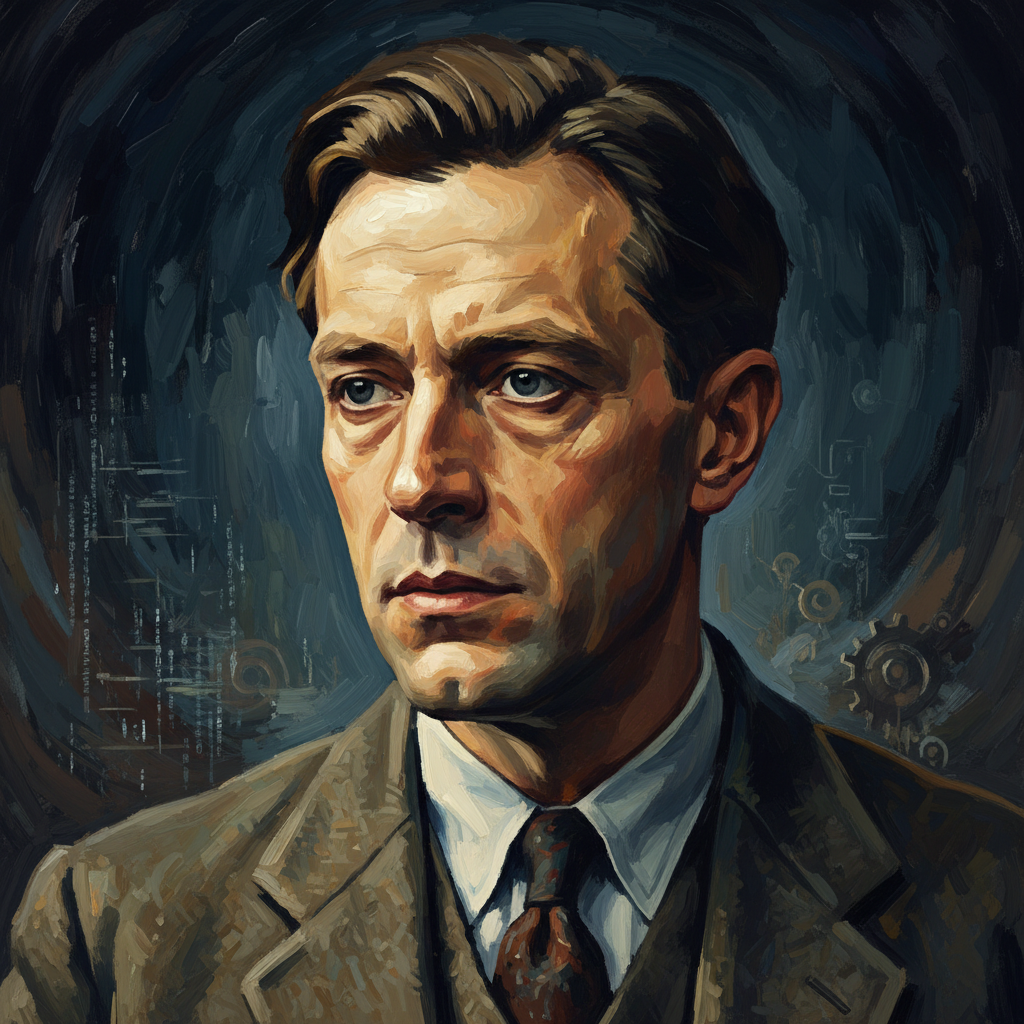
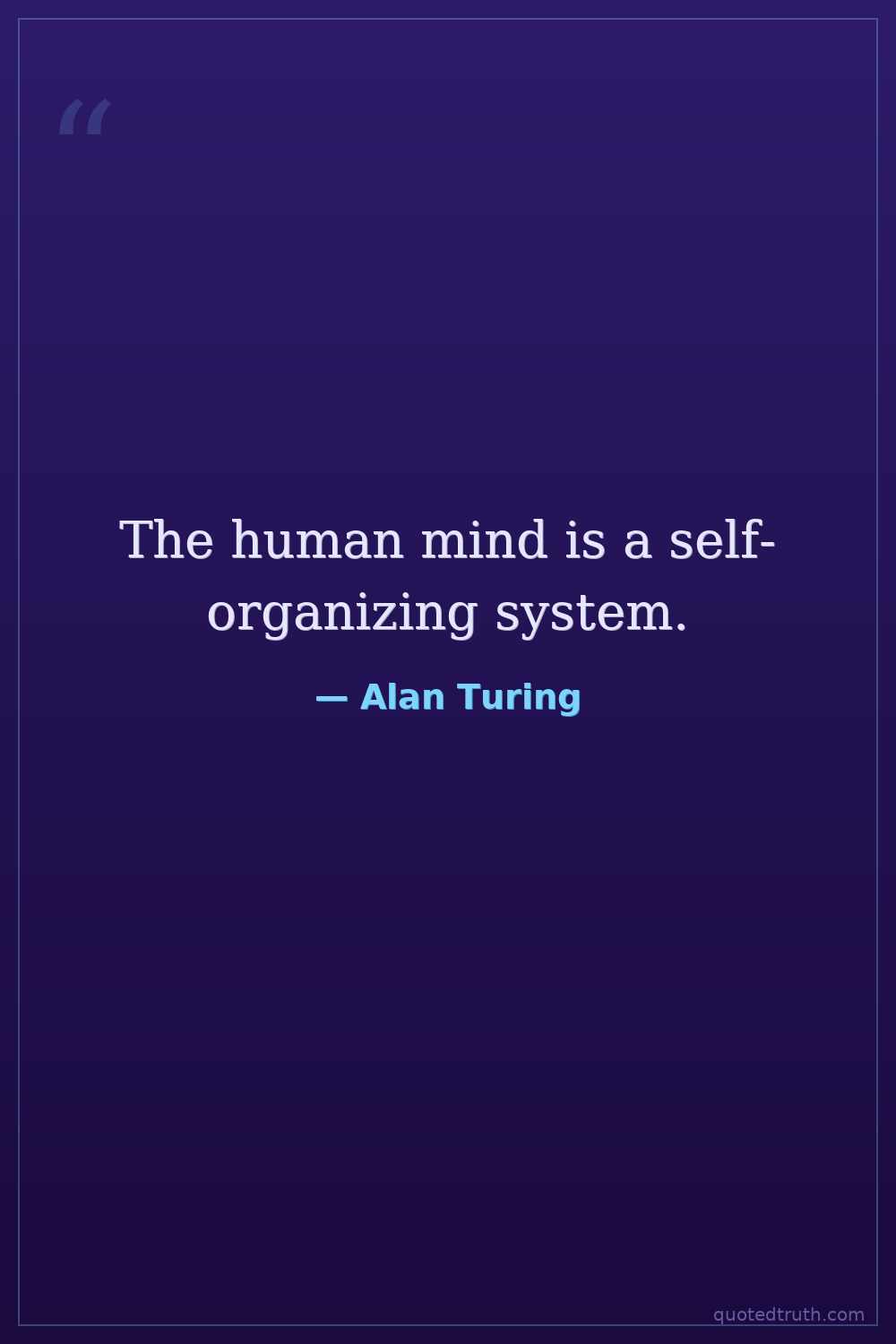
Alan Turing — "The human mind is a self-organizing system."
The human mind is a self-organizing system.
The human mind is a self-organizing system.
Click any product to generate a realistic preview. Up to 3 at a time.
* Initial load can take up to 90 seconds — revising the preview in another color is nearly instant.
"The imitation game is a test of intelligence, not a test of consciousness."
"No, I'm not interested in developing a powerful brain. All I'm interested in is a moderately trained brain. The kind that would be useful in daily life."
"The human intellect is a very powerful thing, but it has its limitations."
"I believe that in about fifty years' time it will be possible to programme computers, with a storage capacity of about 10^9, to make them play the imitation game so well that an average interrogator w…"
"Mathematics, rightly viewed, possesses not only truth, but supreme beauty—a beauty cold and austere, like that of sculpture, without appeal to any part of our weaker nature, without the gorgeous trapp…"
Found in 1 providers: grok
1 source checked
The mind isn't programmed from outside — it builds itself. Intelligence emerges through internal processes: the brain encounters raw experience, finds patterns, and restructures itself without needing a central designer or rigid instruction set. Complexity arises from simple rules interacting over time. This anticipates concepts like neural plasticity, emergent behavior, and machine learning — where sophisticated understanding grows from the bottom up rather than being hardcoded in advance.
Turing spent his career asking whether machines could replicate thought. His 1950 paper introduced the Turing Test, probing the boundary between human and artificial intelligence. He studied morphogenesis — how biological patterns self-organize from chemical reactions — applying the same logic to living systems. His theoretical unorganized machines could learn and rewire themselves. Believing the brain followed discoverable rules, Turing saw self-organization not as mystery but as mechanism waiting to be understood and engineered.
Turing worked in the 1940s–50s when behaviorism dominated psychology, treating the mind as a stimulus-response black box. Early computers like Colossus and ENIAC raised urgent questions about machine cognition. Norbert Wiener's cybernetics in 1948 explored feedback and self-regulation in systems. Cold War pressure accelerated computing research. Against a backdrop of rigid, top-down mechanistic thinking, the notion that minds self-organize was radical — suggesting intelligence was emergent, not designed from above.
AI-generated insights based on extensive research and information for context. Factual errors? Email [email protected].
Your cart is empty