What it means
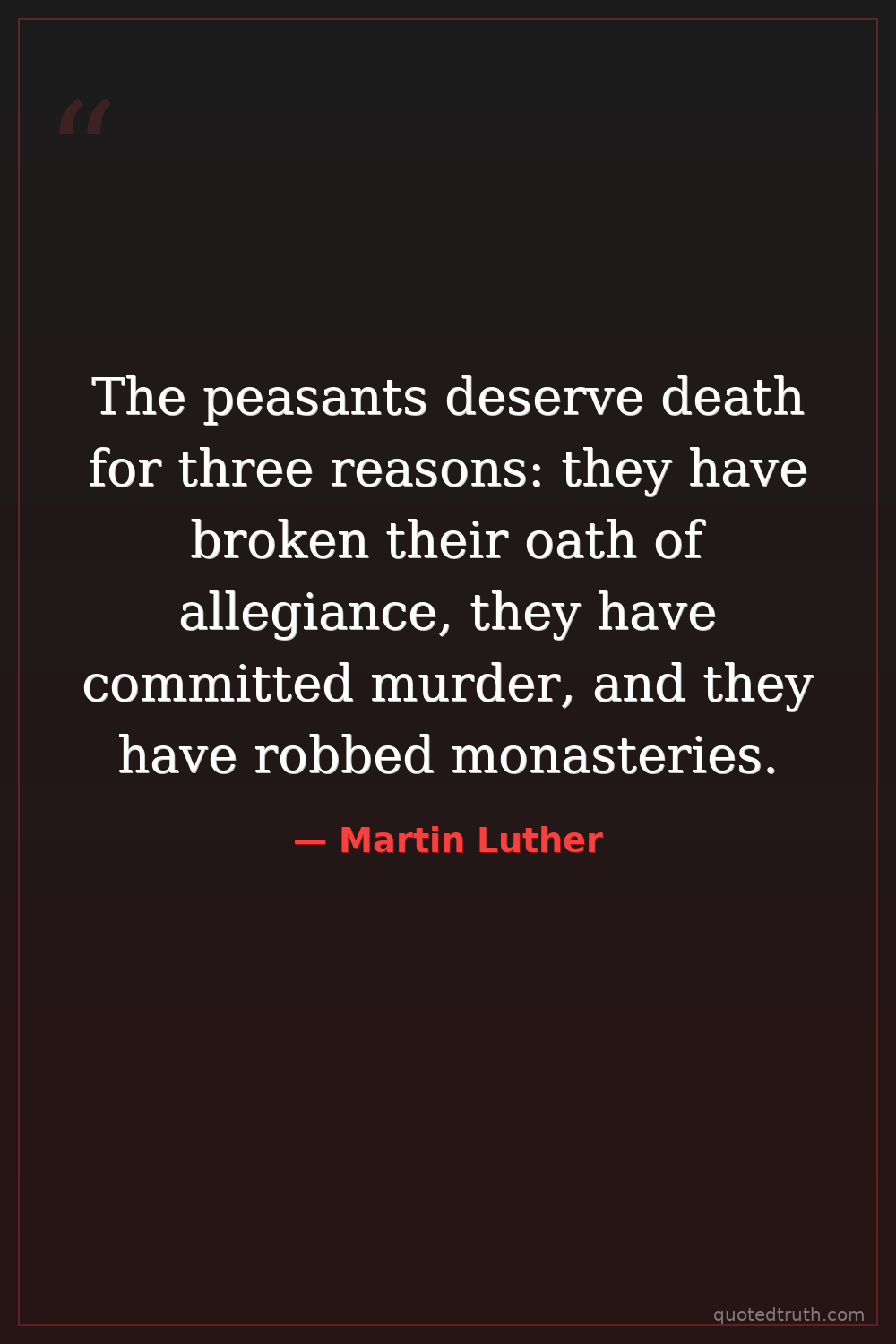
Luther argues that rebelling peasants deserve capital punishment on three grounds: betraying sworn loyalty to their rulers, killing during the uprising, and plundering church property. He frames their execution not as cruelty but as justice, insisting each offense individually warrants death. The statement is a blunt endorsement of state violence against the rebels, stripping away sympathy and casting them as criminals whose crimes are religious, civil, and moral all at once.
Relevance to Martin Luther
Luther wrote this in his notorious 1525 tract Against the Murderous, Thieving Hordes of Peasants, issued during the German Peasants' War. Though his earlier theology of Christian freedom helped inspire the revolt, Luther sided violently with the princes who protected his Reformation. The passage exposes his deep commitment to temporal authority, his reading of Romans 13, and his willingness to sanction bloodshed to preserve social order and his movement's political patrons.
The era
The 1524–1525 Peasants' War was the largest popular uprising in Europe before the French Revolution, with roughly 100,000 peasants killed. Inspired partly by Reformation rhetoric about spiritual equality, peasants demanded relief from serfdom, tithes, and feudal dues. Princes, nobles, and reformers faced a choice between the rebels and the establishment. Luther's endorsement of suppression helped cement the Reformation as a prince-led movement, shaping early modern Europe's fusion of religious reform with state power.
AI-generated insights based on extensive research and information for context. Factual errors? Email [email protected].