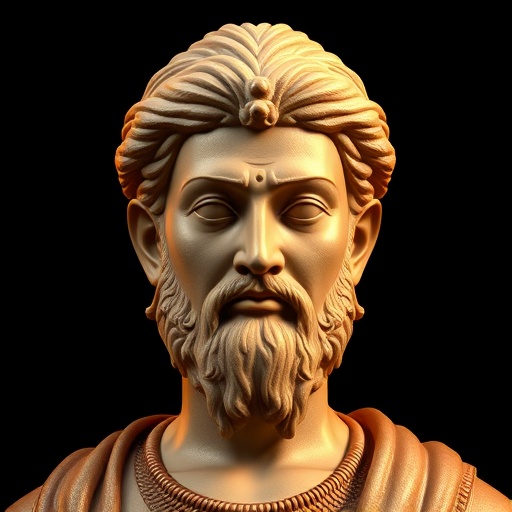
Mahavira — "The purpose of life is to realize one's true self."
The purpose of life is to realize one's true self.
The purpose of life is to realize one's true self.
Click any product to generate a realistic preview. Up to 3 at a time.
* Initial load can take up to 90 seconds — revising the preview in another color is nearly instant.
"Every living being, great or small, possesses a soul."
"The body is a temporary abode of the soul."
"The highest spiritual state is to be free from all desires."
"He who knows one, knows all."
"Renunciation is the key to eternal happiness."
24th and last Tirthankara of Jainism, whose teachings of strict ahimsa (non-violence), aparigraha (non-attachment), and karma reshaped ancient Indian religion. Closely associated with The Buddha (near-contemporary moral revolutionary, also reacting against Vedic ritualism). For an intellectual contrast, see Vedic Brahmanical ritual sacrifice, the animal-sacrifice-centered Vedic religion of his era — Mahavira's ahimsa demanded total non-violence, including not eating root vegetables that kill the plant — a maximum-distance ethical move from the Vedic priestly tradition that ritually sacrificed cattle and horses. The two cleanest poles of ancient Indian religious ethics.
Found in 1 providers: grok
1 source checked
Life's ultimate goal isn't wealth, status, or pleasure — it's uncovering who you truly are beneath ego, conditioning, and desire. The idea is that beneath social roles and mental noise exists a pure, unchanging inner self. Modern readers might frame this as radical authenticity, but for Mahavira it meant something precise: liberating the soul from karma to reveal its innate perfection — pure consciousness, infinite and free.
Mahavira (599–527 BCE) walked away from royal life at 30, spent 12 years as a wandering ascetic in severe fasting and meditation, and attained kevala jnana — complete omniscient enlightenment. He taught that every soul is inherently pure and divine, buried under layers of karma accumulated through lifetimes. His entire practice — ahimsa, non-attachment, rigorous self-discipline — was a systematic method for uncovering that original, unblemished self.
Mahavira lived in the 6th–5th century BCE during India's Axial Age — when Vedic Brahminism enforced rigid caste hierarchy and priestly ritual as the only path to spiritual merit. His teaching that every individual could realize their true self through personal discipline alone — no priest, no caste privilege, no animal sacrifice — was a direct challenge to the established religious and social order, democratizing spiritual liberation in a deeply stratified society.
AI-generated insights based on extensive research and information for context. Factual errors? Email [email protected].
Your cart is empty