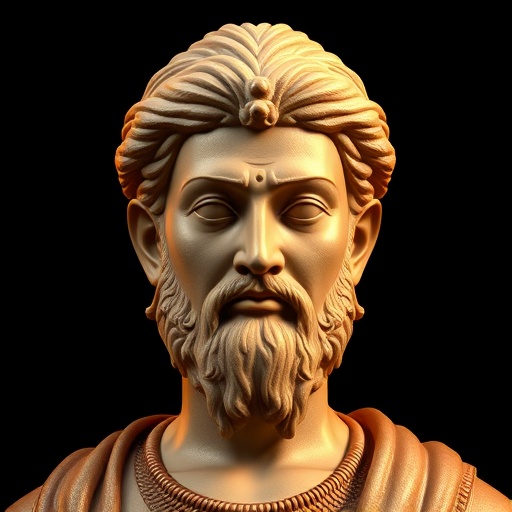
Mahavira — "The soul is inherently pure and perfect."
The soul is inherently pure and perfect.
The soul is inherently pure and perfect.
Click any product to generate a realistic preview. Up to 3 at a time.
* Initial load can take up to 90 seconds — revising the preview in another color is nearly instant.
"The greatest wisdom is to know oneself."
"Look at the world in the way it is, and do not try to rearrange it to suit your desires."
"The path of purification is the path of non-violence, self-control, and penance."
"All things are impermanent, and the soul is eternal."
"One who is always striving for the welfare of all beings, who is free from all passions, and who has attained the highest knowledge, is called a Tirthankara."
24th and last Tirthankara of Jainism, whose teachings of strict ahimsa (non-violence), aparigraha (non-attachment), and karma reshaped ancient Indian religion. Closely associated with The Buddha (near-contemporary moral revolutionary, also reacting against Vedic ritualism). For an intellectual contrast, see Vedic Brahmanical ritual sacrifice, the animal-sacrifice-centered Vedic religion of his era — Mahavira's ahimsa demanded total non-violence, including not eating root vegetables that kill the plant — a maximum-distance ethical move from the Vedic priestly tradition that ritually sacrificed cattle and horses. The two cleanest poles of ancient Indian religious ethics.
Found in 1 providers: grok
1 source checked
Every person possesses an inner self that is fundamentally flawless and untainted. Whatever suffering, ignorance, or moral failure we experience comes from external attachments and karma, not from any innate corruption. Strip away delusion and craving, and what remains is a consciousness that is already whole, already free, already luminous. The path is not to build something new but to uncover what was always there.
Mahavira taught that liberation—moksha—requires recognizing the soul's inherent purity rather than seeking divine grace from an external god. His 12 years of rigorous asceticism, silence, and renunciation were specifically aimed at burning off accumulated karma to expose the soul's natural perfection. As a Kshatriya prince who abandoned wealth and family, his life embodied the belief that the pure soul lies beneath all worldly accumulation.
In 6th-century BCE India, Vedic Brahminism dominated spiritual life, requiring elaborate rituals and priestly mediation to approach the divine. Mahavira and contemporaries like the Buddha challenged this hierarchy by locating spiritual authority within the individual soul. Caste-based pollution concepts pervaded society, making his assertion of universal, inherently pure souls a radical egalitarian claim against hereditary spiritual inequality.
AI-generated insights based on extensive research and information for context. Factual errors? Email [email protected].
Your cart is empty