Laozi — "The Tao never does anything, yet through it all things are done."
The Tao never does anything, yet through it all things are done.
The Tao never does anything, yet through it all things are done.
Click any product to generate a realistic preview. Up to 3 at a time.
* Initial load can take up to 90 seconds — revising the preview in another color is nearly instant.
"The Tao is always nameless. When it is carved, it becomes names. As soon as there are names, know that it is time to stop. Knowing when to stop, one can be free from danger."
"The sage governs by emptying senses and filling bellies."
"The Sage manages affairs without doing anything, and spreads doctrines without speaking."
"The heaviest thing in the world is a human heart."
"Therefore the sage holds to the one and becomes a model for the world. He does not display himself; therefore he shines. He does not assert himself; therefore he is known. He does not boast; therefore…"
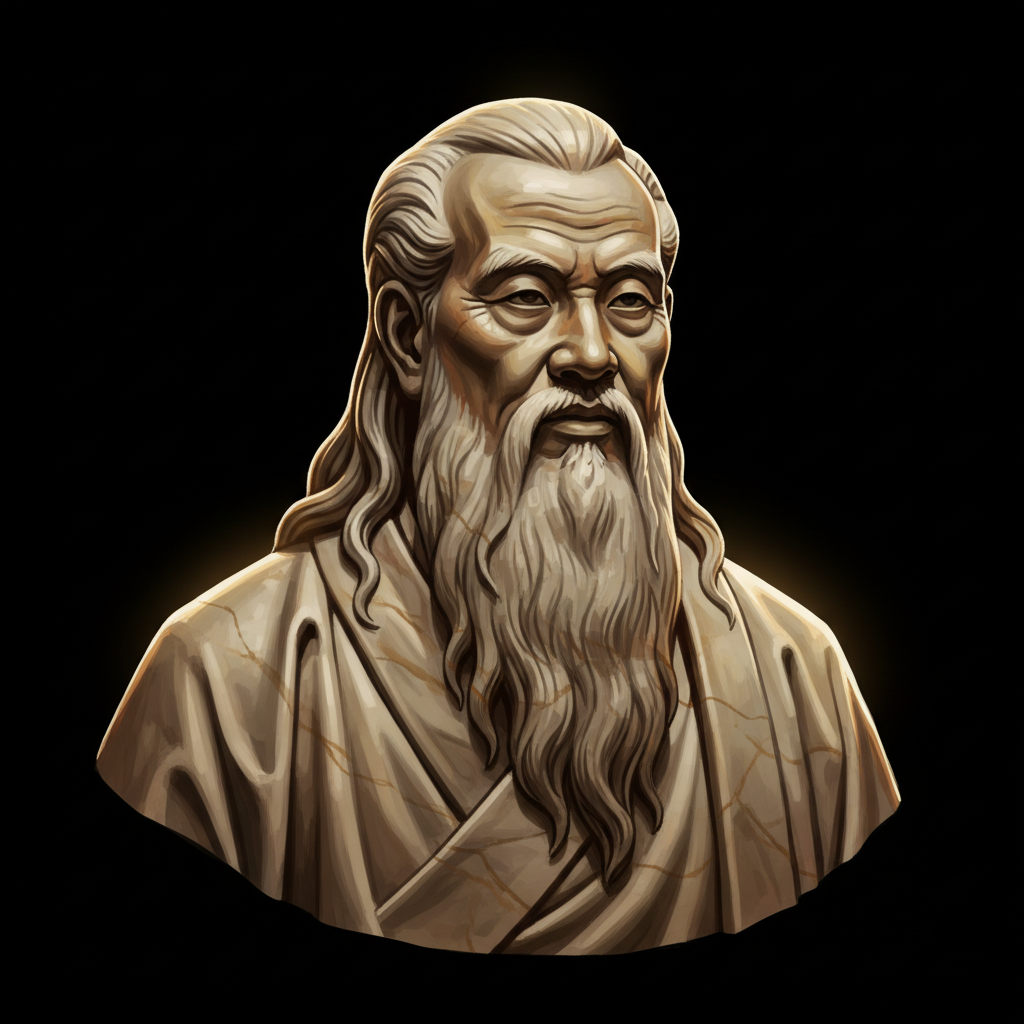
Reputed founder of Taoism and author of the Tao Te Ching, whose wu wei (effortless action) shaped East Asian philosophy. Closely associated with Zhuangzi (later Taoist who extended Laozi's framework). For an intellectual contrast, see Confucius, near-contemporary Chinese sage of social ritual and duty — Confucius systematized social order through ritual and hierarchy; Laozi argued that all such systems were the disease, not the cure — the two founding poles of Chinese moral philosophy.
Found in 1 providers: grok
1 source checked
Reality operates through a fundamental principle that never forces or strives, yet everything gets accomplished through it. Things unfold naturally when we stop interfering. The deepest power works invisibly, without effort or announcement. What looks like doing nothing is actually the source of all doing. Real effectiveness comes from alignment with how things naturally move, not from pushing against them or imposing human will on situations.
Laozi built his entire philosophy around wu wei, or effortless action, which this saying captures exactly. As the legendary founder of Taoism and reputed keeper of the Zhou royal archives, he observed how bureaucratic striving produced worse outcomes than patient non-interference. Legend says he left civilization disillusioned with forced order, dictating the Tao Te Ching at a border pass. The idea that cosmic power works through yielding, not asserting, defines his worldview.
Laozi lived during the chaotic late Zhou dynasty, roughly the 6th century BCE, when feudal states fought constantly and rulers demanded ever more elaborate rituals, laws, and military campaigns. Scholars peddled competing prescriptions for fixing society through stricter control. Against this backdrop of frantic intervention, suggesting that the highest force accomplishes everything by doing nothing was radical. It directly challenged Confucian emphasis on active moral engineering and offered exhausted people a countercultural path.
AI-generated insights based on extensive research and information for context. Factual errors? Email [email protected].
Your cart is empty