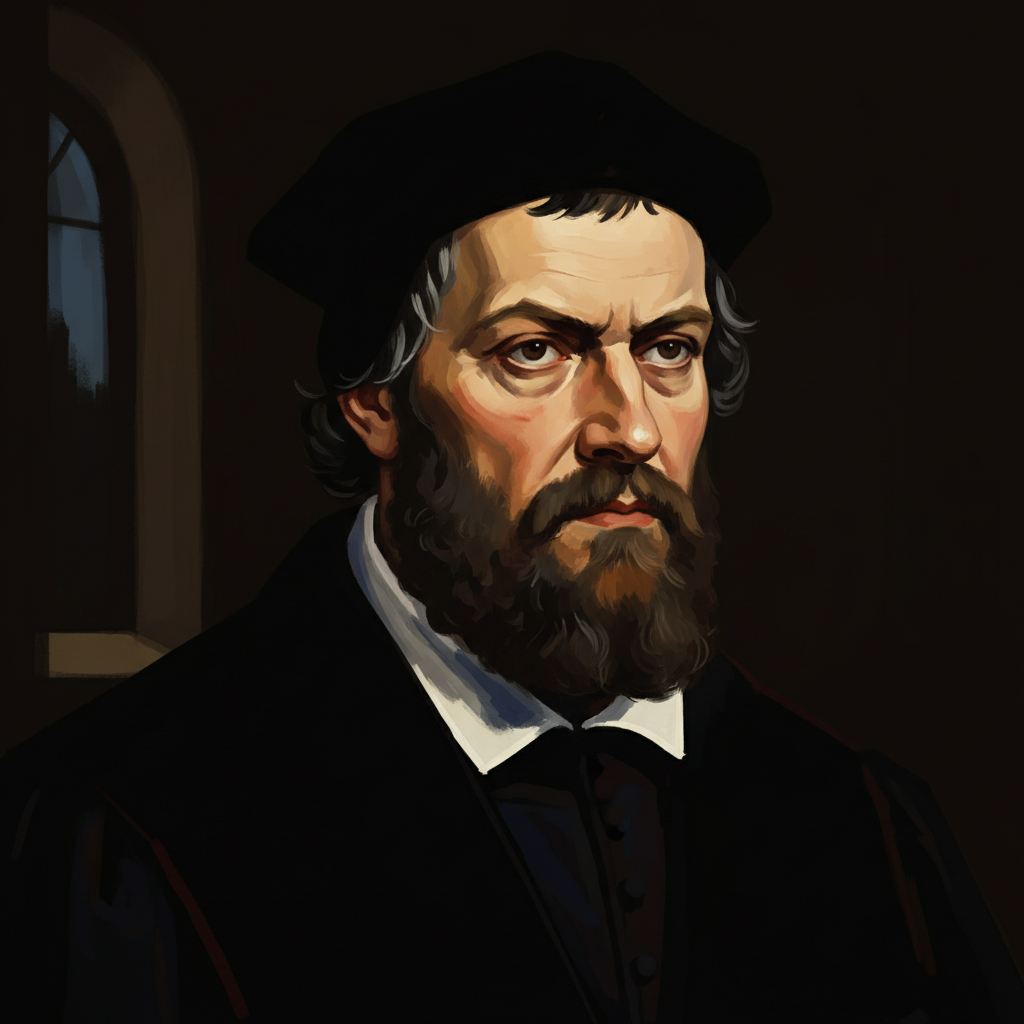
Martin Luther — "The woman is like a nail, driven into the wall. . . . She sits at home."
The woman is like a nail, driven into the wall. . . . She sits at home.
The woman is like a nail, driven into the wall. . . . She sits at home.
Click any product to generate a realistic preview. Up to 3 at a time.
* Initial load can take up to 90 seconds — revising the preview in another color is nearly instant.
"Printing is the ultimate gift of God and the greatest one. Indeed, the invention of printing is the work of God."
"I have had many struggles with the devil, and I know him well."
"The papacy is the kingdom of the devil, and the pope is the Antichrist."
"Whoever smells it first, out of him it crept."
"I resist the devil, and often it is with a fart that I chase him away. When he tempts me with silly sins I say, 'Devil, yesterday I broke wind too. Have you written it down on your list?'"
German theologian whose 95 Theses (1517) launched the Protestant Reformation and broke the Catholic Church's monopoly on Western Christianity. Closely associated with Philipp Melanchthon (Lutheran systematizer) and John Calvin (later Reformer who built on Luther's break). For an intellectual contrast, see Pope Leo X, Renaissance pope (1513-1521) — Leo X's indulgence sales triggered Luther's break and Leo excommunicated him in 1521 — Luther's entire Reformation is structured as a direct answer to the indulgence-funded Vatican Leo represented.
Found in 1 providers: gemini
1 source checked
This saying compares a woman to a nail hammered into a wall—fixed in place, immobile, and defined by her location rather than her movement. The point is that a woman's proper position is inside the home, staying put while life happens around her. She is not meant to travel, work publicly, or roam; her value comes from being anchored to the household, serving the family from that stationary domestic position.
Luther, a former Augustinian monk who married the ex-nun Katharina von Bora in 1525, wrote extensively on marriage and household order. Though he elevated marriage as a holy calling against Catholic celibacy, he held firmly patriarchal views rooted in his reading of Genesis and Pauline letters. His Table Talk and sermons repeatedly assigned wives to childbearing, cooking, and household management, while husbands governed public and spiritual life—a division he considered divinely ordained.
In early modern Germany of the 1500s, women's legal identity was absorbed into their husband's under coverture-style customs. The Reformation closed convents, removing one of the few paths outside marriage, and Luther's teachings helped cement the bourgeois household as women's near-exclusive sphere. Amid peasant revolts, plague, and religious war, stable patriarchal homes were seen as society's foundation, and preachers across confessions reinforced domestic confinement as both godly and socially necessary.
AI-generated insights based on extensive research and information for context. Factual errors? Email [email protected].
Your cart is empty