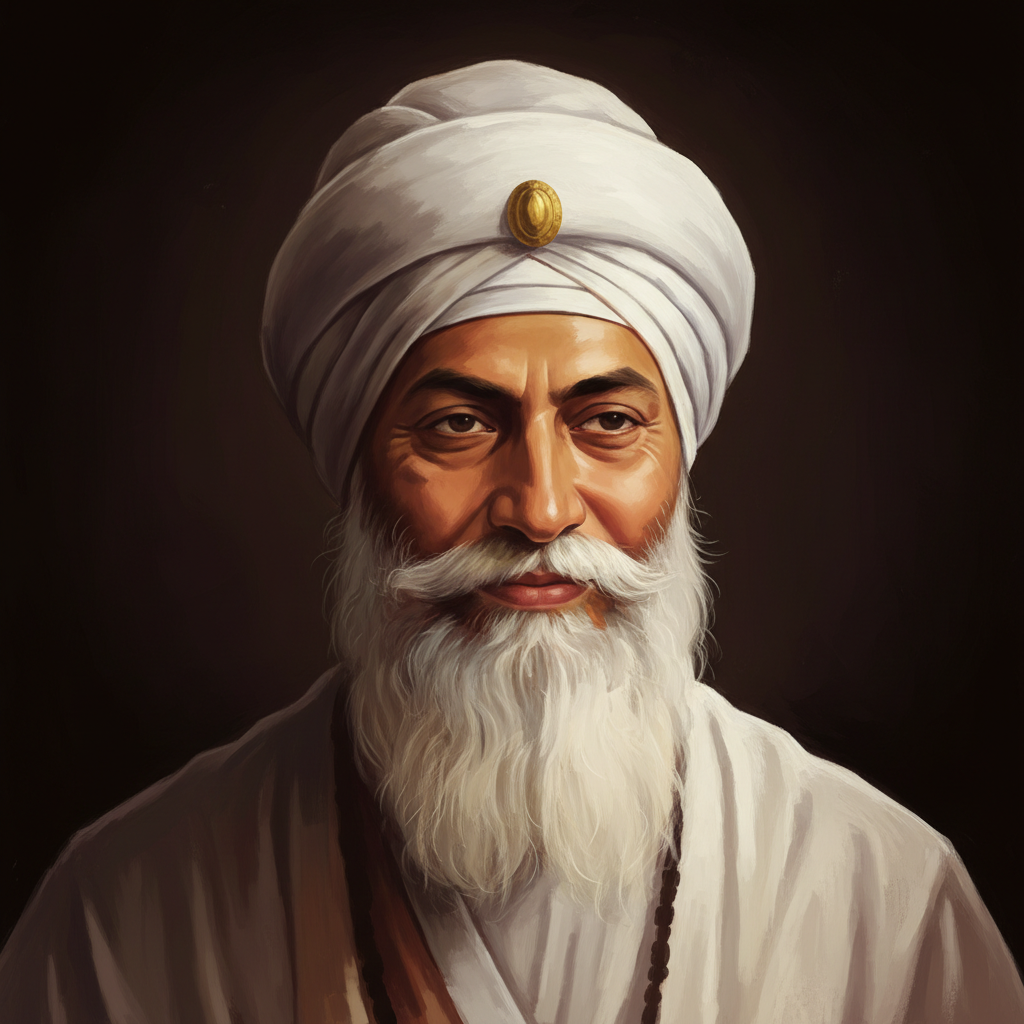
Guru Nanak — "There is no Hindu, there is no Muslim."
There is no Hindu, there is no Muslim.
There is no Hindu, there is no Muslim.
Click any product to generate a realistic preview. Up to 3 at a time.
* Initial load can take up to 90 seconds — revising the preview in another color is nearly instant.
"The lowest among the low castes, lower than the lowliest, Nanak is with them: He envies not those with worldly greatness."
"Hindus are getting Spiritually ruined by worshiping their idols all life and the Muslims by bowing their heads towards Mecca (believing that God exists only in Mecca); but both do not understand/reali…"
"Those who have loved, have found God."
"The one who eats what he earns through hard labor and shares it, he alone knows the path."
"Before becoming a Muslim, a Hindu, a Sikh or a Christian, let's become a Human first."
Founder of Sikhism and the first of the Ten Sikh Gurus, whose teachings of one universal God and rejection of caste shaped Punjab. Closely associated with Kabir (mystical poet whose verses appear in the Sikh Guru Granth Sahib). For an intellectual contrast, see Brahmanical orthodoxy, the Hindu caste-and-ritual establishment of his era — Sikhism was founded as a deliberate alternative to both Hindu ritual hierarchy and Islamic exclusivism — Nanak's universalism was a structural rejection of caste and priestly mediation.
Statement made upon awakening from a profound spiritual experience at the River Bein, questioning religious labels.
Date: 1499
WisdomFound in 2 providers: gemini,deepseek
2 sources checked
The statement declares that the labels Hindu and Muslim do not define a person's essential worth or relationship with the divine. Outward religious identity is secondary to the shared humanity and common spiritual source beneath it. Rituals, caste markers, and sectarian boundaries distract people from recognizing one another as equals before a single truth. In modern terms, it means religious labels should not divide people into insiders and outsiders when the underlying human and spiritual reality is one.
Guru Nanak reportedly spoke these words after emerging from a three-day disappearance in the Bein river around 1499, launching his mission. Born in 1469 in Punjab to a Hindu family yet close to Muslim neighbors, he traveled widely with his Muslim companion Mardana, composing hymns that rejected ritualism and caste. As founder of Sikhism, he built a path centered on one formless God, honest work, and sharing with others, deliberately transcending the Hindu-Muslim divide of his world.
Nanak lived during the late Delhi Sultanate and early Mughal period, when the Lodi dynasty ruled northern India and Babur invaded Punjab in 1526. Hindu-Muslim relations were tense, shaped by conquest, jizya taxation, temple disputes, and rigid caste hierarchies among Hindus. The Bhakti and Sufi movements were simultaneously preaching direct, personal devotion that cut across sectarian lines. Declaring no Hindu or Muslim in this charged setting challenged both religious establishments and offered a unifying alternative rooted in shared devotion.
AI-generated insights based on extensive research and information for context. Factual errors? Email [email protected].
Your cart is empty