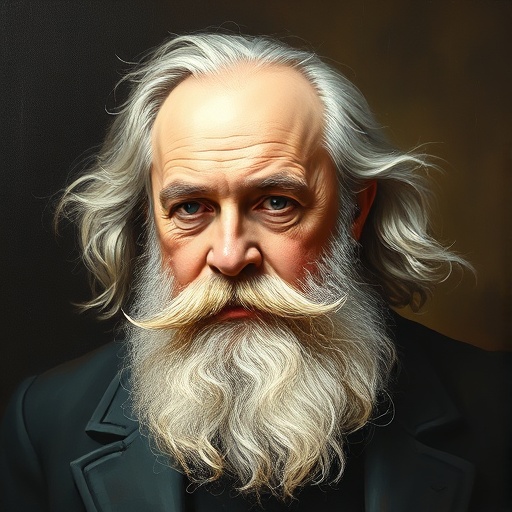
Dmitri Mendeleev — "There will be new elements discovered, and they will fit into the empty spaces i…"
There will be new elements discovered, and they will fit into the empty spaces in my table.
There will be new elements discovered, and they will fit into the empty spaces in my table.
Click any product to generate a realistic preview. Up to 3 at a time.
* Initial load can take up to 90 seconds — revising the preview in another color is nearly instant.
"The future of the Russian nation lies in the hands of the schoolmaster and the priest."
"There is nothing in science that cannot be explained to a barmaid."
"When we see the order of the elements, we must admit that there is a higher reason."
"In science we must all submit not to what seems to us attractive from one point of view or another, but to what represents an agreement between theory and experiment."
"Experiment itself cannot give truth, but it gives the means of destroying erroneous representations whilst confirming those which are true in all their consequences."
Found in 1 providers: grok
1 source checked
Mendeleev is expressing confidence that his arrangement of known chemical elements follows a genuine pattern, not an arbitrary one. The gaps in his table are not mistakes but predictions: elements nobody has found yet exist and will slot neatly into those blank positions once discovered. He is betting that the underlying order of matter is real and that future chemistry will confirm it.
This captures Mendeleev's defining act of scientific courage. When he published his periodic table in 1869, he deliberately left gaps and predicted the properties of missing elements like gallium, scandium, and germanium. Critics scoffed, but within his lifetime all three were discovered with properties matching his forecasts. The quote reflects his conviction that classification could be predictive, not merely descriptive, revealing his bold, systems-thinking mind.
Mendeleev worked in late 19th-century Russia during a chemistry boom: roughly 60 elements were known but seemed a chaotic list. Atomic theory was contested, the electron had not been discovered, and no one understood why elements behaved in families. Science was shifting from collecting facts to seeking deep laws, paralleling Darwin in biology and Maxwell in physics. Mendeleev's predictive gaps became a landmark proof that nature obeys hidden regularities awaiting discovery.
AI-generated insights based on extensive research and information for context. Factual errors? Email [email protected].
Your cart is empty