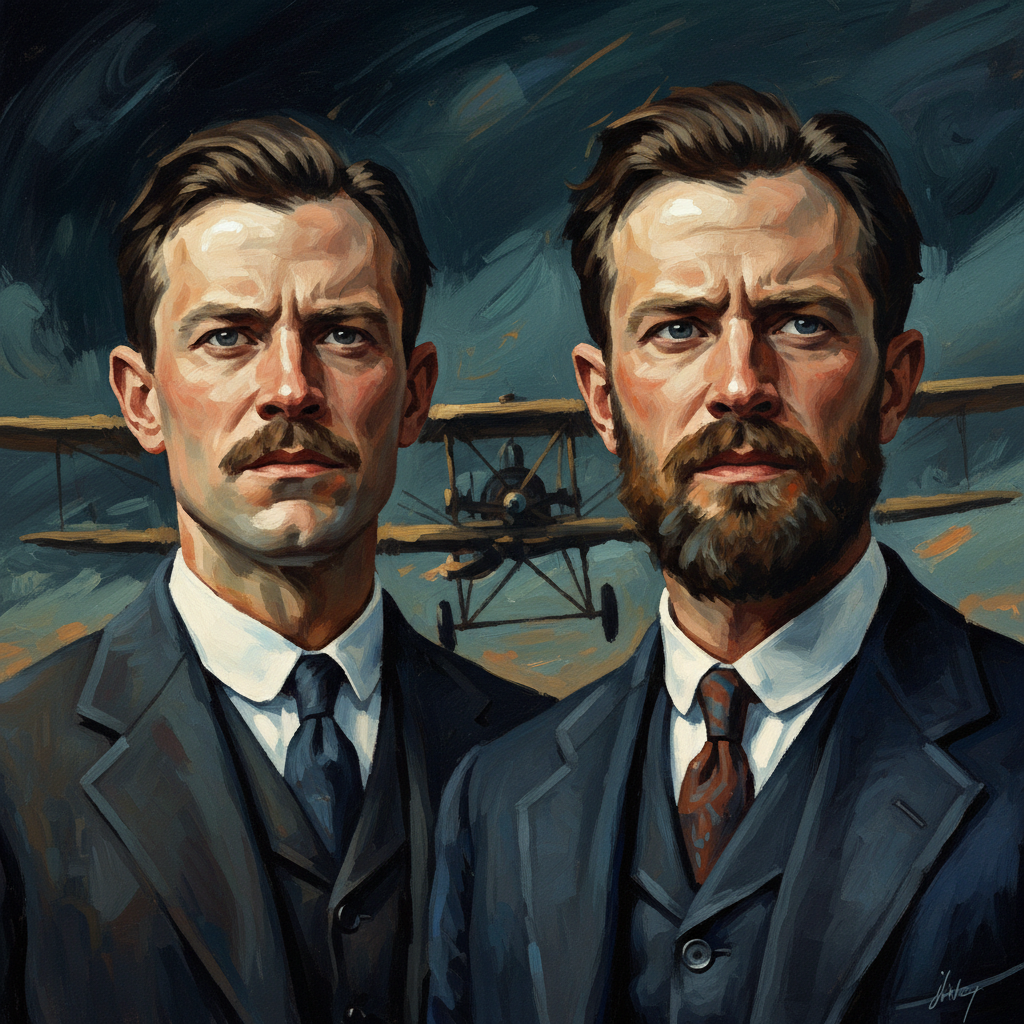
Wright Brothers (Orville & Wilbur) — "We have been very busy with the manufacture of our machines."
We have been very busy with the manufacture of our machines.
We have been very busy with the manufacture of our machines.
Click any product to generate a realistic preview. Up to 3 at a time.
* Initial load can take up to 90 seconds — revising the preview in another color is nearly instant.
"The age of the flying machine is coming; it is not here yet, but it is coming."
"We have been making flights at an altitude of about 50 feet."
"The machine had scarcely cleared the ground when it began to turn up, and the next instant it darted into the ground."
"The only way to learn to fly is to fly."
"Success in inventing depends on the close observation of nature."
American aviation pioneers who achieved the first sustained powered controlled airplane flight at Kitty Hawk, NC, on December 17, 1903. Closely associated with Octave Chanute (their gliding mentor and aeronautical correspondent). For an intellectual contrast, see Samuel Pierpont Langley, Smithsonian Institution Secretary and government-funded aviation researcher — Langley's Aerodrome crashed twice into the Potomac in October-December 1903 with $50,000 of War Department funding; the Wright Brothers' bicycle-shop empiricism beat Langley's institutional Big Science by 9 days. The most-cited example in engineering history of empirical-tinkerer beating institution-funded credentialism.
Found in 1 providers: grok
1 source checked
The speaker is simply saying they've been deeply occupied with building their aircraft. 'Manufacture' signals hands-on construction, not theorizing. The understated tone captures a builder's mindset: progress comes from making things, not talking about them. Breakthrough work demands sustained, focused labor on the physical craft—the actual hardware—not abstract planning or publicity. It's the voice of someone whose results are measured in wood, wire, and working machines, not words.
The Wright Brothers operated a bicycle repair and manufacturing shop before pursuing aviation. Every component of their 1903 Flyer—wing ribs, chain drives, a custom-built engine, hand-carved propellers—they fabricated themselves in their Dayton workshop. Their advantage over well-funded rivals came from this manufacturing discipline: iterating physically, not just theoretically. They were craftsmen who understood that mastering construction was inseparable from mastering flight.
The early 1900s saw fierce competition to achieve powered flight, with Samuel Langley's Smithsonian-backed Aerodrome attempts dominating headlines. Precision machining was transforming American industry. Because no standard aviation components existed anywhere, inventors had to fabricate everything from scratch. Independent tinkerers competed against government-funded teams. For the Wrights, controlling their own production process wasn't a choice—it was the only path to iterating fast enough to win the race.
AI-generated insights based on extensive research and information for context. Factual errors? Email [email protected].
Your cart is empty