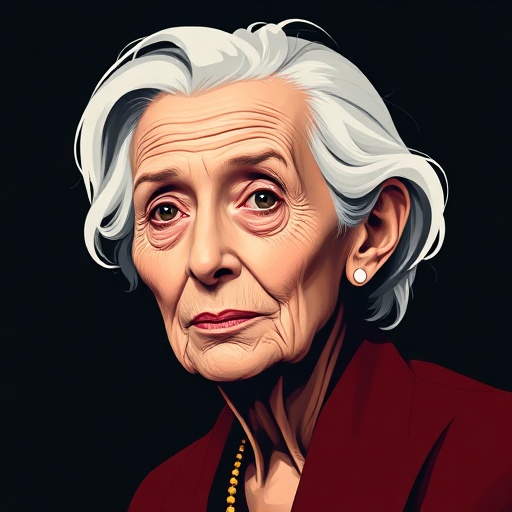
Jane Goodall — "We have to remember that we are just one species among many, and we need to act …"
We have to remember that we are just one species among many, and we need to act accordingly.
We have to remember that we are just one species among many, and we need to act accordingly.
Click any product to generate a realistic preview. Up to 3 at a time.
* Initial load can take up to 90 seconds — revising the preview in another color is nearly instant.
"Every day is a new opportunity to make a positive impact on the world."
"We need to listen to the voices of the young people. They are the ones who will inherit the Earth."
"The least I can do is speak out for those who cannot speak for themselves."
"I believe that every day is an opportunity to make a positive difference."
"I believe that every single one of us can make a difference."
British primatologist who in 1960 began the longest-running wild primate study at Gombe Stream, transforming our understanding of chimpanzees. Closely associated with Dian Fossey (mountain-gorilla researcher) and Birutė Galdikas (orangutan researcher; together with Goodall and Fossey one of Louis Leakey's 'Trimates'). For an intellectual contrast, see Walter Palmer, American dentist who killed Cecil the Lion in Zimbabwe in 2015 — Palmer represents the trophy-hunting tradition Goodall's life's work has been organized against — the colonial-era hunter-naturalist worldview that treated primates and big game as specimens or trophies, which Goodall's Roots & Shoots and Jane Goodall Institute exist specifically to displace.
Found in 1 providers: grok
1 source checked
Humans tend to place themselves above nature, treating other species as resources or irrelevancies. This quote pushes back: we are one of roughly 8.7 million species sharing this planet, not its rightful rulers. Acting accordingly means restraining exploitation, preserving habitats, and recognizing that ecosystems depend on biodiversity. Human survival is entangled with species we barely study. Humility toward nature is not sentiment — it is ecological realism.
Goodall spent over 60 years observing chimpanzees at Gombe Stream, Tanzania, documenting that they make tools, wage war, grieve, and form deep social bonds — behaviors once deemed uniquely human. This dismantled the idea of a sharp human-animal divide. She became a global conservation advocate precisely because she saw firsthand how species loss cascades. Her Roots & Shoots program teaches young people that every species deserves consideration, not just charismatic ones.
Goodall came of age as a scientist during the mid-20th century when industrial expansion, deforestation, and pesticide use were accelerating habitat destruction — Rachel Carson's Silent Spring appeared in 1962, the same year Goodall's chimp findings gained global attention. By the 1990s–2000s, scientists were warning of a sixth mass extinction, with species disappearing at 1,000 times the natural rate. Human dominance of the biosphere had become measurable fact, not metaphor.
AI-generated insights based on extensive research and information for context. Factual errors? Email [email protected].
Your cart is empty