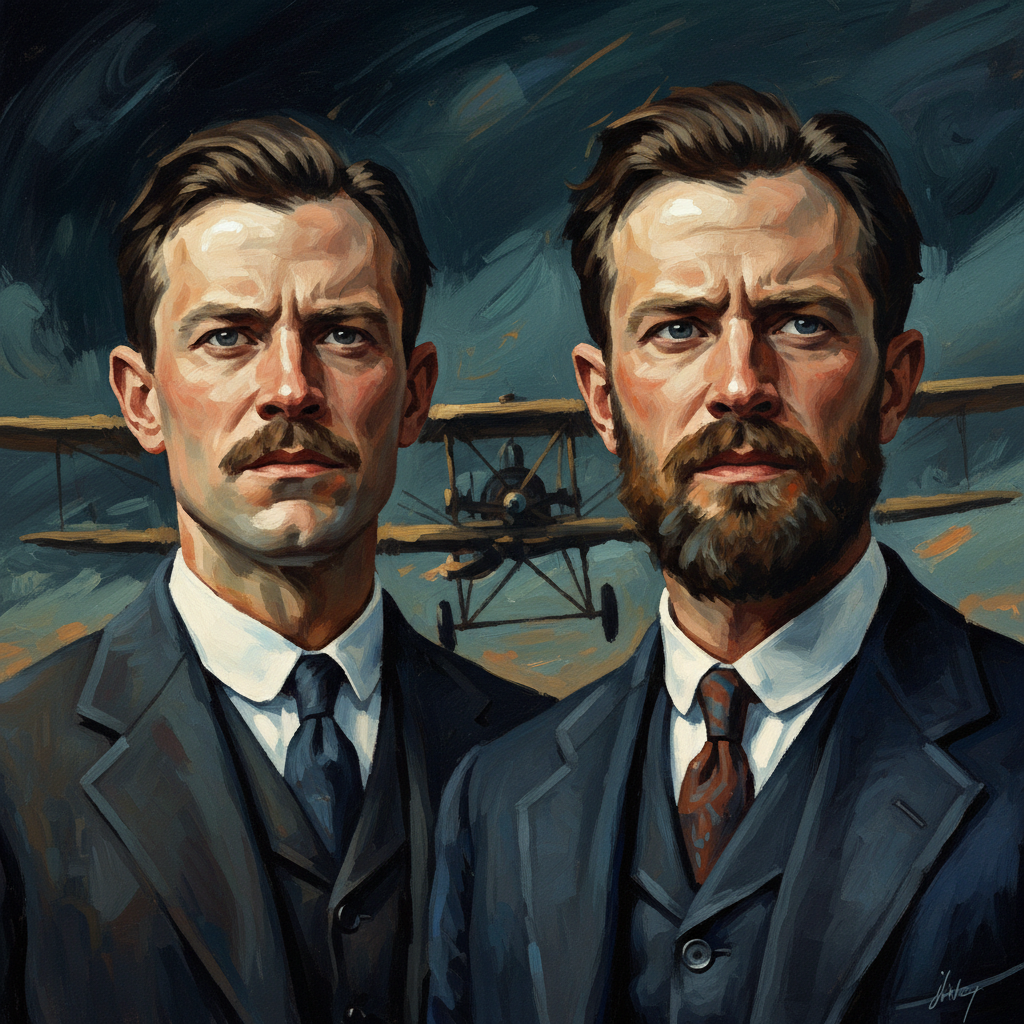
Wright Brothers (Orville & Wilbur) — "We were confident that we had solved the problem of human flight."
We were confident that we had solved the problem of human flight.
We were confident that we had solved the problem of human flight.
Click any product to generate a realistic preview. Up to 3 at a time.
* Initial load can take up to 90 seconds — revising the preview in another color is nearly instant.
"The machine itself was a thing of beauty, a marvel of ingenuity and simplicity."
"In its campaign to discredit others in the flying art, the Smithsonian has issued scores of these false and misleading statements."
"We did not find it necessary to use any of the formulas of the scientists, but we worked out our own formulas."
"I believe that my course in sending our Kitty Hawk machine to a foreign museum is the only way of correcting the history of the flying machine, which by false and misleading statements has been perver…"
"Often, after an hour or so of heated argument, we would discover that we were as far from agreement as when we started, but that each had changed to the other's original position."
American aviation pioneers who achieved the first sustained powered controlled airplane flight at Kitty Hawk, NC, on December 17, 1903. Closely associated with Octave Chanute (their gliding mentor and aeronautical correspondent). For an intellectual contrast, see Samuel Pierpont Langley, Smithsonian Institution Secretary and government-funded aviation researcher — Langley's Aerodrome crashed twice into the Potomac in October-December 1903 with $50,000 of War Department funding; the Wright Brothers' bicycle-shop empiricism beat Langley's institutional Big Science by 9 days. The most-cited example in engineering history of empirical-tinkerer beating institution-funded credentialism.
Found in 1 providers: grok
1 source checked
The speaker declares full certainty that a long-standing, seemingly impossible challenge has finally been cracked. It expresses the quiet pride of inventors who have moved past guessing, tinkering, and failed attempts to a stage of proven, repeatable results. Confidence here is earned through evidence, not bravado. The statement marks the moment when a dream shifts into demonstrated reality and the problem stops being a mystery and becomes an accomplishment.
Orville and Wilbur Wright spent years systematically attacking flight as an engineering puzzle, building their own wind tunnel, rewriting lift tables, and mastering three-axis control through gliders at Kitty Hawk. After the December 17, 1903 powered flights and the refined 1904-1905 Flyer III, they genuinely believed controlled aviation was solved. This confidence mirrored their methodical, data-driven character as self-taught bicycle mechanics who trusted experiments over theory and rarely spoke publicly unless results backed the claim.
In the early 1900s, heavier-than-air flight was widely mocked after Langley's public failures weeks before Kitty Hawk. The Second Industrial Revolution was producing automobiles, electric light, and radio, yet serious scientists still argued powered flight was impossible. Newspapers ignored the Wrights' 1903 success for years. Their quiet confidence came during this skeptical transition, when mechanical ingenuity by ordinary craftsmen was beginning to outpace academic experts, reshaping expectations of what independent inventors could achieve.
AI-generated insights based on extensive research and information for context. Factual errors? Email [email protected].
Your cart is empty