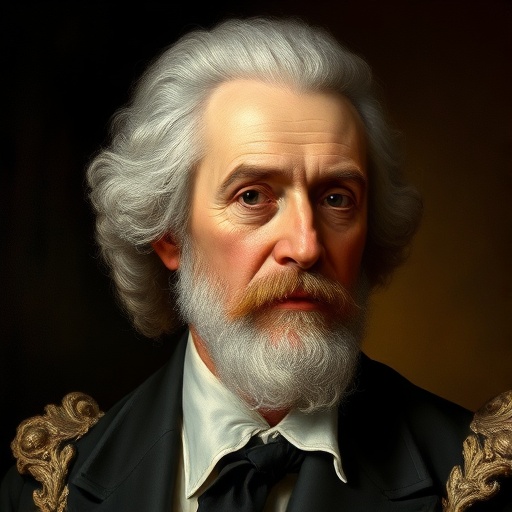
Antoine Lavoisier — "The success of charlatans, sorcerors, and alchemists—and all those who abuse pub…"
The success of charlatans, sorcerors, and alchemists—and all those who abuse public credulity—is founded on errors in this type of calculation.
The success of charlatans, sorcerors, and alchemists—and all those who abuse public credulity—is founded on errors in this type of calculation.
Click any product to generate a realistic preview. Up to 3 at a time.
* Initial load can take up to 90 seconds — revising the preview in another color is nearly instant.
"The desire to do good is the most powerful motive of all."
"The value of a discovery consists not in its novelty, but in its truth."
"The art of drawing conclusions from experiments and observations consists in evaluating probabilities and in judging if they are great enough to constitute proofs."
"The more exact the science, the more difficult it is to make progress."
"The art of concluding from experience and observation consists in evaluating probabilities, in estimating if they are high or numerous enough to constitute proof."
From his writings, a direct critique of pseudo-sciences.
Date: Undated, but from his major works.
GeneralFound in 1 providers: gemini
1 source checked
People who trick others, like fake healers, fortune-tellers, or get-rich-quick schemers, succeed because their audience cannot properly weigh probabilities. When someone does not know how to judge the odds of a claim being true, an unlikely coincidence feels like proof. Frauds exploit this gap in reasoning. The quote argues that gullibility is not just emotional weakness but a failure of mathematical thinking about chance, evidence, and what counts as a meaningful result.
Lavoisier spent his career replacing superstition with measurement. He disproved phlogiston theory by weighing reactants and products on precision balances, showing mass is conserved. He also served on a royal commission that debunked Mesmer's animal magnetism through blind trials. For him, quantitative reasoning was the weapon against quackery, and alchemy was the prior generation's chemistry he had to demolish. Dismissing charlatans through probability was a personal mission, not an abstract observation.
Late-1700s France was a battleground between Enlightenment rationalism and lingering occultism. Mesmerism drew huge Paris crowds, alchemical claims still circulated, and lotteries plus early insurance markets made probability a hot topic. Laplace and Condorcet were formalizing the mathematics of chance. Lavoisier wrote amid this tension, just before the Revolution that would guillotine him in 1794. Science was actively defining itself against mysticism, and calculating rather than believing was a radical civic stance.
AI-generated insights based on extensive research and information for context. Factual errors? Email [email protected].
Your cart is empty