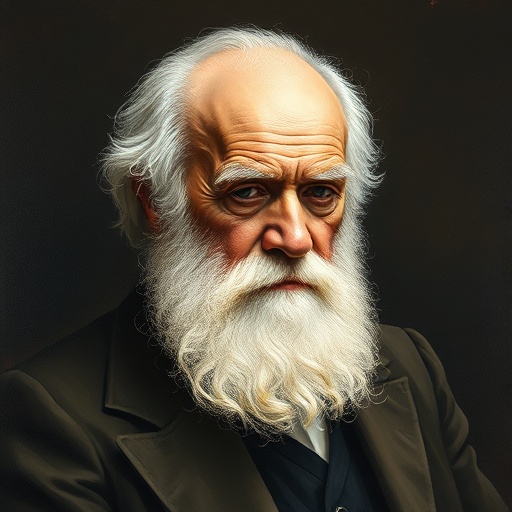
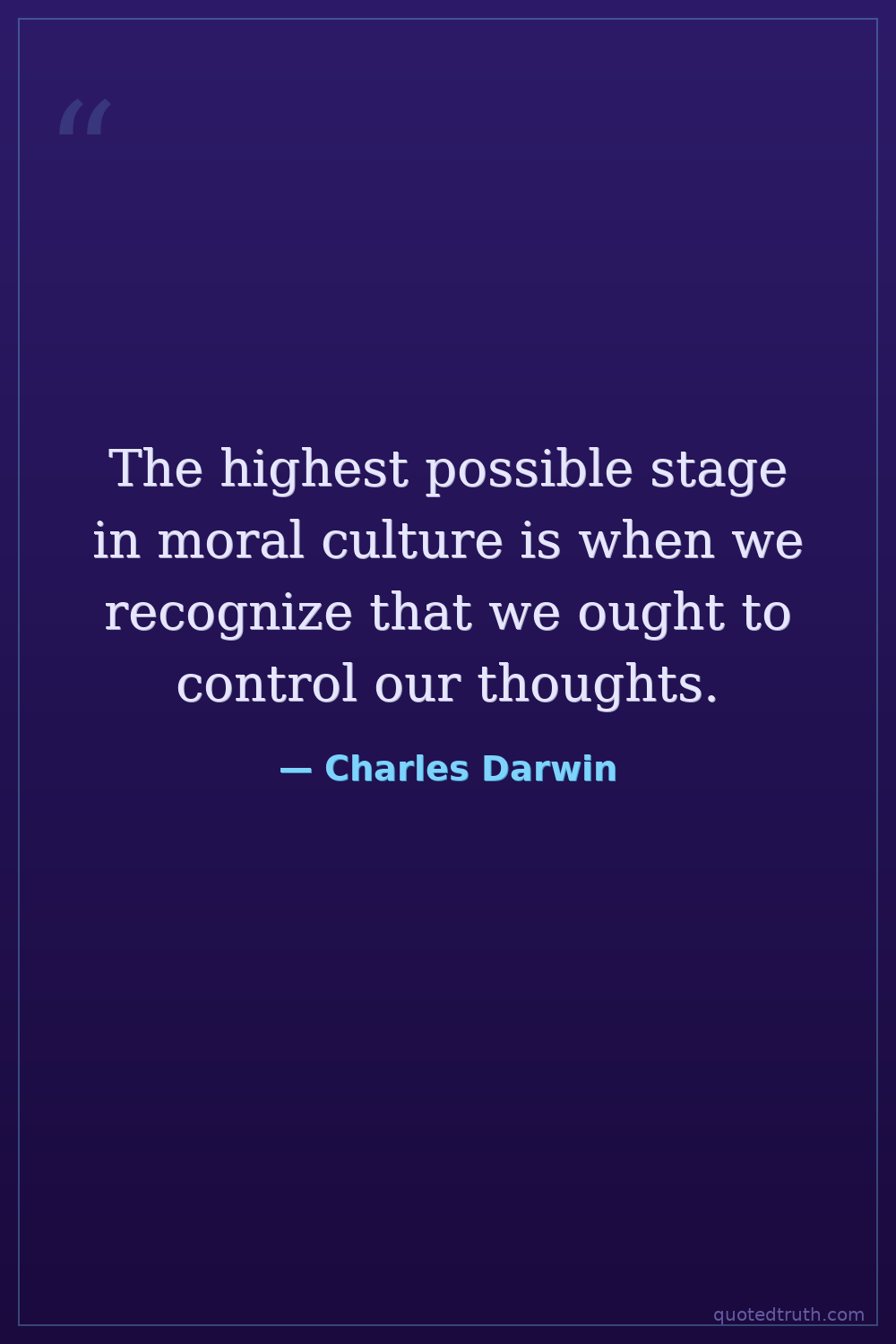
Charles Darwin — "The highest possible stage in moral culture is when we recognize that we ought t…"
The highest possible stage in moral culture is when we recognize that we ought to control our thoughts.
The highest possible stage in moral culture is when we recognize that we ought to control our thoughts.
Click any product to generate a realistic preview. Up to 3 at a time.
* Initial load can take up to 90 seconds — revising the preview in another color is nearly instant.
"If it could be demonstrated that any complex organ existed, which could not possibly have been formed by numerous, successive, slight modifications, my theory would absolutely break down."
"One day, on looking at an orchid, I was struck with the idea that the structure of the flower was adapted to the visits of insects."
"The greatest discovery of all time is that a person can change his future by merely changing his attitude."
"At some future period, not very distant as measured by centuries, the civilized races of man will almost certainly exterminate and replace the savage races throughout the world."
"As a proof of the admirable power of the mind, I may mention that I have been for some years training my mind to reject the evidence of my senses when they do not square with my preconceived notions."
British naturalist whose On the Origin of Species (1859) established evolution by natural selection — the unifying theory of modern biology. Closely associated with Thomas Henry Huxley (his 'bulldog' public defender) and Alfred Russel Wallace (independent co-discoverer of natural selection). For an intellectual contrast, see William Paley, Anglican theologian and Natural Theology author (1743-1805) — Origin of Species is structurally a 400-page reply to Paley — Darwin admired Paley's watchmaker-argument as an undergraduate at Cambridge and then spent 20 years building the empirical machinery to displace him. The cleanest 'design argument vs natural selection' founding rebuttal in science.
The standard scholarly entry points to Charles Darwin's work: Janet Browne (Harvard, history of science) — Charles Darwin: Voyaging (1995) and The Power of Place (2002); Adrian Desmond (UCL, biographer) — Darwin: The Life of a Tormented Evolutionist (1991, with James Moore). These are the works graduate seminars cite when teaching Charles Darwin.
Found in 2 providers: grok,deepseek
2 sources checked
True moral development isn't just about controlling your actions or words—it's about disciplining your own inner thoughts. Most people consider morality a matter of behavior; this pushes deeper, arguing the highest ethical achievement is recognizing that even your mental life carries moral weight. Real virtue demands internal accountability: monitoring what you think, not merely what you do or say publicly.
Darwin spent over 20 years rigorously disciplining his own reasoning before publishing On the Origin of Species, systematically confronting his doubts and biases rather than acting on them prematurely. As a naturalist who studied animal instinct, he understood humans share primitive drives with other creatures—but believed deliberate self-mastery of those impulses defined human moral progress. This quote mirrors his lifelong commitment to intellectual honesty and careful, evidence-based thinking over reactive judgment.
Darwin lived in the Victorian era, when rigid moral codes, religious authority, and explosive scientific change collided directly. His evolutionary theory destabilized humanity's self-image—if humans descended from animals, what grounded human morality? Victorian culture was obsessed with self-improvement and character. Darwin's argument that mastering one's thoughts represents peak morality offered a secular, rational ethical framework at precisely the moment religious foundations were being challenged by science, industrialization, and rising philosophical skepticism.
AI-generated insights based on extensive research and information for context. Factual errors? Email [email protected].
Your cart is empty