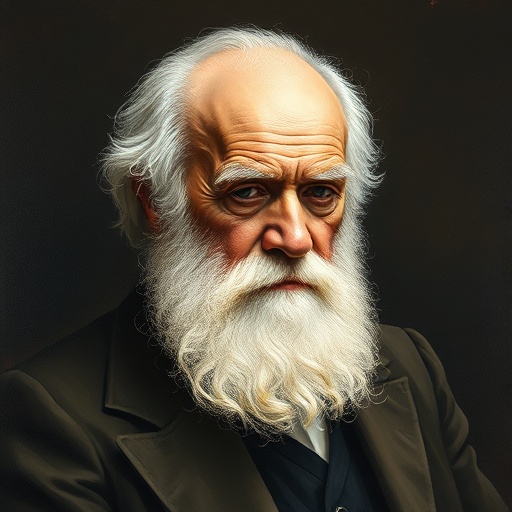
Charles Darwin — "Man selects only for his own good: Nature only for that of the being which she t…"
Man selects only for his own good: Nature only for that of the being which she tends.
Man selects only for his own good: Nature only for that of the being which she tends.
Click any product to generate a realistic preview. Up to 3 at a time.
* Initial load can take up to 90 seconds — revising the preview in another color is nearly instant.
"The difference in mind between man and the higher animals, great as it is, certainly is one of degree and not of kind."
"If it could be demonstrated that any complex organ existed, which could not possibly have been formed by numerous, successive, slight modifications, my theory would absolutely break down."
"A dog might as well speculate on the mind of Newton."
"My mind seems to have become a kind of machine for grinding general laws out of large collections of facts, but why this should have caused the atrophy of that part of the brain alone, on which the hi…"
"What a book a Devil's Chaplain might write on the clumsy, wasteful, blundering, low, and horridly cruel works of nature!"
British naturalist whose On the Origin of Species (1859) established evolution by natural selection — the unifying theory of modern biology. Closely associated with Thomas Henry Huxley (his 'bulldog' public defender) and Alfred Russel Wallace (independent co-discoverer of natural selection). For an intellectual contrast, see William Paley, Anglican theologian and Natural Theology author (1743-1805) — Origin of Species is structurally a 400-page reply to Paley — Darwin admired Paley's watchmaker-argument as an undergraduate at Cambridge and then spent 20 years building the empirical machinery to displace him. The cleanest 'design argument vs natural selection' founding rebuttal in science.
The standard scholarly entry points to Charles Darwin's work: Janet Browne (Harvard, history of science) — Charles Darwin: Voyaging (1995) and The Power of Place (2002); Adrian Desmond (UCL, biographer) — Darwin: The Life of a Tormented Evolutionist (1991, with James Moore). These are the works graduate seminars cite when teaching Charles Darwin.
Found in 1 providers: grok
1 source checked
Human breeders choose traits that serve human interests — faster horses, fatter cattle, more wool. Nature, by contrast, selects traits that help the organism itself survive and reproduce. This distinction is central to Darwin's theory: artificial selection shapes species toward human utility while natural selection shapes them toward fitness in their environment. The two processes can diverge sharply, since what benefits a human owner often differs from what helps the animal thrive.
Darwin spent years studying artificial selection before publishing On the Origin of Species in 1859. He bred pigeons at Down House, consulted livestock farmers, and analyzed domestic plants. This contrast between human-directed and nature-directed selection was the rhetorical backbone of his argument — he used the familiar practice of animal husbandry to make natural selection intuitive for skeptical Victorian readers. His meticulous pigeon-breeding notes appear directly in the Origin's opening chapters.
Victorian Britain was an agricultural powerhouse where selective livestock breeding was profitable and prestigious. Darwin wrote as the British Empire exploited nature globally, and most educated people assumed the natural world existed to serve human needs — a view rooted in natural theology. By arguing nature selects for organisms themselves, not humans, Darwin implicitly challenged this anthropocentric worldview at a moment when industry and empire were accelerating humanity's sense of dominion over the natural world.
AI-generated insights based on extensive research and information for context. Factual errors? Email [email protected].
Your cart is empty