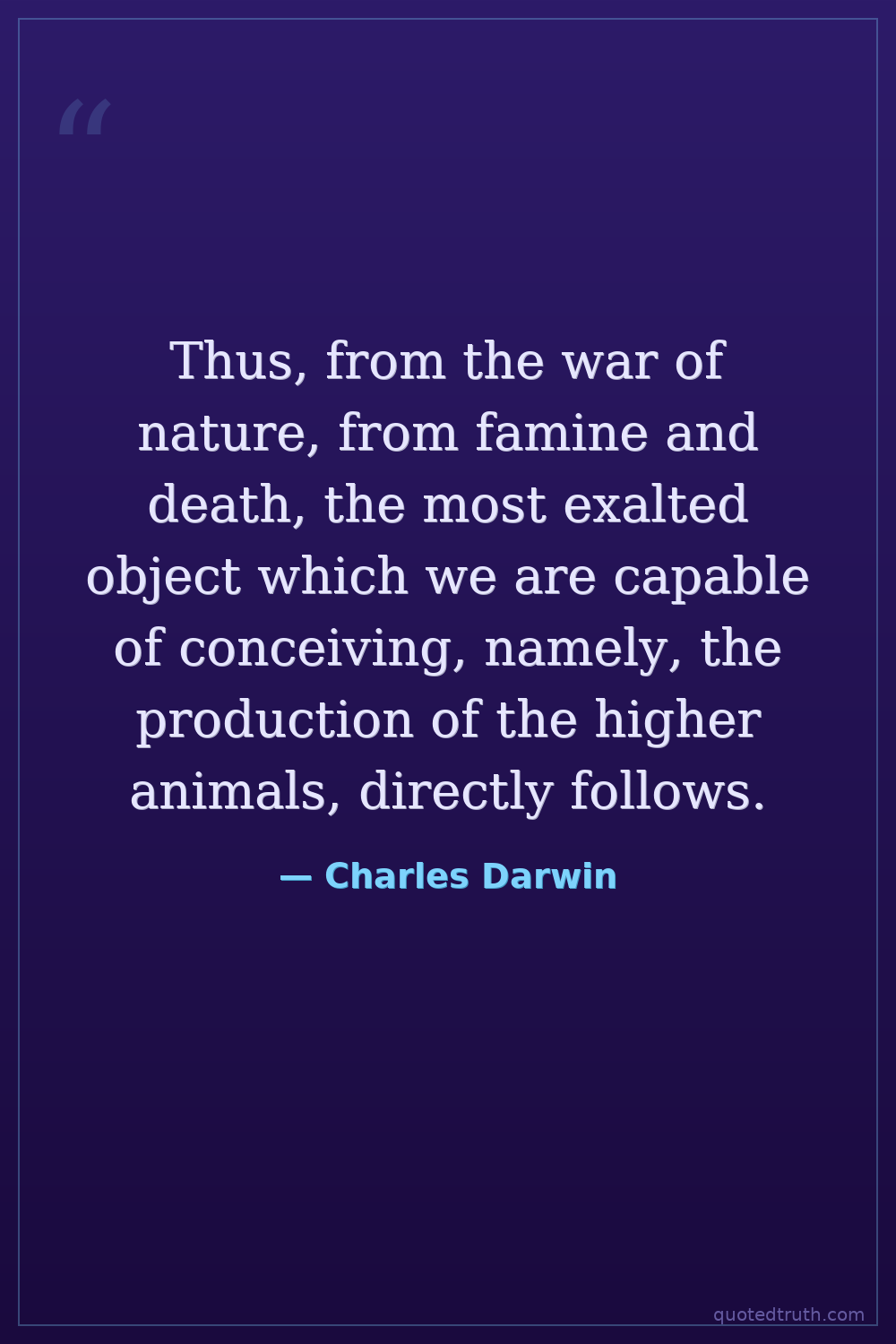
Charles Darwin — "Thus, from the war of nature, from famine and death, the most exalted object whi…"

Thus, from the war of nature, from famine and death, the most exalted object which we are capable of conceiving, namely, the production of the higher animals, directly follows.
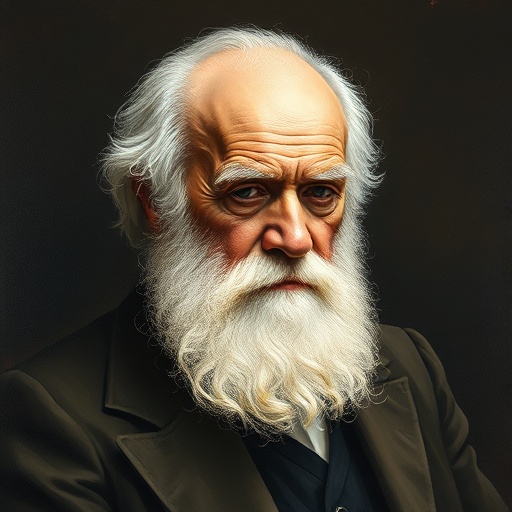
Charles Darwin — Charles Darwin Modern · Theory of evolution

Get This Quote & Author's Image Illustrated On:

Click any product to generate a realistic preview. Up to 3 at a time.
* Initial load can take up to 90 seconds — revising the preview in another color is nearly instant.

Kitchen

Apparel

Other

About Charles Darwin (1809-1882)

British naturalist whose On the Origin of Species (1859) established evolution by natural selection — the unifying theory of modern biology. Closely associated with Thomas Henry Huxley (his 'bulldog' public defender) and Alfred Russel Wallace (independent co-discoverer of natural selection). For an intellectual contrast, see William Paley, Anglican theologian and Natural Theology author (1743-1805) — Origin of Species is structurally a 400-page reply to Paley — Darwin admired Paley's watchmaker-argument as an undergraduate at Cambridge and then spent 20 years building the empirical machinery to displace him. The cleanest 'design argument vs natural selection' founding rebuttal in science.

The standard scholarly entry points to Charles Darwin's work: Janet Browne (Harvard, history of science) — Charles Darwin: Voyaging (1995) and The Power of Place (2002); Adrian Desmond (UCL, biographer) — Darwin: The Life of a Tormented Evolutionist (1991, with James Moore). These are the works graduate seminars cite when teaching Charles Darwin.
Details

On the Origin of Species (Conclusion)

Date: 1859

War & Conflict

Verification

Unverifiable

Found in 1 providers: grok

1 source checked

Understanding this quote

What it means

Life's greatest achievements emerge from brutal struggle. From starvation, predation, and death comes the remarkable complexity of higher life forms. Beauty and complexity are not gifts handed down from above but are forged through relentless competition and suffering. The grandeur of living things is inseparable from the violence and scarcity that produced them over vast stretches of time.

Relevance to Charles Darwin

Darwin wrote this as the closing argument of On the Origin of Species in 1859. Having spent decades documenting nature's cruelty aboard the Beagle and in his studies, he knew evolution required suffering as its engine. This sentence was his deliberate reframing of nature's harshness as generative rather than meaningless, reconciling his scientific conclusions with his lingering sense of wonder.

The era

Published in 1859, Darwin's era was grappling with industrialization's brutal conditions and theological certainty about divine creation. Malthus's essay on population scarcity directly inspired Darwin's mechanism of natural selection. Victorian society simultaneously celebrated progress and confronted poverty and death as constants. Darwin transformed these grim realities from moral failures into the very mechanism producing life's extraordinary diversity.

AI-generated insights based on extensive research and information for context. Factual errors? Email [email protected].

Your Cart

Your cart is empty