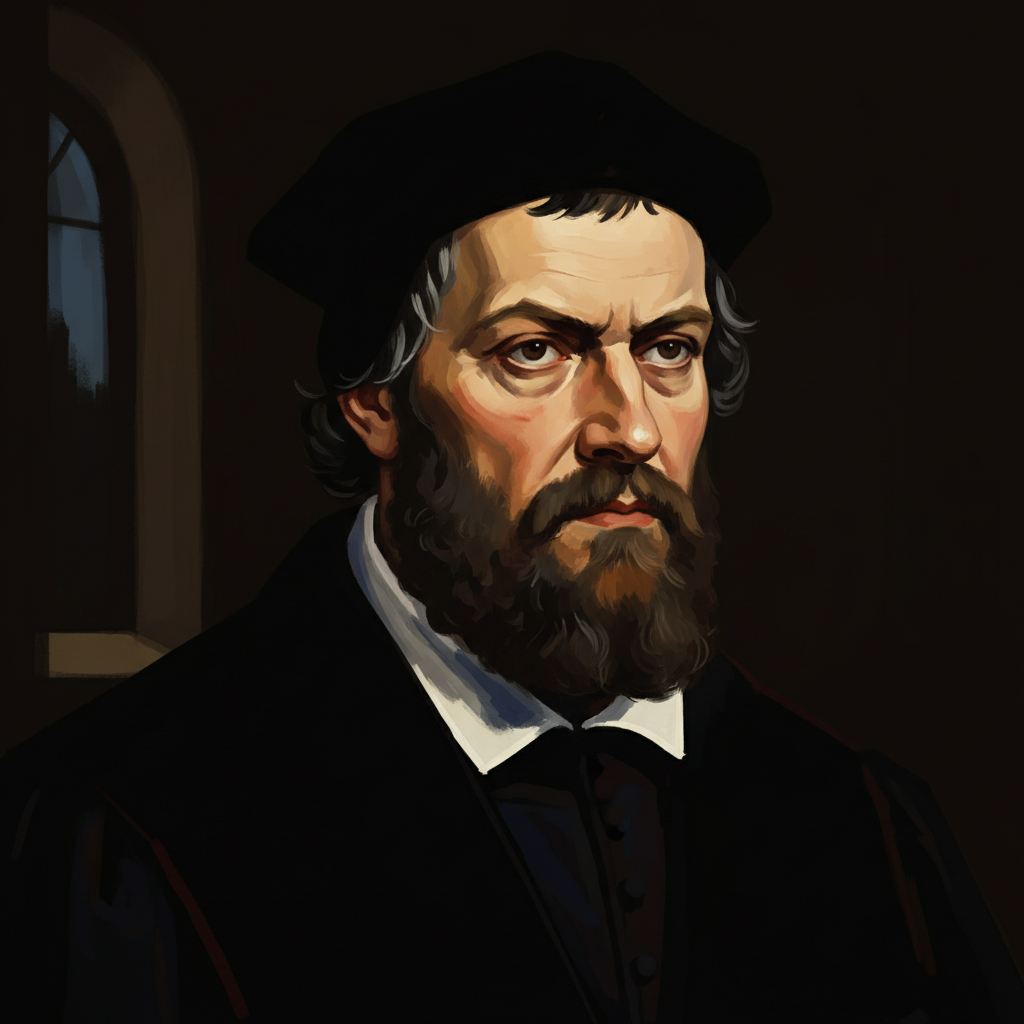
Martin Luther — "If God has no sense of humor, I don't want to go to Heaven."
If God has no sense of humor, I don't want to go to Heaven.
If God has no sense of humor, I don't want to go to Heaven.
Click any product to generate a realistic preview. Up to 3 at a time.
* Initial load can take up to 90 seconds — revising the preview in another color is nearly instant.
"Be a sinner and sin boldly, but believe and rejoice in Christ even more boldly, for he is victorious over sin, death, and the world."
"In lying fashion you ignore what even children know."
"If the earth is fit for laughter, then surely heaven is filled with it. Heaven is the birthplace of laughter."
"Even if I knew that tomorrow the world would go to pieces, I would still plant my apple tree."
"If a woman grows weary and at last dies from childbearing, it matters not. Let her die in childbearing—she is there to do it."
German theologian whose 95 Theses (1517) launched the Protestant Reformation and broke the Catholic Church's monopoly on Western Christianity. Closely associated with Philipp Melanchthon (Lutheran systematizer) and John Calvin (later Reformer who built on Luther's break). For an intellectual contrast, see Pope Leo X, Renaissance pope (1513-1521) — Leo X's indulgence sales triggered Luther's break and Leo excommunicated him in 1521 — Luther's entire Reformation is structured as a direct answer to the indulgence-funded Vatican Leo represented.
Found in 1 providers: gemini
1 source checked
Heaven would be unbearable without laughter and joy. The speaker insists that humor is essential to a life worth living, even an eternal one. A solemn, joyless paradise holds no appeal; if the divine cannot smile or appreciate wit, then eternity in such a place would feel more like punishment than reward. Joy and levity are treated as serious spiritual goods, not trivial distractions from holiness.
Luther was famously earthy, blunt, and quick with a joke, even about sacred matters. His Table Talk recorded countless quips, puns, and barbs aimed at the pope, the devil, and himself. Though he wrestled with depression and scrupulosity, he insisted that music, beer, marriage, and laughter were divine gifts. He rejected monastic gloom, believing a sour, humorless piety actually pleased the devil more than God.
Early sixteenth-century Christendom was dominated by a severe, penitential late-medieval piety: indulgences, relics, fasting, and fear of purgatory shaped daily life. Monastic ideals prized solemnity and bodily mortification. Luther's Reformation, launched with the 1517 Theses, dismantled this machinery of dread, recovering grace, marriage for clergy, and ordinary vocations as holy. His willingness to joke about heaven and the devil was itself a theological revolt against a religion that had grown grim.
AI-generated insights based on extensive research and information for context. Factual errors? Email [email protected].
Your cart is empty