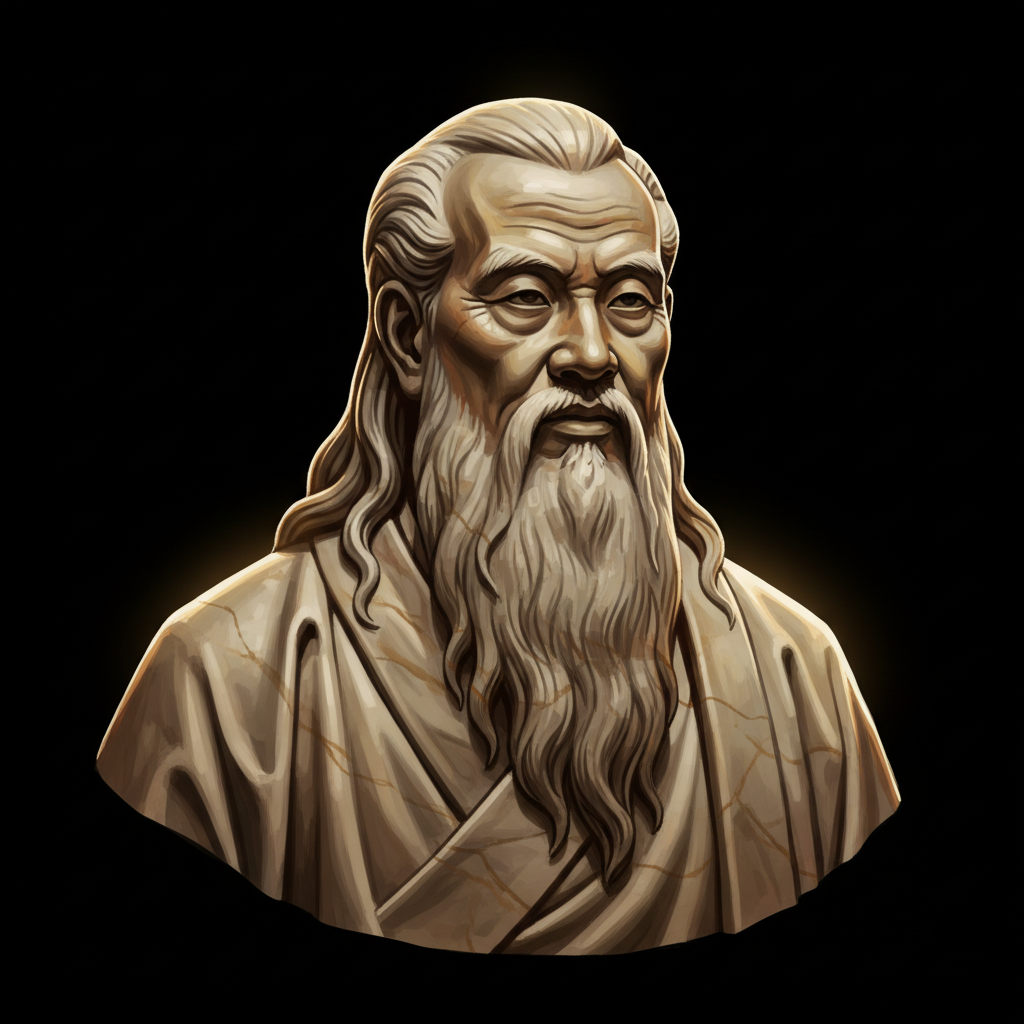
Laozi — "The Way is ever without action, yet nothing is left undone."
The Way is ever without action, yet nothing is left undone.
The Way is ever without action, yet nothing is left undone.
Click any product to generate a realistic preview. Up to 3 at a time.
* Initial load can take up to 90 seconds — revising the preview in another color is nearly instant.
"Simplicity has no name is free of desires. Being free of desires it is tranquil. And the world will be at peace of it's own accord."
"The sage puts his own person last, and yet it is found in the foremost place; he treats his person as foreign to him, and yet it is preserved."
"The empire is a sacred vessel and cannot be acted on. He who acts on it harms it; he who grasps it loses it."
"If you realize that all things change, there is nothing you will try to hold on to."
"Water is fluid, soft, and yielding. But water will wear away rock, which is rigid and cannot yield. As a rule, whatever is fluid, soft, and yielding will overcome whatever is rigid and hard. This is a…"
Reputed founder of Taoism and author of the Tao Te Ching, whose wu wei (effortless action) shaped East Asian philosophy. Closely associated with Zhuangzi (later Taoist who extended Laozi's framework). For an intellectual contrast, see Confucius, near-contemporary Chinese sage of social ritual and duty — Confucius systematized social order through ritual and hierarchy; Laozi argued that all such systems were the disease, not the cure — the two founding poles of Chinese moral philosophy.
Found in 1 providers: gemini
1 source checked
True effectiveness comes not from forcing outcomes but from aligning with the natural flow of things. When you stop straining, manipulating, and imposing your will, things still get accomplished, often better than before. The idea is that reality has its own intelligence and momentum; step in tune with it rather than shoving against it, and the work happens through you rather than from you.
Laozi reportedly served as a royal archivist in the Zhou court, witnessing bureaucrats exhaust themselves micromanaging a collapsing dynasty. Legend says he rode west on an ox, weary of human striving, and only wrote the Tao Te Ching at a border guard's insistence. This line distills his central teaching of wu wei, effortless action, reflecting a lifelong preference for quiet observation over ambition and for yielding over controlling.
Laozi lived during the late Zhou dynasty, an age of fracturing feudal states sliding toward the Warring States period. Rulers hired strategists, legalists, and Confucian moralists, each prescribing more rules, rituals, and interventions to restore order. Against that backdrop of frantic statecraft and escalating warfare, a teaching that power flows from restraint and non-interference was radical, offering exhausted officials and peasants alike a counterweight to the era's obsession with forceful reform.
AI-generated insights based on extensive research and information for context. Factual errors? Email [email protected].
Your cart is empty