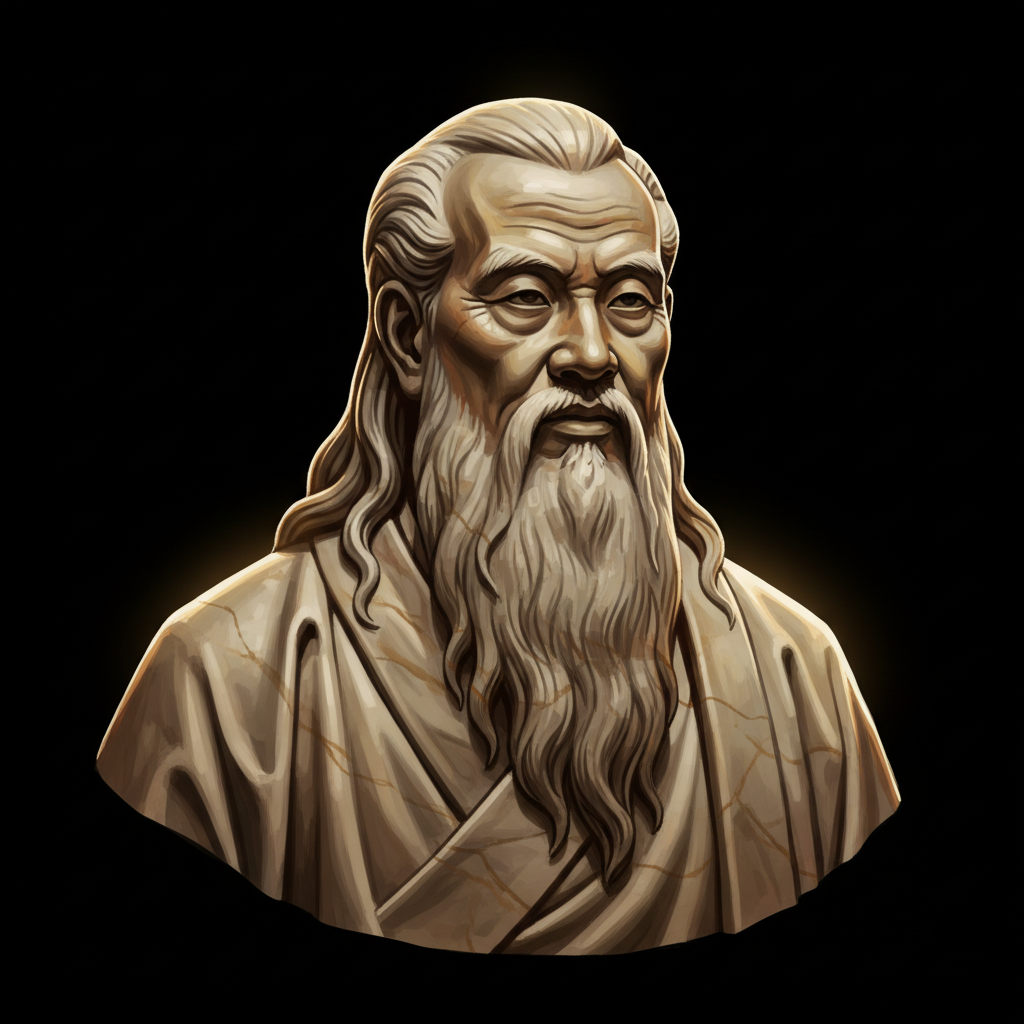
Laozi — "Fill your bowl to the brim and it will spill. Keep sharpening your knife and it …"
Fill your bowl to the brim and it will spill. Keep sharpening your knife and it will blunt.
Fill your bowl to the brim and it will spill. Keep sharpening your knife and it will blunt.
Click any product to generate a realistic preview. Up to 3 at a time.
* Initial load can take up to 90 seconds — revising the preview in another color is nearly instant.
"All things in the world come from being. And being comes from non-being."
"He (the sage) wants all things to follow their own nature, but dares not act."
"When the great Tao is lost, there is 'benevolence' and 'righteousness'."
"The greatest evil is to have no satisfaction."
"Lightly given promises must meet with little trust."
Reputed founder of Taoism and author of the Tao Te Ching, whose wu wei (effortless action) shaped East Asian philosophy. Closely associated with Zhuangzi (later Taoist who extended Laozi's framework). For an intellectual contrast, see Confucius, near-contemporary Chinese sage of social ritual and duty — Confucius systematized social order through ritual and hierarchy; Laozi argued that all such systems were the disease, not the cure — the two founding poles of Chinese moral philosophy.
Found in 1 providers: gemini
1 source checked
Pushing anything past its natural limit backfires. Overfill a bowl and water spills; keep sharpening a blade and the edge wears away. The saying warns against excess, striving, and the obsession with accumulating more, whether wealth, power, knowledge, or perfection. Knowing when enough is enough preserves what you already have; chasing maximum gain usually destroys it. Restraint and moderation are not weaknesses but the way to keep things intact.
Laozi, traditionally a royal archivist in the Zhou court, is said to have left civilization disillusioned with its ambition and ceremony, writing the Tao Te Ching on his way out. This line captures his core teaching of wu wei, effortless action, and the Taoist principle that the sage holds back rather than forcing outcomes. His life story, real or legendary, embodies the same retreat from striving that the quote recommends.
Laozi lived during the late Zhou period, an age of collapsing feudal order drifting toward the Warring States. Rival lords hoarded armies, taxes, and territory, while Confucian reformers pushed elaborate ritual and moral striving as the cure. Against that backdrop of overreach, overbuilding, and relentless political sharpening, Laozi's warning about brimming bowls and over-honed knives read as direct social critique, advising rulers and scholars that ambition without limits was exactly what was breaking the world.
AI-generated insights based on extensive research and information for context. Factual errors? Email [email protected].
Your cart is empty