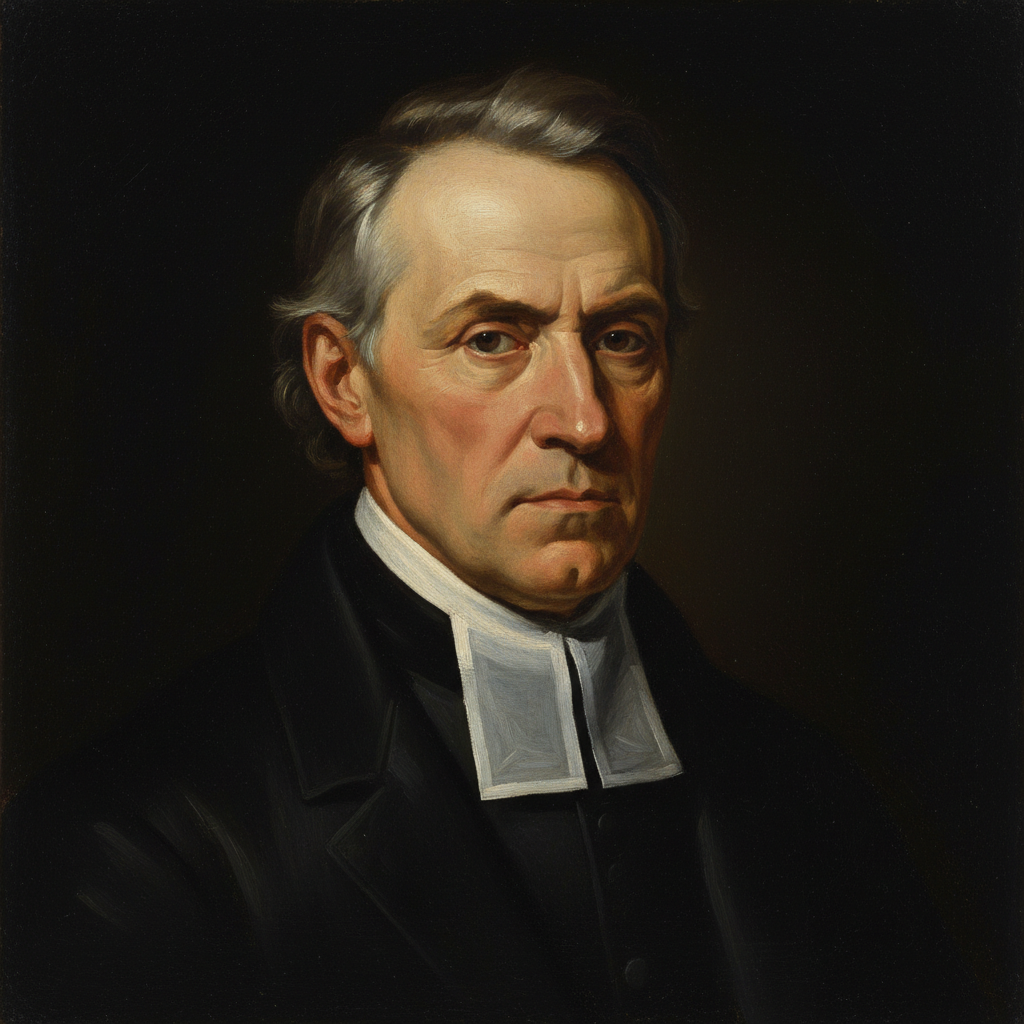
John Wesley — "I have no doubt that God will be merciful to me, a poor miserable sinner."
I have no doubt that God will be merciful to me, a poor miserable sinner.
I have no doubt that God will be merciful to me, a poor miserable sinner.
Click any product to generate a realistic preview. Up to 3 at a time.
* Initial load can take up to 90 seconds — revising the preview in another color is nearly instant.
"By Methodists, I mean such as profess to pursue a Christian life by Scriptural rules and methods."
"I cannot but observe, that the Methodists are not a people who are fond of novelties."
"I have been accounted a madman, a fool, a knave, a liar, a deceiver, and a devil."
"We have nothing to do but to save souls."
"I have learned to suffer in silence, and not to make my complaints known to any but God."
English Anglican cleric and founder of Methodism, whose open-air preaching and class-meeting structure created the largest 18th-century evangelical revival. Closely associated with Charles Wesley (his hymn-writing brother) and George Whitefield (early co-revivalist, later doctrinal opponent). For an intellectual contrast, see George Whitefield, Calvinist evangelical revivalist — Whitefield's predestinarian Calvinism vs Wesley's free-grace Arminian theology split the early Methodist movement permanently in the 1739-41 break. The founding evangelical Calvinist-Arminian schism — the two parallel evangelical traditions American Christianity descends from.
Found in 1 providers: grok
1 source checked
Wesley expresses a paradox of humble certainty: he has no doubt God will be merciful, yet calls himself a poor, miserable sinner. This isn't contradiction — it's the evangelical doctrine of assurance. Salvation comes entirely from God's grace, not human worthiness. The believer can be confident precisely because confidence rests on God's character, not personal merit. Admitting sinfulness and claiming certainty of mercy are two sides of the same Protestant faith.
Wesley's Aldersgate experience (1738) transformed him — his heart 'strangely warmed,' he felt God's direct assurance of mercy for the first time. This became Methodism's cornerstone: the doctrine of assurance, that every believer can know they are saved. Wesley preached to miners, prisoners, and the rural poor — society's miserable sinners — insisting God's mercy reached them all. His Arminian theology rejected Calvinist predestination, holding mercy universally available to those who accept it.
Wesley lived through Britain's Evangelical Revival, when the Church of England was widely seen as spiritually cold and socially indifferent. Calvinist theology dominated, teaching that only a predestined elect were saved, leaving ordinary people with no personal assurance. Wesley's Arminian counter-message — that mercy is available to all and certainty of it is possible — was revolutionary, democratizing salvation at a time when industrial poverty was reshaping British society and the poor desperately needed hope.
AI-generated insights based on extensive research and information for context. Factual errors? Email [email protected].
Your cart is empty