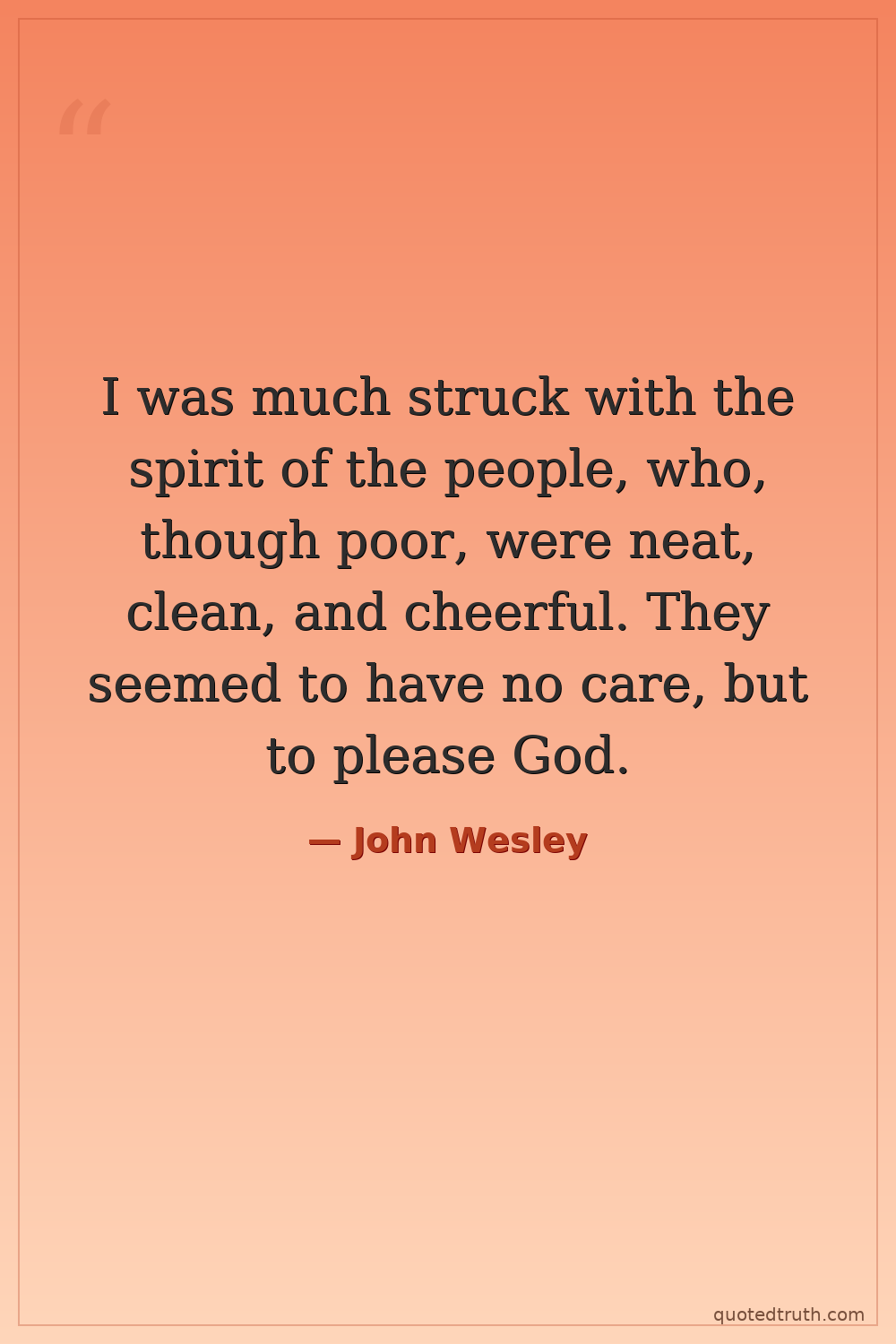
John Wesley — "I was much struck with the spirit of the people, who, though poor, were neat, cl…"
I was much struck with the spirit of the people, who, though poor, were neat, clean, and cheerful. They seemed to have no care, but to please God.
I was much struck with the spirit of the people, who, though poor, were neat, clean, and cheerful. They seemed to have no care, but to please God.
Click any product to generate a realistic preview. Up to 3 at a time.
* Initial load can take up to 90 seconds — revising the preview in another color is nearly instant.
"I am not afraid of giving too much, but of giving too little."
"I am not afraid of the devil himself."
"Preach faith till you have it; and then, because you have it, you will preach faith."
"The Bible knows nothing of solitary religion."
"And are we not to use our reason? Unquestionably. But no more than we are to use our hands or feet. We are to use it as a servant, not as a master."
English Anglican cleric and founder of Methodism, whose open-air preaching and class-meeting structure created the largest 18th-century evangelical revival. Closely associated with Charles Wesley (his hymn-writing brother) and George Whitefield (early co-revivalist, later doctrinal opponent). For an intellectual contrast, see George Whitefield, Calvinist evangelical revivalist — Whitefield's predestinarian Calvinism vs Wesley's free-grace Arminian theology split the early Methodist movement permanently in the 1739-41 break. The founding evangelical Calvinist-Arminian schism — the two parallel evangelical traditions American Christianity descends from.
Found in 1 providers: grok
1 source checked
Wesley observes that poverty doesn't strip people of dignity, cleanliness, or joy. The people he describes find contentment not through wealth but through devotion to God. He's noting that spiritual orientation sustains a person through material hardship - that a community centered on pleasing God naturally cultivates orderliness and inner peace regardless of economic circumstance. Purpose, not prosperity, produces genuine happiness.
Wesley traveled over 250,000 miles preaching across Britain, spending his ministry among miners, factory laborers, and the urban poor. His Methodist movement made personal holiness practical, famously linking cleanliness to godliness. He believed the poor deserved dignity and spiritual care the established Church denied them. This reflects his core conviction that sanctification was visible in everyday conduct, and his genuine admiration for working-class piety fueled Methodism's explosive growth.
Wesley's lifetime (1703-1791) coincided with Britain's early Industrial Revolution and brutal displacement of rural communities into urban poverty. The established Church largely ignored laboring-class congregations, widely associating poverty with moral failure. Wesley's observation was countercultural: he found virtue, not vice, among the poor. Enlightenment thinkers were simultaneously debating human nature and happiness, making his field evidence - that spiritual purpose, not wealth, produced contented people - philosophically significant.
AI-generated insights based on extensive research and information for context. Factual errors? Email [email protected].
Your cart is empty