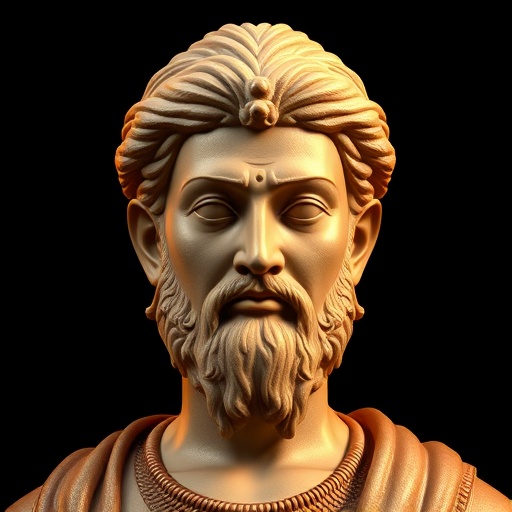
Mahavira — "The soul is the ultimate reality."
The soul is the ultimate reality.
The soul is the ultimate reality.
Click any product to generate a realistic preview. Up to 3 at a time.
* Initial load can take up to 90 seconds — revising the preview in another color is nearly instant.
"One who knows himself, knows God."
"The greatest wealth is health."
"Patience is the highest form of virtue."
"The path to liberation is through right faith, right knowledge, and right conduct."
"The universe is a beginningless and endless cycle of creation and destruction."
24th and last Tirthankara of Jainism, whose teachings of strict ahimsa (non-violence), aparigraha (non-attachment), and karma reshaped ancient Indian religion. Closely associated with The Buddha (near-contemporary moral revolutionary, also reacting against Vedic ritualism). For an intellectual contrast, see Vedic Brahmanical ritual sacrifice, the animal-sacrifice-centered Vedic religion of his era — Mahavira's ahimsa demanded total non-violence, including not eating root vegetables that kill the plant — a maximum-distance ethical move from the Vedic priestly tradition that ritually sacrificed cattle and horses. The two cleanest poles of ancient Indian religious ethics.
Found in 1 providers: grok
1 source checked
Every conscious being possesses a soul that exists independently of the physical body, social rank, or material world. This soul is not a religious abstraction but the actual bedrock of existence—more fundamental than matter or circumstance. Everything external is transient and secondary; the inner conscious self is what genuinely and permanently exists. Understanding this redirects attention from acquiring things to purifying one's consciousness toward liberation.
Mahavira spent 12 years in naked asceticism, renouncing his royal upbringing to pursue liberation of the soul from karmic bondage. Jain philosophy divides all existence into jiva (soul) and ajiva (non-soul); moksha means freeing the jiva from material contamination. His every practice—fasting, silence, non-violence—aimed at purifying the soul rather than satisfying the body. This quote is the foundational thesis of his entire teaching and the core of Jain metaphysics.
Mahavira lived during India's Axial Age (6th–5th century BCE), when Vedic Brahmanism dominated through ritual sacrifice and strict caste hierarchy. Materialist schools like Charvaka denied the soul entirely. Buddhism was simultaneously emerging with similar anti-ritualist reforms. Asserting the soul as ultimate reality challenged priestly monopoly on spiritual access and materialist denial alike—implying all souls, regardless of caste or birth, possessed equal capacity for liberation through right conduct.
AI-generated insights based on extensive research and information for context. Factual errors? Email [email protected].
Your cart is empty