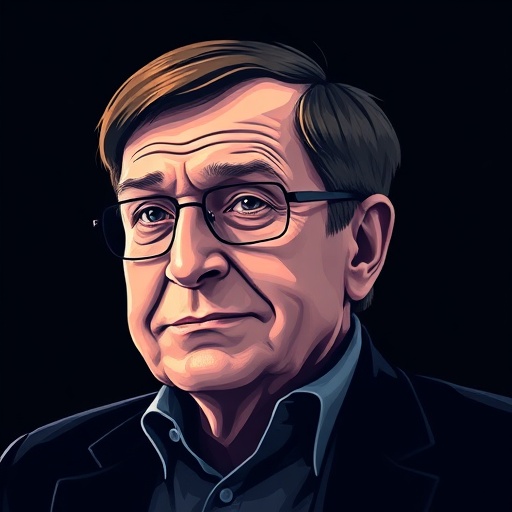
Stephen Hawking — "The world is a dangerous place to live; not because of the people who are evil, …"
The world is a dangerous place to live; not because of the people who are evil, but because of the people who don't do anything about it.
The world is a dangerous place to live; not because of the people who are evil, but because of the people who don't do anything about it.
Click any product to generate a realistic preview. Up to 3 at a time.
* Initial load can take up to 90 seconds — revising the preview in another color is nearly instant.
"Of course it is possible that UFO's really do contain aliens as many people believe, and the government is hushing it up."
"The human race is a single, genetic family. When a child is born, it is born into the human race, not into some particular tribe or nation. The human race is one. And we are all brothers and sisters."
"We are just an advanced breed of monkeys on a minor planet of a very average star. But we can understand the Universe. That makes us something very special."
"We are all different, but we share the same human spirit. Perhaps it's human nature that we adapt and survive."
"Einstein was wrong when he said, 'God does not play dice'. Consideration of black holes suggests, not only that God does play dice, but that he sometimes confuses us by throwing them where they can't …"
British theoretical physicist whose Hawking radiation work and A Brief History of Time (1988) brought black-hole physics to a mass audience while he lived with ALS for 55 years. Closely associated with Roger Penrose (his collaborator on singularity theorems) and Carl Sagan (fellow popularizer who wrote Brief History's foreword). For an intellectual contrast, see William Lane Craig, American philosopher of religion — Craig's Kalam cosmological argument depends on the Big Bang requiring a divine first cause; Hawking's no-boundary proposal was specifically designed to remove the moment that would require one — the cleanest cosmology-vs-natural-theology contrast in modern thought.
Often attributed to Einstein, but Hawking also used a similar sentiment.
Date: Unknown
GeneralFound in 1 providers: grok
1 source checked
Passive bystanders—not active wrongdoers—are civilization's greatest threat. When people witness harm, injustice, or danger and do nothing, evil gains its real power. Moral responsibility extends beyond avoiding wrongdoing; it demands intervention. Indifference is not neutrality—it is a choice that enables the worst outcomes. The danger isn't only in those who act badly, but in those who refuse to act at all.
Hawking, despite total physical paralysis from ALS, was the opposite of passive. He repeatedly issued urgent warnings about AI risk, climate change, nuclear weapons, and genetic engineering—dangers he believed demanded immediate collective action. His life demonstrated that circumstance is no excuse for silence. He treated scientific knowledge as an obligation to speak, not a privilege to hoard.
Hawking's career ran from 1963 to 2018, through Cold War nuclear standoff, accelerating climate change, and the first AI breakthroughs. Each era presented civilizational dangers where inaction by capable institutions proved catastrophic. Governments knew about climate risks for decades before acting. Nuclear arsenals expanded despite warnings. Hawking watched capable societies stall repeatedly—making the cost of bystander behavior concrete and measurable.
AI-generated insights based on extensive research and information for context. Factual errors? Email [email protected].
Your cart is empty