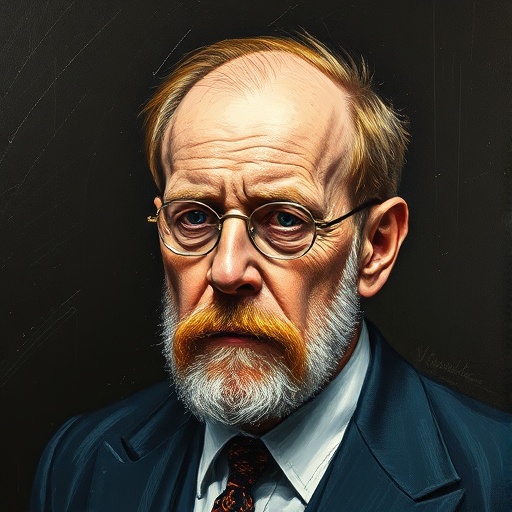
Werner Heisenberg — "Where there is no uncertainty, there is no quantum mechanics."
Where there is no uncertainty, there is no quantum mechanics.
Where there is no uncertainty, there is no quantum mechanics.
Click any product to generate a realistic preview. Up to 3 at a time.
* Initial load can take up to 90 seconds — revising the preview in another color is nearly instant.
"The smallest units of matter are not physical objects in the ordinary sense; they are forms, structures or—in Plato's sense—Ideas."
"Not only is the Universe stranger than we imagine, it is stranger than we *can* imagine."
"Modern physics has, in a certain sense, revived Plato's philosophy of forms in the atomic world."
"The Copenhagen interpretation of quantum mechanics starts from the paradox that we describe our experiments in terms of classical physics, and we describe the elementary particles in terms of quantum …"
"I was forced to find a new way of expressing the fundamental laws of nature, one which would not rely on the outdated concepts of classical physics."
Found in 1 providers: grok
1 source checked
Uncertainty is not a flaw in our measurements but a built-in feature of reality at the smallest scales. You cannot pin down both a particle's position and momentum at the same time, no matter how good your tools. The blurriness is the physics. Without accepting this fundamental unpredictability, the entire framework describing atoms, electrons, and subatomic behavior collapses. Quantum mechanics exists precisely because nature refuses to give us exact answers.
Heisenberg formulated the uncertainty principle in 1927, proving that position and momentum cannot both be known precisely. This quote captures his core insight: indeterminacy is not ignorance but structure. As a founder of matrix mechanics alongside Born and Jordan, and later head of Germany's wartime nuclear program, he spent his career defending probabilistic physics against Einstein's deterministic objections, famously arguing that observation itself shapes outcomes at the quantum scale.
Early 20th-century physics was in upheaval. Newtonian determinism, which had ruled for 250 years, cracked under experiments revealing wave-particle duality and atomic weirdness. Between 1900 and 1930, Planck, Einstein, Bohr, Schrödinger, and Heisenberg rebuilt physics from the ground up. The Copenhagen interpretation emerged amid Weimar Germany's intellectual ferment, just before Nazi rule scattered the physics community and set the stage for the atomic age.
AI-generated insights based on extensive research and information for context. Factual errors? Email [email protected].
Your cart is empty